Clinically reviewed by Dr. Ponlawat Pitsuwan, Physician, Takecare Clinic Phuket.
Last reviewed: October 2026
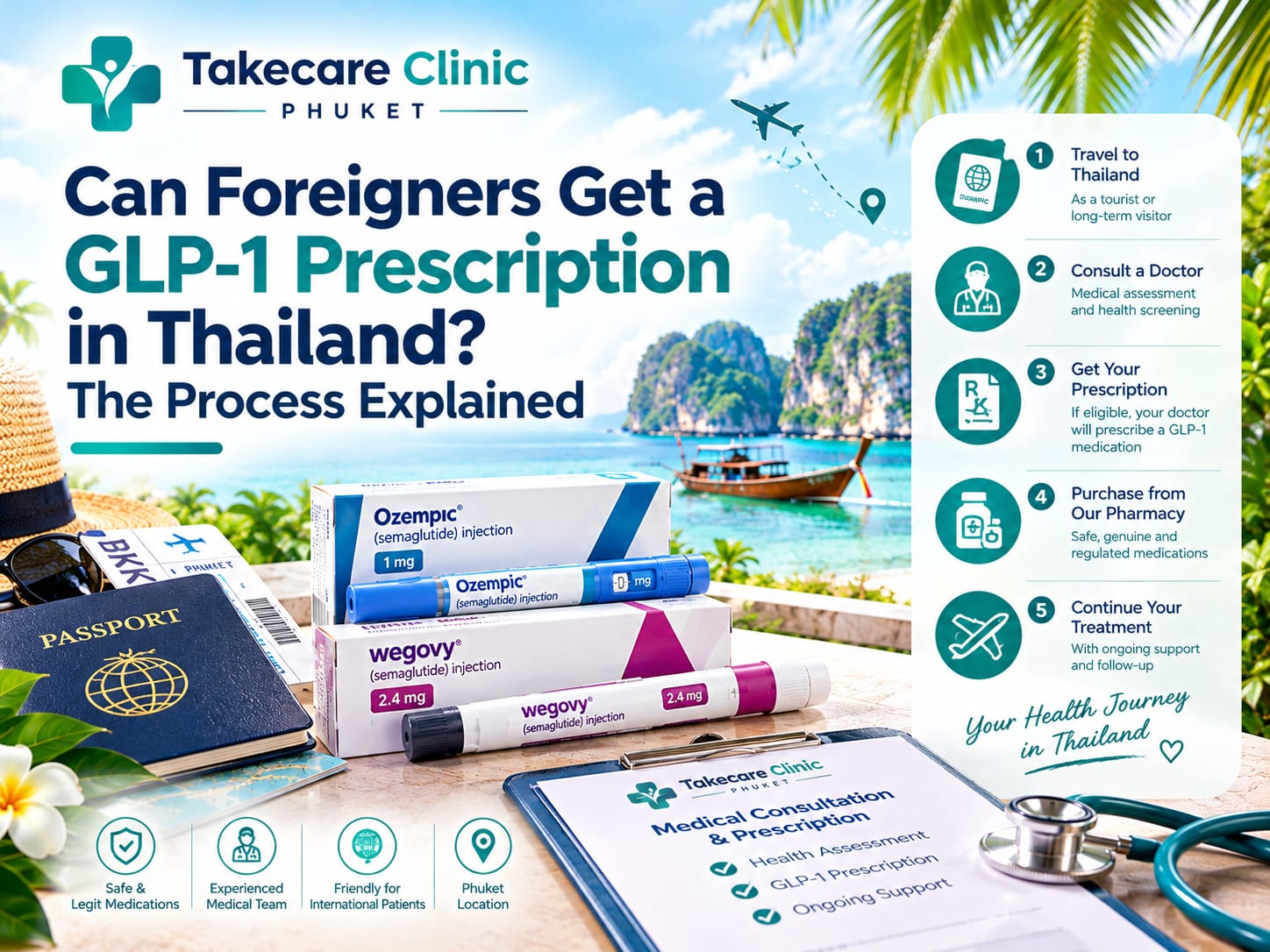
Yes, foreigners can get a GLP-1 prescription in Thailand. You do not need Thai health insurance, a work permit, or a long-term visa. You need a consultation with a Thai-licensed physician, who can assess your eligibility and issue a prescription the same day if you qualify. From September 2026, injectable GLP-1 medicines are classified as specially controlled medicines under Thai pharmaceutical law, which means they must come from a licensed medical channel. A valid Thai prescription is required to dispense them legally.
You are three weeks into a planned two-month stay in Phuket. You brought one Ozempic pen from home, you are running low, and your next supply is sitting in a fridge in another country. Or you have been thinking about starting GLP-1 therapy for a while and this feels like the right time to finally talk to a doctor about it. Either way, you are wondering whether this is even possible here, and whether you need to fly to Bangkok to sort it out.
You do not. Foreigners can get a GLP-1 prescription in Phuket, at a walk-in clinic, without an appointment, with an English-speaking doctor. What follows is the actual process: what the Thai rules say, what happens at a consultation, what to watch out for, and what you need to know about keeping your medication safe in this climate.

What the 2026 Thai FDA Rule Change Means for You
From 15 September 2026, injectable GLP-1 receptor agonists, the class of medicines that includes semaglutide (Ozempic, Wegovy) and tirzepatide (Mounjaro), are classified as specially controlled medicines under Thai pharmaceutical law.
This does not mean they are banned or restricted to Thai nationals. In practice, it means they must be dispensed through a licensed healthcare channel with a valid Thai prescription. Buying from an informal seller, a Telegram channel, or an unlicensed online source is now more clearly illegal under Thai law and carries real consequences, including fines and potential immigration issues.
For a foreigner going through a proper clinic, the day-to-day process has not changed significantly. You see a doctor, the doctor assesses you, and if you qualify, a Thai prescription is issued. That prescription is filled at a licensed pharmacy. The classification makes the paper trail mandatory rather than recommended.
Who Qualifies for a GLP-1 Prescription in Thailand
Your visa type is irrelevant. Your nationality is irrelevant. Thai-licensed physicians apply eligibility criteria that broadly follow international clinical guidance.
Semaglutide is generally considered for adults with a BMI of 30 or above, or a BMI of 27 or above alongside a weight-related condition such as type 2 diabetes, high blood pressure, or high cholesterol. Tirzepatide follows similar criteria. The doctor will ask about your medical history, because some conditions make GLP-1 therapy unsuitable. These include a personal or family history of certain thyroid cancers, a history of pancreatitis, and some gastrointestinal conditions. GLP-1 medicines should not be used during pregnancy or while breastfeeding.
If you are already on GLP-1 therapy at home and are not starting from scratch, the threshold is lower in practical terms. You bring your documentation, the doctor reviews it, and if your current treatment is appropriate, they issue the Thai prescription needed to fill it locally.
Already on GLP-1 at Home? Getting a Prescription Refill in Phuket
You are mid-treatment, you are here longer than expected, and you need a refill without flying home.
Bring everything you have: your original prescription, the manufacturer packaging with the lot number visible, and any recent blood results or doctor’s letters from home. None of this is required by law, but all of it speeds the process. A Thai physician can review your current dose, confirm it is clinically appropriate, and issue a local prescription, often at the same visit.
Your foreign prescription cannot be dispensed directly at a Thai pharmacy. A Thai prescription is always required. But your home documentation means the doctor is not starting your medical history from zero, and that matters. You can read more about how this works on the prescription refill Phuket page.
What Happens at a GLP-1 Consultation in Phuket
The consultation is straightforward. The doctor takes your weight, height, and blood pressure. They ask about your medical history, current medications, and what you are hoping to achieve. They will go through eligibility and any contraindications.
If you have not had recent bloodwork, the doctor may recommend a baseline blood test before starting or continuing treatment. This typically includes blood sugar, a full blood count, and kidney and liver function. An HbA1c, which reflects your average blood sugar over recent months, is useful if diabetes management is part of why you are on this medication. Blood tests in Phuket can be done at the same visit, with most results back within a few hours to one day.
If you qualify, the prescription is issued that day. You take it to a licensed pharmacy. Ozempic and Mounjaro are stocked at major pharmacies and private hospital pharmacies across Phuket, though availability of specific brands varies.
GLP-1 Availability in Phuket: What You Can Actually Get Here
Phuket is not Bangkok, and the formulary is not identical. That said, you do not need to go to Bangkok to access these medications.
Ozempic has been available at licensed pharmacies and private hospital pharmacies in Phuket for some time. Mounjaro has become more consistently available through 2025 and 2026. Wegovy has more variable availability and may need to be ordered. The doctor at your consultation can advise on what is currently in stock locally.
Do not buy from anyone who does not ask for a prescription. That is the clearest sign you are not dealing with a licensed channel.
Counterfeit and Grey-Market GLP-1 in Phuket: What to Check
Phuket’s resort economy creates real opportunity for counterfeit and unverified medicines to circulate, particularly targeting tourists who want to skip the doctor. The 2026 reclassification makes this more explicitly illegal, but enforcement takes time.
Before injecting anything purchased outside a licensed pharmacy, check the following. The pen should have a serial number and a Thai-language package insert. The packaging should show an unbroken cold-chain seal. The product should carry a Thai FDA registration number, which you can verify on the Thai FDA’s official online database. If anything about the packaging looks off, or the price is significantly below what a licensed pharmacy charges, do not use it.
A compounded semaglutide product, meaning one mixed at a compounding pharmacy rather than manufactured by a licensed pharmaceutical company, is not the same as the pharmaceutical-grade product. Dosing accuracy and sterility standards differ, and this matters more for an injectable than for an oral medication.
Storing Your GLP-1 Pen in Phuket’s Heat
This is where most visitors run into a problem they did not think about.
Before first use, semaglutide and tirzepatide pens must be stored at 2 to 8°C. After first use, according to manufacturer labelling, Ozempic pens can be kept below 30°C for up to 56 days, and Wegovy pens for up to 28 days. Phuket’s ambient temperature regularly exceeds 35°C outdoors and can reach that inside a car or a non-air-conditioned room. A pen left in a beach bag, a poolside bag, or a hotel room where the air conditioning is set to eco mode overnight is at real risk.
Store opened pens in your hotel minibar or ask the hotel for a medical refrigerator. Do not put the pen in the freezer. If you think a pen has been heat-exposed, do not inject it without speaking to a doctor first. The active compound can degrade without any visible sign.
Travelling Out of Thailand With Your GLP-1
If you are leaving Phuket and want to take your medication with you, Thai customs allows up to 30 days of personal medication supply for personal use. Because injectable GLP-1 medicines are now classified as specially controlled medicines, carry your prescription or a doctor’s letter with the medication. Keep the medication in its original manufacturer packaging with a clear label. Carry your Thai prescription and, if possible, a physician letter confirming the medication is for personal use.
Beyond 30 days of supply, formal customs declaration is required. Also check your home country’s import rules. Some jurisdictions restrict importing prescription medicines purchased abroad, even if the medicine itself is legal at home. An English-speaking doctor in Phuket can provide a travel documentation letter to help at both ends of your journey.
If you are in Phuket and need a GLP-1 consultation, a prescription refill, or baseline bloodwork to start or continue treatment, Takecare Clinic Phuket sees patients on a walk-in basis in Patong, with English-speaking physician care across the whole island. No appointment needed. Whether you are in Kata, Karon, Rawai, Chalong, Bang Tao, or anywhere else on the island, come in or contact us to confirm current medication availability before your visit.
Frequently Asked Questions
Dr. Ponlawat Pitsuwan
Physician, Takecare Medical Clinic Phuket
a walk-in medical clinic based in Patong with English-speaking physician care across the whole island. He sees tourists, expats, and long-stay residents for weight management consultations, GLP-1 prescription assessments, prescription refills for foreigners, and ongoing chronic disease management. His approach is straightforward, evidence-based care delivered in plain language.
References
- Wilding JPH, et al. Once-Weekly Semaglutide in Adults with Overweight or Obesity. New England Journal of Medicine. 2021;384:989-1002.
- Jastreboff AM, et al. Tirzepatide Once Weekly for the Treatment of Obesity. New England Journal of Medicine. 2022;387(3):205-216.
- Thai Food and Drug Administration. Guideline of importation for personal use: Bringing of health products into the Kingdom of Thailand. Thai FDA, 2024.
- Novo Nordisk. Ozempic (semaglutide) US Prescribing Information, including storage and handling instructions. Novo Nordisk, 2024.
- Tourism Authority of Thailand / Thai FDA. Thailand FDA Issues Traveller-Friendly Guidelines for Importing Personal Health Products. TAT Newsroom, November 2024.
- World Health Organization. Obesity and overweight fact sheet. WHO, 2024.
The information in this article is for educational purposes only and does not constitute medical advice. It should not be used to self-diagnose or replace a consultation with a qualified physician. If you have concerns about your health, contact a licensed medical professional. For appointments at Takecare Clinic Phuket, visit takecareclinicphuket.com.