
Clinically reviewed by Dr. Ponlawat Pitsuwan, Physician, Takecare Clinic Phuket.
Last reviewed: October 2026
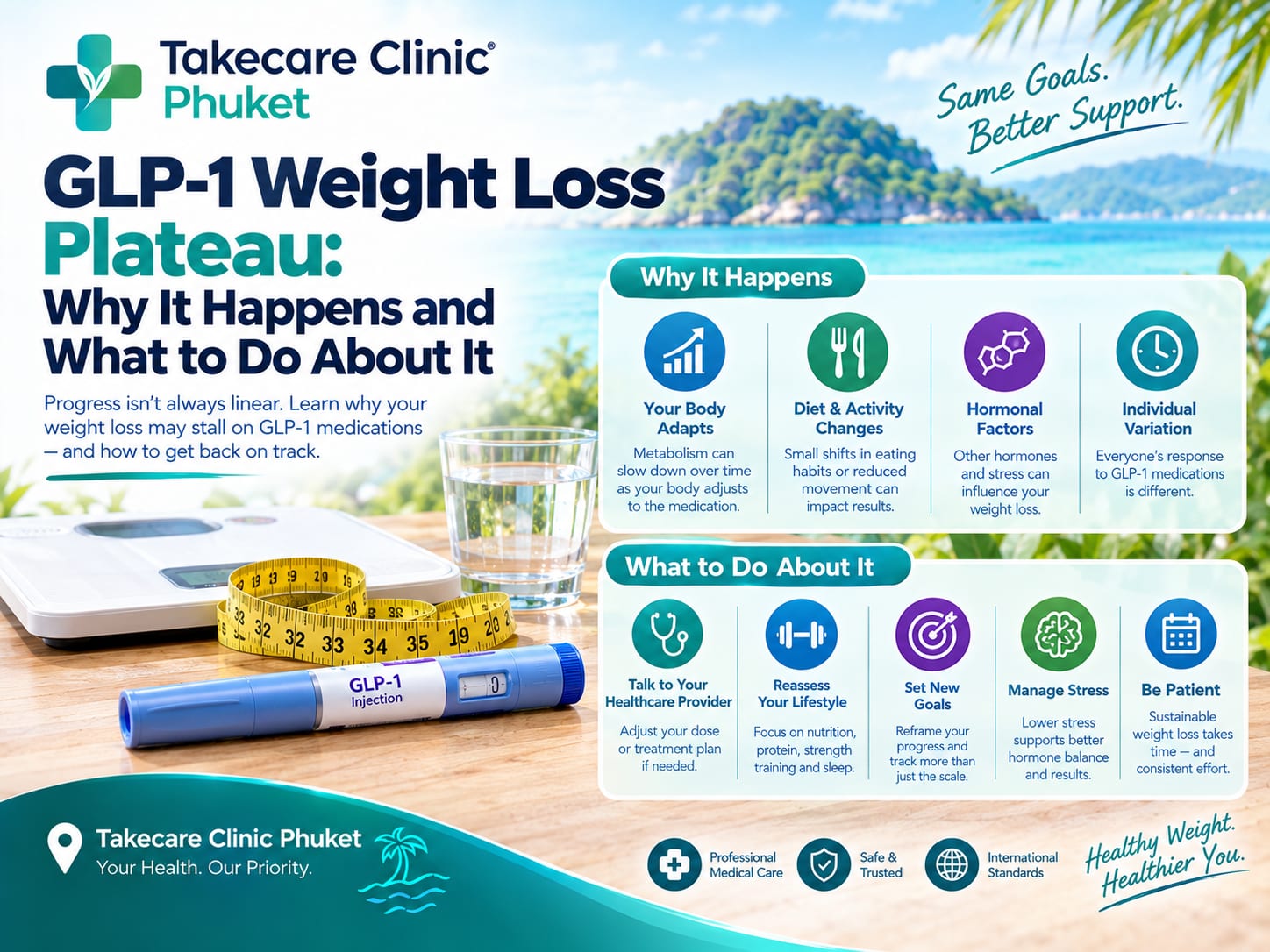
A GLP-1 weight loss plateau is when your weight stays stable for four or more consecutive weeks despite consistent medication use and no major change in diet or activity. It is common and does not mean the medication has failed. The most frequent causes are metabolic adaptation, gradual muscle loss, and caloric intake that no longer matches a lighter body. In most cases, a structured review of dose, nutrition, and exercise resolves it.
You are three months into semaglutide or tirzepatide, staying long-stay in Rawai or Laguna, and the scale has not moved in weeks. The medication is still in the fridge. You have not changed what you are eating. But the weight that was coming off steadily a month ago has simply stopped. You are not imagining it, and you are not doing anything wrong.
This is one of the most predictable points in GLP-1 therapy. It has a name, it has identifiable causes, and in most cases it has a clear response. What matters is understanding which cause is actually driving your stall, because the right fix depends entirely on that.

What Actually Causes a GLP-1 Weight Loss Plateau
Your body is not passive. When you lose weight, it responds by burning fewer calories at rest. This is called metabolic adaptation, and it happens on GLP-1 therapy just as it does with any other weight loss approach. Your resting metabolic rate drops as your body gets lighter. The caloric deficit that worked at your starting weight no longer works at your current one.
At the same time, appetite suppression softens. GLP-1 receptor agonists like semaglutide and tirzepatide reduce hunger strongly at first. Over time, the body partly compensates. Most people notice this without realising what it means for their intake.
Your body also has a defended weight range it considers normal. It will deploy several mechanisms to return to it. This is not a failure of willpower. It is biology, and GLP-1 therapy is one of the most effective tools we have for shifting that range, but it takes time and the right conditions.
The Muscle Loss Problem Most People Miss
When you lose weight quickly on any medication, including semaglutide and tirzepatide, a portion of that loss can come from lean muscle rather than fat. Without resistance training and enough protein, that proportion can be significant.
This matters for a plateau because muscle burns calories even at rest. Less muscle means a lower resting metabolic rate. This compounds the adaptation effect and can bring weight loss to a hard stop.
Preserving or rebuilding muscle is the most underused tool in GLP-1 therapy. Two to three resistance sessions per week, even bodyweight training at a Bangtao resort gym or a Chalong fitness studio, make a real difference. This is not optional if you want to keep the weight moving.

Nutrition Adjustments That Break a Plateau
Here is the part that surprises most people. Some patients on GLP-1 therapy are eating too little. The appetite suppression is strong, so intake drops below what the body needs to preserve muscle and maintain basic function. The body slows metabolism further. Eating less is not always the answer when you plateau.
A practical protein target is around 30 to 40 grams per meal. That level helps preserve lean muscle, supports satiety, and keeps your metabolism from slowing further. Most people on GLP-1 therapy are nowhere near this because the medication makes large meals unappealing. Smaller, protein-focused meals work better than fewer, lighter ones.
Your caloric needs also change as your body weight drops. What created a deficit six months ago may now be close to your maintenance level. A rough recalibration, without obsessive tracking, helps most people restart progress.
When to Talk to a Doctor About Your GLP-1 Dose
Not every plateau needs a dose change. But some do, and the decision should follow a clear order.
First, confirm it is a real plateau: four or more consecutive weeks of stable weight despite genuine consistency with medication, diet, and activity. Week-to-week fluctuations of half a kilogram or more are normal fluid shifts, not a plateau. Changes in sleep, stress, or the heat of a Phuket wet season can all cause short stalls that resolve on their own.
If it is a real plateau and you are not yet at your maximum tolerated dose, a dose escalation may be appropriate. A dose level should be given adequate time before concluding it is not producing further effect; how long depends on tolerance and whether side effects have settled. Unsupervised increases carry real risks including severe nausea, vomiting, and in rare cases pancreatitis. This is not a change to make on your own. If you are wondering whether you should increase your GLP-1 dose if you plateau, a clinical review is the right starting point.
If you are already at the maximum tolerated dose of semaglutide and still stalled, switching to tirzepatide is a legitimate clinical option. Tirzepatide acts on both GLP-1 and GIP receptors, which gives it a different mechanism. In a 2025 head-to-head trial, tirzepatide produced greater weight loss than semaglutide, and real-world data suggest some patients who plateau on semaglutide see further weight loss after switching. A transition requires restarting at the lowest dose, and a brief plateau of a few weeks is normal as the medication reaches steady state.
Managing Your GLP-1 Treatment in Phuket Without a Home GP
This is the gap that matters most for people reading this in Phuket right now. If you started GLP-1 therapy at home, in the UK, Australia, or Europe, and you are now several months into a long stay and your weight has stalled, your home prescriber may not be reachable across time zones. Your original clinic may be eight hours behind.
In Thailand, GLP-1 weight-loss medications are prescription-only. You cannot adjust or switch your medication without a physician assessment. That is not a barrier, it is a safeguard. But it does mean you need access to a doctor who understands the medication and can assess you properly.
Takecare Clinic Phuket offers walk-in access with no appointment needed and an English-speaking physician on site. Whether you are staying in Kamala, Laguna, Rawai, or the centre of Patong, a same-day review is available. A prescription review or regimen assessment can happen on the day you walk in.
An English-speaking doctor in Phuket can assess your current dose, check your weight and baseline metrics, and advise whether a dose adjustment, agent switch, or lifestyle change is the right next step. If your plateau has raised questions about related blood markers, a blood test in Phuket on the same visit gives a clearer picture of what is driving the stall. For expats and long-stay visitors managing ongoing treatment, a prescription refill in Phuket is also available during the same appointment.
If your weight has stalled on semaglutide or tirzepatide and you are in Phuket, Takecare Clinic Phuket can review your GLP-1 regimen on the same day you walk in. No appointment needed. English-speaking physician care is available across the whole island, from Patong to Rawai to Bangtao. Walk-in GLP-1 dose reviews, prescription continuity, and medication assessments for tourists, long-stay visitors, and expats. Visit us at 34/14 Prachanukhro Rd, Patong, or contact us at takecareclinicphuket.com.
Frequently Asked Questions
Dr. Ponlawat Pitsuwan
Physician, Takecare Medical Clinic Phuket
a walk-in medical clinic based in Patong with no appointment needed and English-speaking physician care for the whole island. He sees tourists, expats, and residents across Phuket for weight loss medication management, GLP-1 dose reviews, prescription continuity, and related metabolic health concerns. His focus is straightforward, evidence-based care delivered in plain language.
References
- Wilding JPH, et al. Once-Weekly Semaglutide in Adults with Overweight or Obesity. New England Journal of Medicine. 2021;384(11):989-1002.
- Jastreboff AM, et al. Tirzepatide Once Weekly for the Treatment of Obesity. New England Journal of Medicine. 2022;387(3):205-216.
- Garvey WT, et al. Tirzepatide versus Semaglutide for Obesity (SURMOUNT-5). New England Journal of Medicine. 2025.
- Rosenbaum M, Leibel RL. Adaptive thermogenesis in humans. International Journal of Obesity. 2010;34(Suppl 1):S47-55.
- Novo Nordisk. Wegovy (semaglutide) Prescribing Information. FDA. 2024.
- World Health Organization. Obesity and overweight. WHO Fact Sheet. 2024.
The information in this article is for educational purposes only and does not constitute medical advice. It should not be used to self-diagnose or replace a consultation with a qualified physician. If you have concerns about your health, contact a licensed medical professional. For appointments at Takecare Clinic Phuket, visit takecareclinicphuket.com.
