
Clinically reviewed by Dr. Ponlawat Pitsuwan, Physician, Takecare Clinic Phuket.
Last reviewed: October 2026
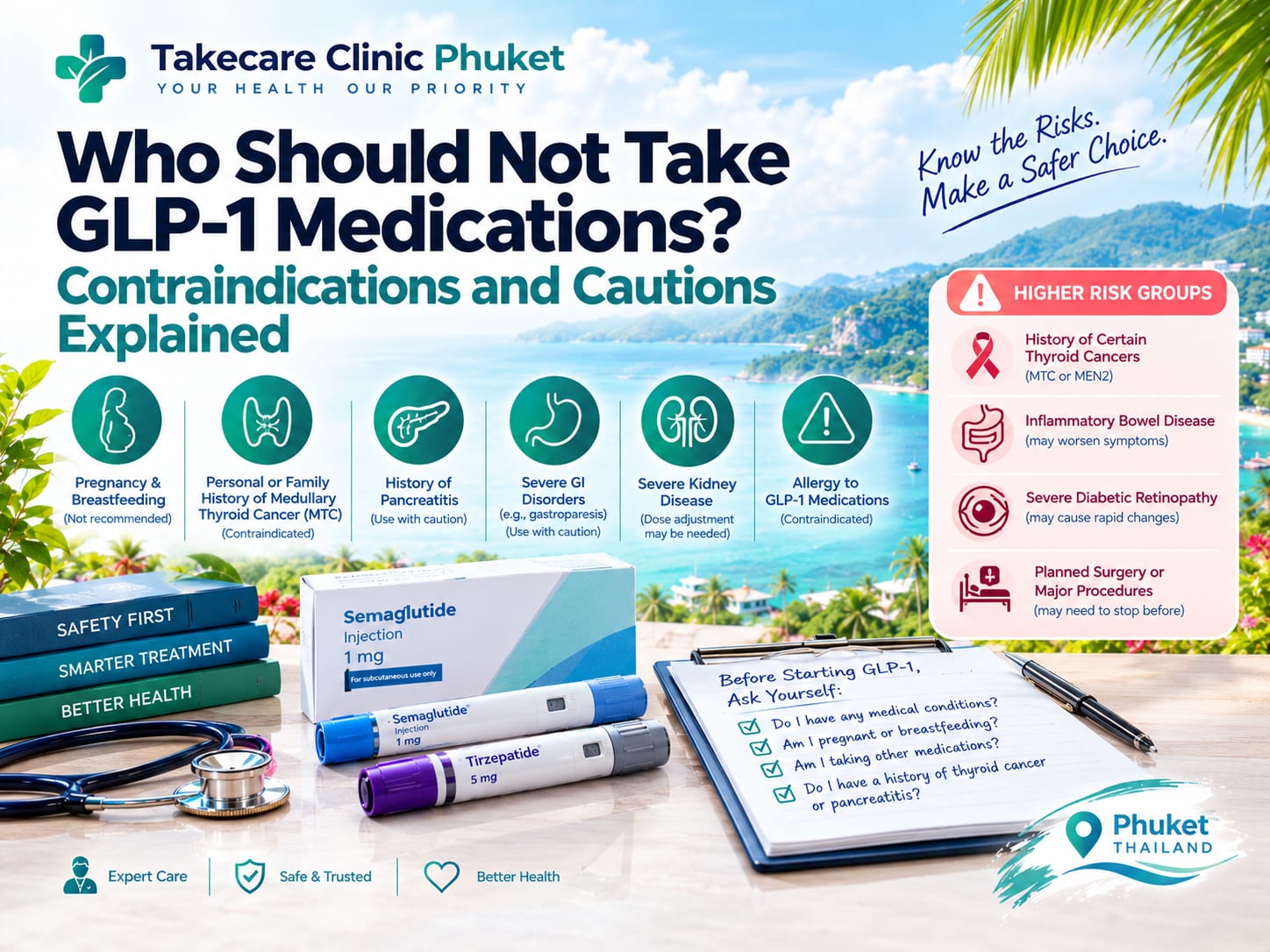
GLP-1 receptor agonists like semaglutide and tirzepatide are not safe for everyone. People with a personal or family history of medullary thyroid carcinoma or Multiple Endocrine Neoplasia type 2 must not take them. Pregnancy, active pancreatitis, and known hypersensitivity are also absolute reasons to avoid these medications. Several other conditions require careful assessment before a prescription is appropriate.
A long-stay expat in Chalong or Bang Tao may have been managing their weight for months, only to find their home prescription has run out and need to either continue or finally start GLP-1 therapy here in Phuket. The first question they usually ask is which brand to use. That is the wrong first question.
The right first question is whether they are actually a safe candidate. Some people have medical histories that make these medications genuinely dangerous, not just uncomfortable. This article covers who should not take GLP-1 medications, who needs extra caution, and what a proper safety assessment looks like before any prescription is written.

Absolute Contraindications: Who Must Not Take GLP-1 Medications
These are not judgment calls. They are boxed-warning level restrictions written into the prescribing labels for semaglutide, liraglutide, and tirzepatide.
A personal or family history of medullary thyroid carcinoma is the first. GLP-1 receptor agonists caused thyroid tumors in animal studies, and while a direct causal link in humans has not been confirmed, the label prohibition stands. The second is Multiple Endocrine Neoplasia syndrome type 2, a genetic condition that raises the risk of medullary thyroid cancer. If you or a close relative has been diagnosed with either of these, GLP-1 therapy is not an option.
Known hypersensitivity to the active ingredient is also absolute. This means a documented allergic reaction to semaglutide, liraglutide, tirzepatide, or any component of the formulation. Pregnancy belongs in this category too, covered in detail below.
Relative Contraindications: Who Should Not Take GLP-1 Without Careful Assessment
These are conditions where GLP-1 use is not automatically ruled out, but where starting without proper assessment carries real risk.
A history of pancreatitis is one of the most important cautions. Post-marketing reports have linked GLP-1 receptor agonists to pancreatitis cases. A single mild episode of acute pancreatitis in the past does not automatically disqualify someone, but chronic pancreatitis is a stronger reason to stop. If you have had pancreatitis, tell your prescriber. Do not leave it out.
Gastroparesis, where the stomach empties too slowly, is another concern. GLP-1 medications slow gastric emptying, and adding them on top of existing gastroparesis can worsen symptoms significantly. A history of gallstones is also relevant. Rapid weight loss of any kind raises the risk of new gallstone formation, and GLP-1-assisted loss is no different.
Diabetic retinopathy requires attention too. Rapid improvement in blood sugar control has been associated with early worsening of diabetic retinopathy in some patients. This does not mean people with diabetes cannot use these medications, but an eye review before starting is worth discussing with your prescriber.
Active inflammatory bowel disease, meaning Crohn’s or ulcerative colitis, warrants caution. GLP-1 medications affect gut motility, and their safety in active IBD has not been well studied.
Drug interactions matter here too. If you take a sulfonylurea, which includes glibenclamide and glipizide, adding a GLP-1 agonist raises the risk of low blood sugar. Insulin combinations carry the same concern. Your prescriber needs your full medication list before writing anything.

Kidney and Liver Disease: When GLP-1 Prescribing Requires Specialist Input
For kidney disease, the guidance is drug-specific and depends on how well your kidneys are currently functioning. Some GLP-1 agents have restrictions at lower kidney function thresholds. If you have known kidney disease, a blood test before starting is not optional.
Severe liver impairment is a separate concern. The way some agents are processed by the body changes in serious liver disease, and most prescribing labels recommend caution or avoidance in severe cases. Mild or moderate liver issues are generally less restrictive, but disclosure is still necessary.
If you are an expat in Phuket managing a chronic condition and you have not had recent blood work done, a health check-up at Takecare Clinic Phuket that includes kidney and liver function is a sensible starting point before any GLP-1 conversation.
Pregnancy, Breastfeeding, and Fertility: Washout Periods Explained
GLP-1 medications must be stopped before pregnancy. The washout period, meaning the time you need to stop before trying to conceive, is drug-specific. NHS prescribing guidance recommends stopping semaglutide at least two months before a planned pregnancy, tirzepatide at least one month before, and exenatide at least three months before. These intervals reflect each drug’s half-life and the time needed to clear it from your system.
These medications are not recommended during breastfeeding either. Transfer into breast milk and effects on infants have not been adequately studied. If you are planning a pregnancy or currently breastfeeding, this should be your prescriber’s first question, not an afterthought.
Eating Disorders and Mental Health: A Caution That Gets Overlooked
This one does not appear as a formal contraindication on the product label, which is exactly why it needs to be said plainly. Active or recently treated restrictive eating disorders, including anorexia nervosa and avoidant-restrictive food intake disorder, are a reason not to start GLP-1 therapy. These medications suppress appetite, and layering that effect onto a condition already defined by severe restriction is clinically unsafe. Clinical society consensus advises against initiation in this group.
Earlier versions of GLP-1 prescribing labels included warnings about suicidal ideation and depression, but the FDA requested removal of those warnings in January 2026 after reviews by both the FDA and EMA found no confirmed causal link. That does not mean mental health history is irrelevant. If you have a history of depression or other mental health conditions, disclose it honestly before any prescription is written so your prescriber can monitor you appropriately.
Who GLP-1 Is Designed For, and Who May Still Be Excluded
GLP-1 receptor agonists are approved for type 2 diabetes management and, at higher doses, for weight management in people meeting specific body mass index thresholds. Typically this means a BMI of 30 or above, or 27 and above with a weight-related condition. Wanting to lose weight does not automatically make someone eligible.
Age also matters. These medications have not been adequately studied in very elderly patients, and prescribing caution is appropriate. Pediatric use has specific licensed indications that differ from adult prescribing.
What Tourists and Expats in Phuket Need to Know Before Starting GLP-1
The Thai FDA tightened controls on GLP-1 slimming pens in 2026, moving toward classifying them as special controlled drugs. Sourcing these medications without a valid Thai prescription carries legal risk. A prescription written abroad does not automatically allow you to purchase or continue therapy here without local medical oversight.
If you are a tourist who wants to start semaglutide during a visit to Phuket, understand that starting a new injectable medication without a full medical history review is not safe practice, regardless of how short your trip is. Starting fresh without the right assessment carries real risk. The same applies to expats who arrived with a prescription from another country and want to continue without establishing local care.
The prescription refill service at Takecare Clinic Phuket is available for residents and long-stay visitors who need ongoing management. An English-speaking physician can review your history, check your current health status, and make a proper prescribing decision with no appointment needed.
Getting a GLP-1 Safety Assessment at Takecare Clinic Phuket
A proper contraindication screen before starting any GLP-1 medication covers your thyroid history, kidney function, liver function if there is any reason for concern, your current medication list, a pregnancy check if relevant, and a gastrointestinal history covering pancreatitis, gastroparesis, and gallbladder disease.
This is what responsible prescribing looks like. If blood tests in Phuket are needed before a decision is made, those can be arranged on the same visit. You do need to bring your current medication list and be ready to answer questions honestly about your medical history.
If something concerns you about your eligibility, the right move is a conversation with a physician, not a search that ends with an online pharmacy checkout.
Ready to find out whether GLP-1 medications are right for you? Takecare Clinic Phuket offers walk-in consultations with an English-speaking physician, no appointment needed. We can review your medical history, check for contraindications, and arrange any necessary blood work on the same visit. We see tourists, expats, and residents across the whole island, from Patong to Rawai. Visit us at 34/14 Prachanukhro Rd, Kathu District, Patong, or find us at takecareclinicphuket.com.
FAQ
Dr. Ponlawat Pitsuwan
Physician, Takecare Medical Clinic Phuket
a walk-in medical clinic based in Patong with no appointment needed and English-speaking physician care available across the island. He sees tourists, expats, and residents for weight management consultations, chronic disease management including type 2 diabetes, and GLP-1 eligibility assessments. His focus is straightforward, evidence-based care delivered in plain language.
References
- U.S. Food and Drug Administration. Ozempic (semaglutide) Prescribing Information. FDA, 2026.
- Marso SP, et al. Semaglutide and Cardiovascular Outcomes in Patients with Type 2 Diabetes. New England Journal of Medicine, 2016.
- NHS England. Semaglutide (Wegovy) for weight management: guidance for prescribers. NHS England, 2023.
- HMP Global Learning Network. FDA Requests Removal of Suicide Risk Warnings from GLP-1 RA Labels. 2026.
- News-Medical. Experts call for eating-disorder screening before GLP-1 treatment. 2026.
The information in this article is for educational purposes only and does not constitute medical advice. It should not be used to self-diagnose or replace a consultation with a qualified physician. If you have concerns about your health, contact a licensed medical professional. For appointments at Takecare Clinic Phuket, visit takecareclinicphuket.com.
