
Clinically reviewed by Dr. Ponlawat Pitsuwan, Physician, Takecare Clinic Phuket.
Last reviewed: November 2026
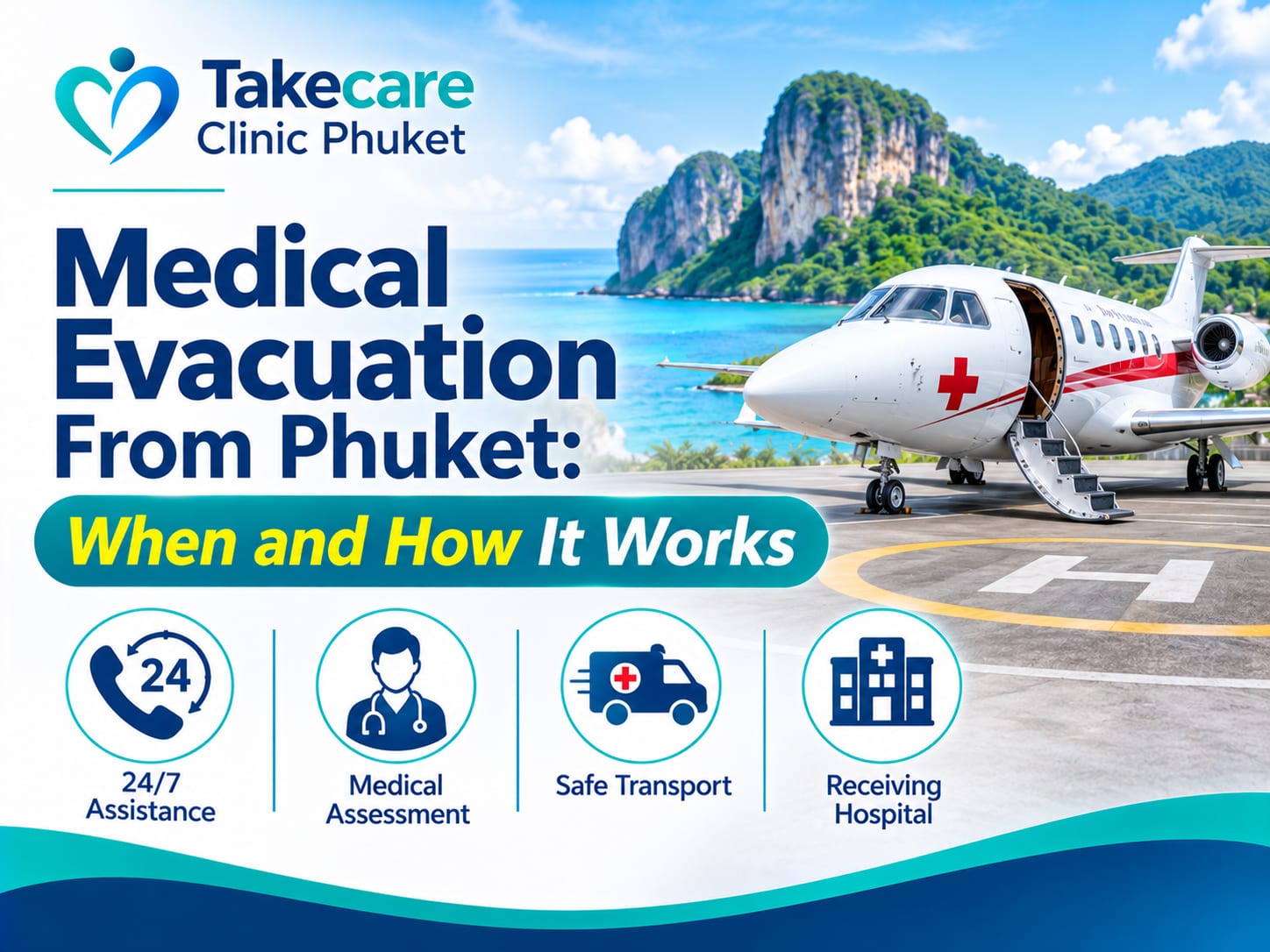
Medical evacuation from Phuket means arranging transport to a higher level of care, either to Bangkok or back to your home country. Most cases go to Bangkok first. Before any air ambulance is dispatched, your insurer needs a current medical report from a treating physician, so the first step is usually a clinic visit, not a phone call to a medevac company. Costs range from significant for a regional flight to Bangkok to very high for full international repatriation, which is why travel insurance with a named evacuation benefit is essential before you arrive.
Say you are three weeks into a long-stay in Rawai. A family member has a cardiac event. The local hospital stabilises him, but his cardiologist back home in Germany says he needs a procedure not available here. You call the insurer. They ask for a medical report. You do not have one. That is where most families lose time, and that is where the process either moves quickly or stalls for days.
Medical evacuation covers any situation where the care someone needs is not available where they are. The decision involves a physician, an insurer, and sometimes a family in a different time zone. Knowing how those pieces connect before something goes wrong is the most useful preparation you can do.

When Air Ambulance from Phuket Is Needed
Not every serious illness needs an air ambulance. The question is whether the care required exists at a reachable facility without putting the patient at greater risk getting there.
Conditions that typically require dedicated medical transport include spinal injuries where lying flat is mandatory, patients who need a ventilator, unstable cardiac cases after a procedure, and severe trauma after a road accident. Phuket’s hill roads, including Route 4028 and the Patong climb, produce serious trauma cases regularly, and those patients cannot sit upright in a commercial seat or go without continuous monitoring.
Conditions that can often travel commercially with a medical escort include stable post-surgical patients, managed infections, and patients with controlled chronic illness who need ongoing specialist access at home. The distinction matters because the cost difference is very large.
Stabilisation before evacuation is a step that is easy to overlook under pressure. In practice, a patient is rarely evacuated from the point they collapse. They are assessed, stabilised, and documented first. That documentation, a current medical summary from the treating physician, is what your insurer’s assistance line needs before they will approve anything. If you are in Rawai, Chalong, or Kata and not already admitted to a hospital, a walk-in clinic can provide that assessment and produce the report quickly. Takecare Clinic Phuket can assess, write the medical summary your insurer requires, and liaise with the assistance line the same day, with no appointment needed.
Air Ambulance vs Commercial Flight With Escort
These are genuinely different things. An air ambulance is a dedicated aircraft with critical care equipment and a flight medical team on board. A commercial flight with a medical escort is a nurse or doctor accompanying a stable patient on a scheduled airline.
Air ambulances are used when the patient cannot tolerate a commercial environment, needs continuous monitoring during the flight, or when time is critical. Some providers operating in Thailand hold CAMTS or EURAMI accreditation, meaning their aircraft, crew, and protocols meet an independently audited standard. If you are arranging this through your insurer, they will typically use an accredited provider. If you are arranging it privately, check for that accreditation before confirming.
Sky Doctor Thailand is the government-funded air medical transport programme that handles emergency transfers within the country. It is available to both Thai nationals and foreign visitors through the 1669 emergency line, with costs covered by the Emergency Medical Fund. In practice, the programme is most active in remote areas and may have aircraft or landing-zone limitations, so foreign visitors and expats should not rely on it as their primary evacuation plan. Evacuation for foreign visitors is most reliably arranged through private insurance assistance lines or directly with private providers.
A commercial escort is cheaper and appropriate for stable patients. The airline requires a MEDIF form, completed and signed by a licensed physician, submitted to the airline’s medical department before ticketing. This process can take several days. If the patient cannot wait, a dedicated air ambulance is the right choice. We can complete the MEDIF form at Takecare Clinic Phuket if your treating physician has already issued a discharge summary or clinical report. For patients who also need a fit-to-fly certificate in Phuket, that can be issued at the same visit.

Bangkok First or Straight Home
The majority of serious cases from Phuket are transferred to Bangkok first, not repatriated internationally on the first flight.
Bangkok hospitals including Bumrungrad, Bangkok Hospital Bangkok, and Samitivej have specialist capabilities that are not available in Phuket. For many conditions, transfer to Bangkok is the medically appropriate step, and it is significantly cheaper and faster than flying to Europe or Australia. Insurers often prefer this pathway. Confirm it with your insurer’s assistance line before assuming you need to go all the way home.
Full international repatriation is arranged after Bangkok stabilisation, or for cases where the required treatment genuinely does not exist in Thailand. If your condition is managed in Bangkok and you are well enough to fly commercially with a MEDIF clearance, that is usually how the return home is handled.
What Air Ambulance from Phuket Costs
Specific cost figures change frequently and vary by provider, route, aircraft type, and crew configuration. Any number printed here can be out of date within months. That said, regional transport from Phuket to Bangkok costs substantially less than international repatriation to Europe, North America, or Australia, which requires a longer flight, a larger aircraft, and a full critical care team for the full duration.
Out-of-pocket costs without insurance are very high for either route. This is not a situation where you negotiate later and pay from savings. It is the reason every responsible travel health guide recommends confirming your policy has a named evacuation benefit before you travel, and checking whether that benefit has a sub-limit that might not cover the full cost.
If your policy has an evacuation sub-limit, ask the insurer directly what the cap is and whether it covers international repatriation or Bangkok transfer only. Some Thai-only health plans exclude international evacuation entirely.
How Insurance Approval Works
Your insurer’s assistance line is the central point. Call them before calling a medevac company. They need to approve the evacuation, choose the provider, and confirm coverage, in that order. Going around them usually means paying out of pocket.
What they will ask for: the patient’s current diagnosis, a medical report from the treating physician, the name of the facility where the patient is now, and the proposed destination. If that medical report does not exist yet, that is the first thing to fix. For long-stay expats managing a chronic condition in Phuket, keeping your treating physician’s contact details and your most recent clinical summary on hand is practical, not excessive.
If the insurer is slow to respond or issues a preliminary denial, ask them to put the reason in writing. A treating physician can respond to a clinical denial with additional documentation. If the delay is administrative rather than clinical, escalate within the insurer’s own structure. Your policy documents should name a 24-hour assistance line separate from the claims line. That is the number to call in an active situation.
Paying out of pocket and claiming back is possible under some policies, but confirm it before you spend. Some evacuation benefits require prior authorisation as a condition of payment. If you need an emergency doctor in Phuket to start that documentation process, acting early gives the insurer more time to respond before the clinical situation changes.
Patients arriving from day trips to Phi Phi or the outer islands face a practical extra step: reaching Phuket mainland before air transport can begin. If you have had a jellyfish sting or reef injury that escalated on a dive day, that boat-to-clinic-to-insurer sequence is worth understanding before you go, not after.
If you need a medical assessment before evacuation is arranged, a fit-to-fly certificate, or a medical report for your insurer’s assistance line, Takecare Clinic Phuket is open with no appointment needed. We are based in Patong and see patients from across the island, including Rawai, Chalong, Kata, Kamala, and Phuket Town. We can assess, document, and liaise with your insurer the same day. Visit our fit-to-fly certificate service or our medical certificates page at takecareclinicphuket.com.
Frequently Asked Questions
Dr. Ponlawat Pitsuwan
Physician, Takecare Medical Clinic Phuket
a walk-in medical clinic based in Patong with English-speaking physician care available across the island. He sees tourists, expats, and long-stay residents for urgent care, pre-evacuation assessment, fit-to-fly certification, and medical documentation for insurance purposes. His focus is straightforward, evidence-based care delivered in plain language.
References
- Thailand Official Website. Thai Sky Doctor: Air Patient Assistance Program. Thailand.go.th.
- Nation Thailand. Health minister Cholnan eyes nationwide expansion as Sky Doctor project soars. Asian News Network, 2023.
- EURAMI. Air Ambulance Fixed Wing Accreditation. eurami.org.
- CAMTS. Commission on Accreditation of Medical Transport Systems. camts.org.
- LOT Polish Airlines. When should a MEDIF form be filled in and where to send it? lot.com.
- Emirates. Medical Information Forms. emirates.com.
The information in this article is for educational purposes only and does not constitute medical advice. It should not be used to self-diagnose or replace a consultation with a qualified physician. If you have concerns about your health, contact a licensed medical professional. For appointments at Takecare Clinic Phuket, visit takecareclinicphuket.com.
