Clinically reviewed by Dr. Ponlawat Pitsuwan, Physician, Takecare Medical Clinic Phuket. Last reviewed: September 2026
If you have been sick during your Phuket trip and want to dive again, feeling better is not the same as being fit to dive. Ear infections, food poisoning, fever, and dehydration all carry real risks underwater that do not disappear when your symptoms do. A physician needs to confirm you are clear before you get back in the water. Takecare Clinic Phuket issues same-day diving medical clearance with no appointment needed.
You spent three days on a liveaboard out of Chalong, and somewhere between the Phi Phi dive sites and the Patong hotel buffet on the way home, your stomach turned. You feel mostly okay now. Your dive trip has two days left. The question I get asked constantly: can I still dive? The honest answer is that it depends on what happened to your body, not just whether your symptoms are gone.
I see this pattern every week in season. A diver comes in wanting a quick green light, and sometimes I give it. Other times I do not, and explaining why takes longer than people expect. This article covers the illnesses I see most often in Phuket divers, when you genuinely need a physician’s sign-off before getting back in the water, and what that sign-off actually involves.

Why Feeling Better Does Not Always Mean Fit to Dive
Your body’s recovery from an illness and your body’s ability to handle diving pressure are two different things. They do not always line up.
Dehydration is the clearest example. After gastroenteritis, your fluid levels can still be low even when you feel normal. Dehydration thickens your blood, makes gas exchange in your tissues less efficient, and raises the risk of bubble formation on ascent. That is a real decompression sickness risk, not a theoretical one.
Fever does something similar. If you had a fever even 24 hours ago, your metabolic rate is still elevated. You breathe through your tank faster, your judgment is less sharp, and nitrogen loads into your tissues at a rate your dive plan did not account for. Feeling fine this morning does not reset everything overnight.
Congestion is the third thing I check. A head cold that seems resolved can still leave your Eustachian tubes partially blocked. You will not know that until you are at five metres and cannot equalise. That is a bad place to find out.
Illness-by-Illness Guide: When to Stop and When You Can Return
Ear Infections After Diving in Phuket
Ear problems are the most common acute illness I see in Phuket divers, and the one most likely to be misread. There are two types, and they require different decisions.
Otitis externa is swimmer’s ear, an infection of the outer canal. Phuket’s warm water speeds this up. Your ear hurts when you pull on the outer ear, it may feel blocked, and there may be discharge. You must stop diving immediately. Water in an infected canal makes it worse every time.
Otitis media is a middle ear infection, deeper in. Diving with this risks rupturing your eardrum. You cannot reliably tell from the outside which type you have. Both require a physician to look in your ear with an otoscope and confirm whether you are clear to dive. If your ear hurts after diving, do not put your head back under until that has happened.
Food Poisoning and Gastroenteritis
The question is never just whether your stomach has settled. It is whether your hydration is back and whether you are genuinely well or just improved.
If your episode was mild, lasted under 24 hours, involved no fever and no antibiotics, you can often return to diving once you are clearly rehydrated. Check your urine. Pale yellow is acceptable. Dark yellow or amber means you are not ready.
If your episode included fever, vomiting for more than 24 hours, blood in your stool, or IV fluids, you need a physician assessment before you dive. I can usually see you, run a quick check, and give you a same-day answer.
Fever From Any Cause
Fever is a hard stop. Elevated body temperature increases your metabolic rate, your air consumption, and your risk of nitrogen loading. It also dulls the judgment that safe diving requires.
Wait until you have been fever-free for at least 48 hours, not just this morning. If the fever had an identified infectious cause, such as dengue, a bacterial infection, or anything requiring antibiotics or IV treatment, get physician clearance before you dive. Dengue is not rare in residential parts of Phuket. I see it in Chalong, Cherng Talay, and Thalang regularly, and some of those patients end up on a dive boat two days later thinking the worst is behind them. It may be. But someone needs to confirm that.
Scooter Road Rash and Wound Infections
An open or infected wound is a direct pathway for waterborne bacteria, and Phuket’s warm coastal water is not sterile. If you have road rash from a spill on the Patong hill roads or Route 4028, or a reef cut from Kata or Karon that is showing signs of infection: spreading redness, swelling, warmth, or pus, do not put that wound in the ocean.
Get it assessed first. If it is clean, healing well, and can be fully waterproofed, we can talk about diving. If there is any active infection, treatment comes before that conversation.
What Diving Medical Clearance in Phuket Actually Involves
The process is simpler than most divers expect.
I review your recent illness: what happened, how long it lasted, what you took for it, and where you are now. I do a targeted physical exam based on the specific illness. For ear problems, that means an otoscope check and a look at Eustachian tube function. For gastroenteritis, it means hydration status. For fever, it means confirming you are afebrile and that nothing suggests an ongoing infection.
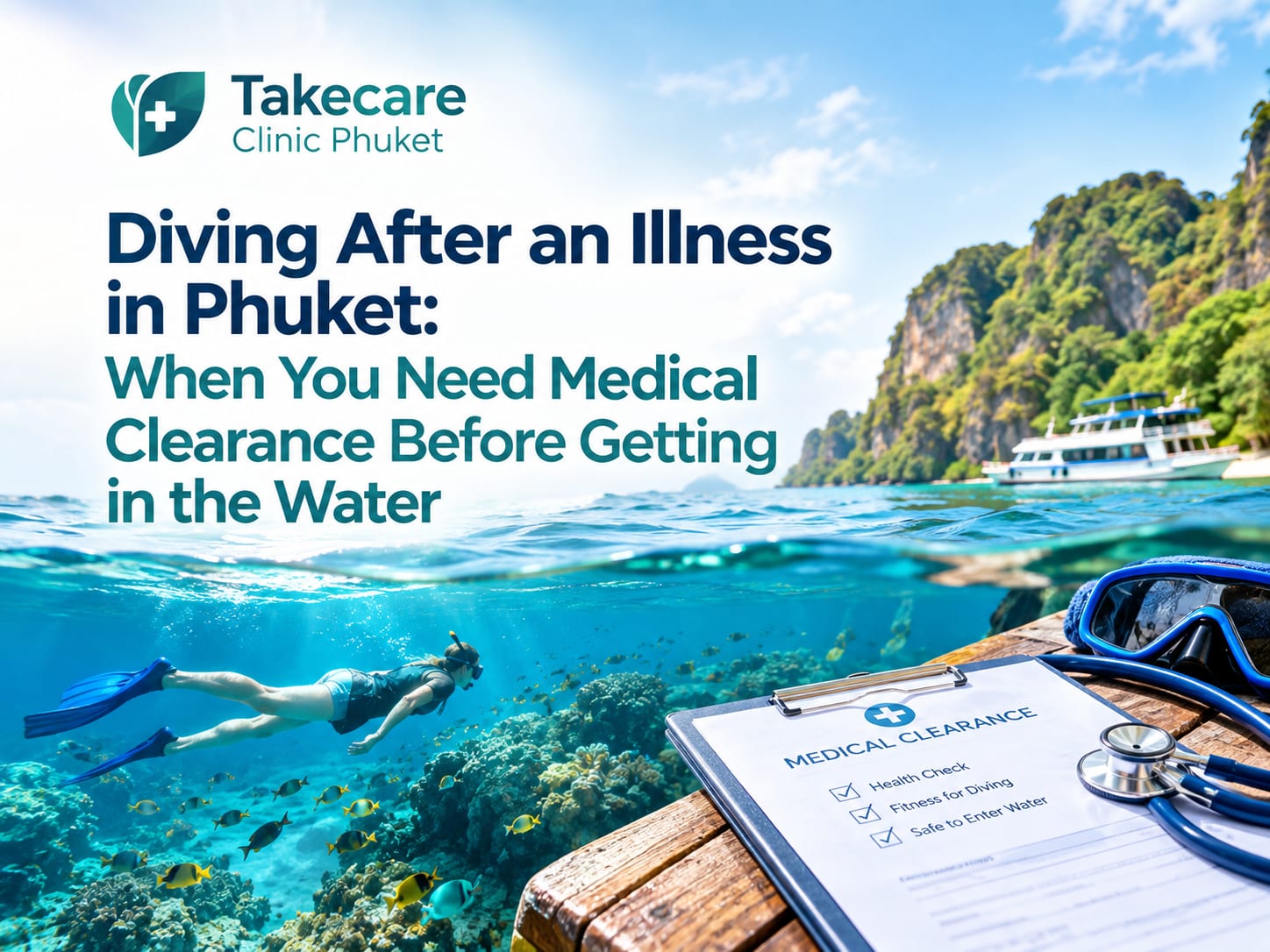
I then issue a letter confirming you are fit to scuba dive, with the specific condition assessed noted. That is what your dive operator needs. A certificate that says "generally healthy" does not always satisfy a dive school’s insurance requirements. The letter needs to state fit to dive.
For a straightforward acute illness clearance, the whole visit typically takes under an hour. For diving medical clearance in Phuket, Takecare Clinic Phuket handles these walk-in, no appointment required, same day for most cases.
The Medical Questionnaire and When It Requires a Doctor’s Signature
If you are doing a PADI or SSI course, or joining a dive operator using the RSTC diver medical questionnaire, you fill out a yes/no form before you dive. Certain answers automatically require a physician signature before you can proceed.
These include recent ear surgery, chest infections, asthma, prior decompression sickness, heart conditions, diabetes, and any illness in the period before the dive. If you answer yes to any of these and try to wave it off, your operator is within their rights to refuse. Their insurance does not cover you if the form was completed dishonestly.
The Phuket-specific issue: if you answered no on your original form and then got sick mid-trip, that form no longer reflects your current health status. You need a fresh assessment.
Conditions That Need Clearance Versus Conditions That Are a Hard Stop
Some conditions can be cleared with physician approval. A resolved ear infection, a recovered bout of food poisoning, a clean healing wound: these are assessable and clearable.
Others are absolute bars to recreational diving regardless of what any physician says. Uncontrolled epilepsy, spontaneous pneumothorax (a collapsed lung with no clear cause), and certain cardiac arrhythmias fall into this category. No letter clears you for these. If any of these are in your history, your dive school needs to know before you book, not after you surface.
If you are unsure which category your situation falls into, come in and ask. That question takes five minutes to answer, and it is worth asking before you commit to a liveaboard deposit.
Getting Your Diving Medical Clearance Sorted in Phuket
For most acute illness clearances, you do not need a hyperbaric medicine specialist. You need a physician who understands dive medicine standards and knows what Phuket dive operators require on a certificate.
Takecare Clinic Phuket is based at 34/14 Prachanukhro Road in Patong, walk-in with no appointment needed, and sees divers from across the island whether they are staying in Bang Tao, Rawai, Kata, or Kamala. Our English-speaking physicians issue fit-to-dive certificates that meet PADI, SSI, and local operator requirements. If your situation involves prior decompression sickness, a lung condition, or anything more complex, we will tell you honestly whether a specialist referral makes more sense.
Most divers who come in worried leave with a clear answer. That is worth a short detour from the dive boat.
Sick during your Phuket trip and want to get back in the water safely? Takecare Clinic Phuket can assess your fitness to dive the same day, no appointment needed. Our English-speaking physicians issue fit-to-dive certificates accepted by PADI, SSI, and local Phuket dive operators. Walk in to 34/14 Prachanukhro Road, Patong, or visit takecareclinicphuket.com to learn more about our diving medical clearance service.
FAQ
Dr. Ponlawat Pitsuwan
Physician, Takecare Medical Clinic Phuket
a walk-in medical clinic in Patong with English-speaking physician care and no appointment needed. He regularly assesses divers returning to the water after acute illness, issues fit-to-dive certificates for PADI and SSI operations across Phuket, and manages the ear, gastrointestinal, and wound-related conditions that interrupt dive trips. His focus is straightforward, evidence-based care delivered in plain language.