Clinically reviewed by Dr. Ponlawat Pitsuwan, Physician, Takecare Medical Clinic Phuket. Last reviewed: September 2026
Most healthy divers in Phuket do not need a doctor’s certificate before their first dive. You complete a self-declaration form at the dive centre, and if every answer is no, you are cleared to go. If you answer yes to any question on that form, the dive school cannot let you in the water until a physician signs off. That sign-off is a diving medical certificate, and it can be done the same day at a walk-in clinic in Phuket.
You booked a liveaboard to the Similan Islands months ago. You are standing at the dive centre in Patong, filling in the PADI medical statement, and you tick yes to one question. Maybe it is asthma. Maybe it is blood pressure medication. Maybe it is a knee surgery from two years back. The instructor hands the form back and tells you they need a doctor’s signature before you can get in the water. Your boat leaves tomorrow morning.
This is one of the most common situations I see at Takecare Clinic Phuket. It is not a crisis. It is a process, and for most patients it takes less than an hour. What matters is knowing what the check involves, which conditions actually stop you from diving, and what to do in Phuket when you need clearance fast.

Self-Declaration vs. Doctor Sign-Off: Which Do You Actually Need?
Every major certification agency uses a version of the same form. PADI calls it the Medical Statement. The RSTC form works the same way. If every answer is no, you sign it and dive.
Answer yes to anything on that list, and a physician needs to assess you before the dive school can clear you. This is not a punishment. The questions flag conditions that can become dangerous under pressure or at depth, and a doctor needs to decide whether your specific situation is a problem.
Common triggers include asthma, heart disease, epilepsy, insulin-dependent or medicated diabetes, high blood pressure, a history of decompression sickness, surgery in the past year, and certain psychiatric medications. Answering yes does not mean you cannot dive. It means a doctor needs to look at your actual history, not just the checkbox.
What the Doctor Actually Checks
When you come in for a diving medical in Phuket, I am not rubber-stamping a form. Each body system matters underwater in a specific way, and the exam reflects that.
I start with your lungs. Any air trapped during ascent can cause barotrauma, meaning pressure-related damage, so I listen carefully and ask about past chest problems. If there is any doubt about lung function, I run spirometry, a simple breathing test, in the same visit.
Your heart comes next. I check blood pressure, resting heart rate, and listen for anything irregular. For divers over 45, I recommend an ECG as well. Diving in current around the Similans or Racha puts real load on the cardiovascular system, and age-related changes matter more at depth than they do on land.
I also check your ears, nose, and throat. Equalising on descent is something every diver does, and anything blocking that process can cause a middle ear injury or a ruptured eardrum. I look at your neurological history and assess any metabolic condition, like diabetes, based on how well controlled it is right now.
Conditions That Are an Absolute Stop, and Conditions That Just Need Review
Some conditions are firm contraindications to diving. A history of spontaneous pneumothorax, where a lung collapses without injury, is one. Uncontrolled epilepsy is another. Severe unstable heart disease, certain significant psychiatric conditions, and active middle ear or sinus disease on the day of diving also fall here. These are not open to negotiation.
Most conditions are not in that category. Well-managed, stable asthma with no recent flares is often cleared after spirometry confirms normal lung function. Type 2 diabetes on oral medication with good glucose control can frequently be cleared. Controlled high blood pressure on a single medication is usually not a barrier.
This is the part dive school briefings often get wrong. They list asthma and diabetes as problems without explaining that the real question is severity and control. I see divers every week who assumed they were disqualified and nearly walked away from a trip they did not need to cancel. Come in, get assessed. The answer may not be the one you are expecting.
Return-to-Dive Assessments After Illness, Surgery, or a Diving Incident
This is something that barely gets covered in Phuket dive content, but I see it regularly. A diver surfaces near Koh Bon with joint pain and skin mottling. They go to the hyperbaric chamber. Three days later, they want to know if they can finish the liveaboard. The answer requires a return-to-dive assessment from a physician, not a conversation with a divemaster.
The same applies after middle ear barotrauma, a chest illness, surgery in the preceding weeks, or a significant ear infection picked up around Phi Phi or Racha. A doctor needs to confirm the original problem has resolved before you get back in the water.
At Takecare Clinic Phuket, this works the same as an initial diving medical. Walk in, no appointment needed. I take a history of what happened, examine the relevant systems, and give written clearance if it is appropriate. If I have concerns, I will tell you plainly, and I will tell you the minimum surface interval before you dive again.
Getting Your Diving Medical Certificate in Phuket
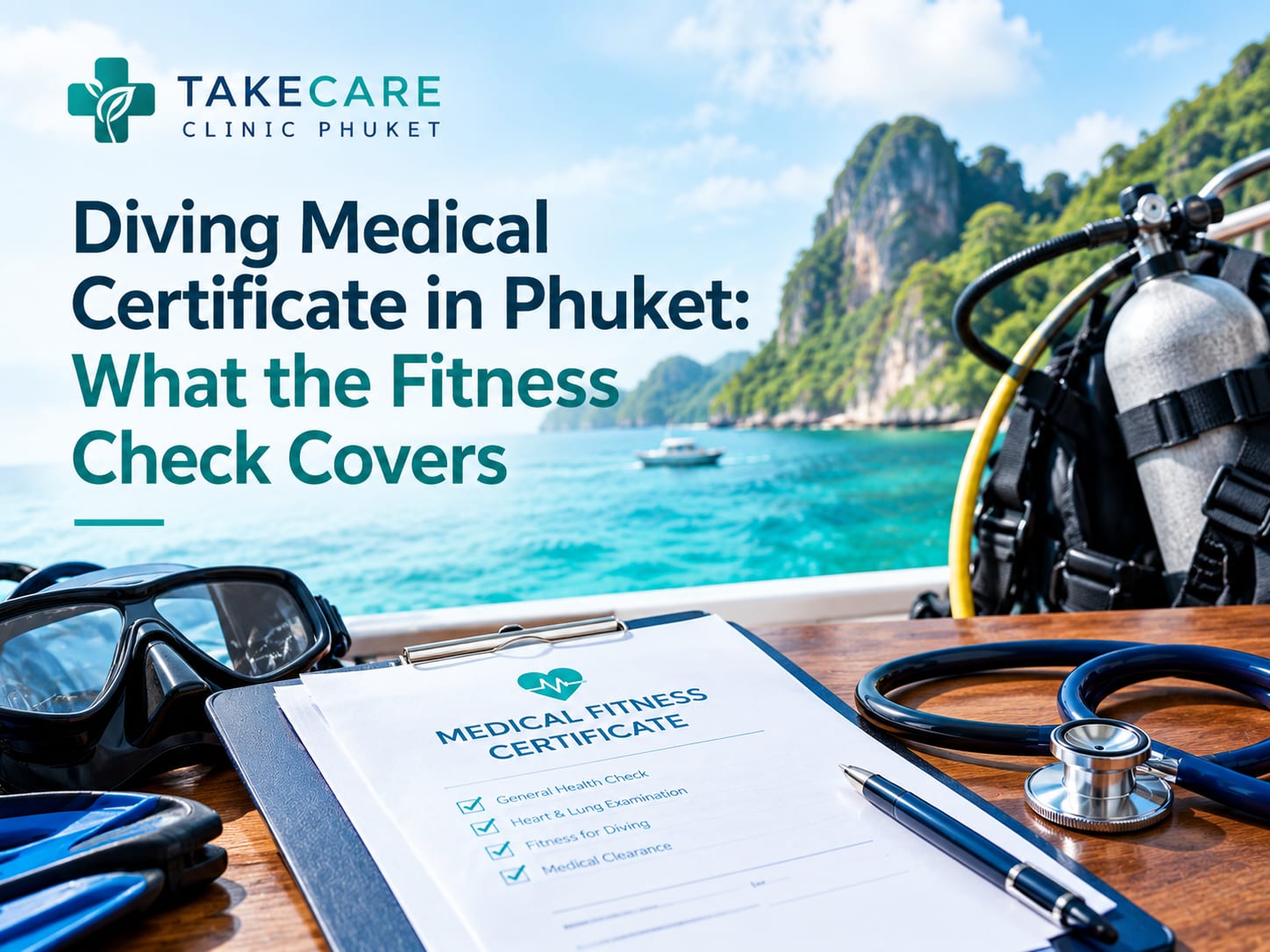
Walk-in access matters when your dive boat leaves the next morning. Takecare Clinic is based in Patong, close to most of the dive shops in the area. No appointment needed, and English-speaking doctors. The process takes around 30 to 45 minutes depending on what needs examining.
You do not need to bring anything specific, but a current medication list or a letter from your regular doctor about a chronic condition will help. If your situation requires spirometry or an ECG, we can do both in the same visit.
Same-day certification is possible for most recreational dive medicals where no specialist referral is needed. The certificate satisfies the requirements of PADI, SSI, and most liveaboard operators running out of Phuket. For divemaster or instructor candidates doing PADI Pro courses in Phuket, the requirements are more formal than a recreational self-declaration. If you are working toward a professional rating, mention that when you come in, because the certificate for a recreational diver and the one for a divemaster candidate are not the same document.
For a full breakdown of what the certificate at our clinic covers, see our diving medical certificate page.
Need a diving medical certificate in Phuket before your next dive day? Takecare Clinic Phuket is a walk-in clinic in Patong with no appointment needed and English-speaking physicians. We issue same-day fitness-to-dive certificates for recreational divers, liveaboard passengers, and PADI Pro candidates. Whether you triggered a yes on the self-declaration form, are returning to dive after an incident, or want clearance before a Similan Islands trip, come in and we will handle it in a single visit. We also see patients from Kata, Karon, Rawai, Chalong, Bang Tao, and Phuket Town.
FAQ
Dr. Ponlawat Pitsuwan
Physician, Takecare Medical Clinic Phuket
a walk-in medical clinic based in Patong with no appointment needed and English-speaking physician care for the whole island. He sees tourists, expats, and residents for diving medical certificates, fitness-to-dive assessments, return-to-dive evaluations after diving incidents, and general travel and occupational health. His focus is straightforward, evidence-based care delivered in plain language.