Clinically reviewed by Dr. Ponlawat Pitsuwan, Physician, Takecare Medical Clinic Phuket.
Last reviewed: September 2026
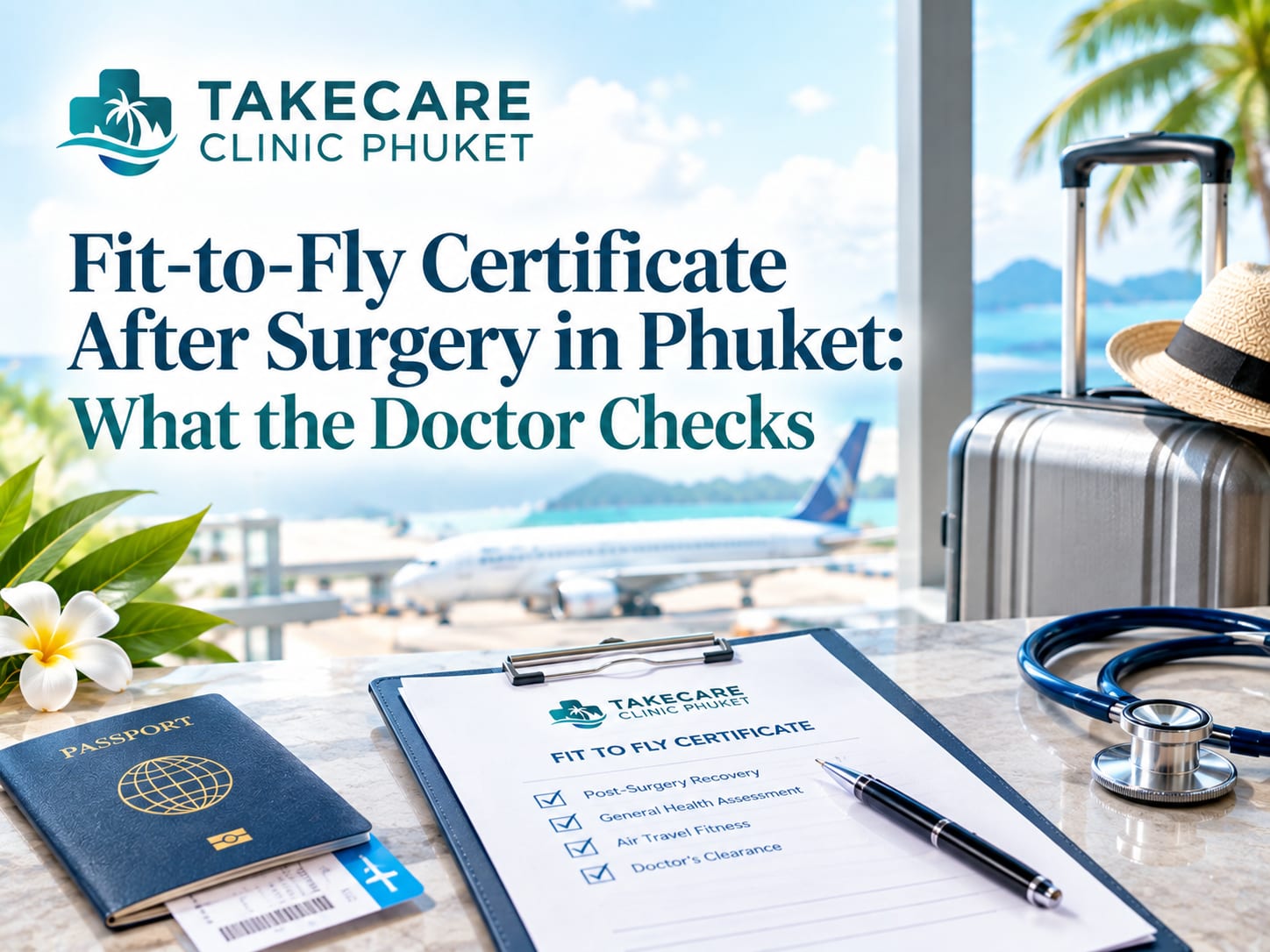
A fit-to-fly certificate is a written medical statement confirming you are safe to travel by air after surgery. At Takecare Clinic Phuket, a doctor checks your wound, blood clot risk, and overall recovery before issuing the certificate, usually within the same visit. Bring your hospital discharge notes, your flight details, and any specific form your airline has requested.
You had an appendectomy at Bangkok Hospital Phuket five days ago. Or a rhinoplasty at a Patong clinic. Or surgical repair after a reef cut from a day trip to Phi Phi that went deep enough to need stitches under sedation. Now you have a flight home in 48 hours and your airline wants medical clearance before they will let you board. Most patients at this point have the same two questions: is it actually safe to fly, and where do I get the paperwork?
The honest answer is that flying after surgery carries real risks. A fit-to-fly certificate is not a formality your airline invented. It exists because a pressurised cabin at cruising altitude changes things: oxygen levels drop slightly, immobility on a long-haul flight raises the chance of a blood clot, and trapped gas in a healing body can expand and cause pain or worse. Knowing what the assessment covers helps you walk in prepared.

Why Flying After Surgery Is Riskier Than It Looks
Sitting still for eight or ten hours on a flight from Phuket to Europe or Australia is hard on anyone. After surgery, it is genuinely risky. Blood moves more slowly through your legs when you are not moving, and a healing body is already in a state where clotting happens more easily. That combination raises your risk of a deep vein thrombosis, a blood clot that forms in a leg vein and can travel to your lungs.
Cabin pressure adds another layer. Commercial aircraft are pressurised to roughly the equivalent of 6,000 to 8,000 feet above sea level. That slight drop in oxygen can stress a body still in recovery. It can also cause gas trapped in a surgical site to expand, which matters most after abdominal surgery or any operation involving gas insufflation. Wounds that look closed can swell or begin to reopen. I see patients who underestimated this every season.
What the Doctor Actually Checks
This is what the assessment at Takecare Clinic Phuket covers when you come in for a fit-to-fly evaluation.
Wound Status
The doctor will look at the wound directly. Is it closed, dry, and healing cleanly? Or is there redness, swelling, discharge, or warmth pointing to infection? In Phuket’s heat and humidity, wounds can turn quickly. A wound that looked fine at hospital discharge two days ago can look quite different today. Any sign of active infection is a problem for flying.
Blood Clot Risk
The doctor will assess your personal risk for deep vein thrombosis. This includes your procedure type, your mobility since surgery, how long your flight is, and individual factors like age and weight. For longer flights, compression stockings are routinely recommended. The assessment may also include checking your legs for swelling or tenderness, which can be early signs that a clot is already forming.
Cardiovascular and Respiratory Stability
Blood pressure, heart rate, and oxygen levels are checked. After any general anaesthetic or major procedure, the doctor needs to confirm your body is handling recovery well before putting it through a long flight. Patients who are still pale, fatigued, or showing abnormal readings are not safe to fly regardless of how they feel at rest.
Medication and Anaesthetic Clearance
If you had a general anaesthetic, the doctor checks that you are past the point where residual effects could cause a problem at altitude. For patients on new post-operative medications, the doctor confirms what you are carrying is safe onboard and that you have enough supply for the full journey plus any delays.
Procedure-Specific Waiting Times
There is no single safe waiting period that applies to every surgery. The doctor makes this call based on what was actually done to your body.
| Procedure Type | Typical Minimum Before Flying |
|---|---|
| Minor wound repair, skin procedures | 24 to 48 hours |
| Dental surgery under sedation | 24 to 48 hours |
| Keyhole (laparoscopic) surgery | 5 to 7 days |
| Appendectomy or abdominal surgery | 7 to 10 days |
| Cosmetic surgery (rhinoplasty, breast, liposuction) | 1 to 3 weeks depending on extent |
| Chest or cardiac surgery | 2 to 6 weeks, specialist clearance required |
| Eye surgery involving gas bubble | Until bubble fully absorbed, check with surgeon |
These are general guides only. The doctor assesses the individual in front of them, not a table.
What Airlines Flying Out of Phuket Actually Require
Requirements differ between carriers, and this matters if you are departing from Phuket International Airport.
Thai Airways requires a MEDIF form for passengers with recent surgery or active medical conditions. AirAsia Thailand requires medical clearance documentation and their policy typically asks for the certificate to be dated within 72 hours of departure. Bangkok Airways has its own high-risk passenger policy and may require direct contact between their medical desk and the issuing physician.
Check your airline’s specific requirements before you come in. Bring your flight booking details and any form or wording your airline has specifically requested. The doctor can tailor the certificate language to match what your carrier needs, which prevents last-minute rejections at the gate.
When a Standard Certificate Is Not Enough
Most patients who come to Takecare Clinic Phuket after surgery get cleared, fly home, and recover without incident. But some presentations genuinely cannot be cleared for commercial travel.
If your wound is infected, your clot risk is high, or your vitals are not stable, issuing a certificate would put you in danger at altitude, possibly hours from the nearest hospital. In that situation, the honest medical answer is not yet. The doctor will advise on a realistic revised departure window. In more serious cases, medical air transport with appropriate onboard care may be the safer option, and the clinic can advise on escalation paths.
If the Doctor Cannot Clear You
Getting an unfit-to-fly certificate is not a failure. It is clinical protection. Airlines routinely accept this documentation to support rebooking without penalty. Travel insurers use it to process claims for extended accommodation, replacement flights, and additional medical costs. Without it in writing, those claims are far harder to make. If a doctor tells you verbally you cannot fly but does not give you written documentation, ask for it. It has real financial and logistical value.
Getting Your Fit-to-Fly Certificate Before You Leave Phuket
Bring everything the doctor needs to make a proper assessment: your hospital discharge summary, operative notes, any imaging, your current medication list, your passport, your flight details, and any specific form your airline has requested.
Takecare Clinic Phuket is a walk-in clinic with no appointment needed and English-speaking physician care. The assessment and fit-to-fly certificate are usually completed within the same visit. If you are unsure what documents to bring, you can check via WhatsApp before you come in. The clinic serves patients across the whole island, from Kata, Karon, and Rawai to Bang Tao, Kamala, and Phuket Town.
Had surgery in Phuket and need medical clearance before your flight home? Takecare Clinic Phuket issues same-day fit-to-fly certificates in English after a full post-surgical assessment by an English-speaking physician. Walk in at 34/14 Prachanukhro Road, Kathu District, Patong, no appointment needed. Bring your hospital discharge notes, your flight booking details, and any airline-specific form. If you are unsure what to bring, contact us via WhatsApp first.
Can I get a fit-to-fly certificate from a different clinic if my surgeon was at a Phuket hospital?
Yes. You do not need to return to the hospital where you had surgery. An independent physician can review your discharge notes, examine your wound, and issue a certificate based on that assessment. Patients discharged from Bangkok Hospital Phuket, Mission Hospital, or any private Phuket facility can walk into Takecare Clinic Phuket with their paperwork and be seen the same day.
How soon after surgery can I get a fit-to-fly certificate in Phuket?
The certificate can be issued the same day you come in, as long as the doctor is satisfied you are clinically ready to fly. The limiting factor is your recovery, not the paperwork process. Minor procedures may allow clearance within 24 to 48 hours; major abdominal or cosmetic surgery typically takes longer, and the doctor will assess you as an individual rather than applying a fixed rule.
What documents should I bring to my fit-to-fly assessment?
Bring your hospital discharge summary, operative notes, any scan or X-ray images, your current medications, your passport, your flight details including the airline name, and any specific form your airline has requested. If you are not sure what you have or what you need, contact Takecare Clinic Phuket via WhatsApp before your visit and the team can advise.
What happens if the doctor decides I am not yet fit to fly?
The doctor will give you a written unfit-to-fly statement and advise on a safer departure window. That written documentation matters: airlines use it to rebook without penalty, and travel insurers use it to process claims for extended hotel stays, missed flights, and additional medical costs. Not having that letter in writing makes insurance claims significantly harder.
Do Thai airlines have different fit-to-fly requirements than international carriers?
Yes, and the differences are practical. Thai Airways requires a MEDIF form, AirAsia Thailand typically requires the certificate to be dated within 72 hours of departure, and Bangkok Airways has its own medical desk protocol. Check your carrier’s specific rules before your visit and bring your booking details so the doctor can match the certificate wording to what your airline actually needs.
I had cosmetic surgery at a Patong clinic. Can I get fit-to-fly clearance without going back to the cosmetic surgeon?
Yes. An independent physician at Takecare Clinic Phuket can assess your recovery and issue clearance based on your post-operative documents and a direct wound examination. Many patients who had rhinoplasty, liposuction, or breast procedures at Patong or Kata clinics come in for an independent assessment before flying, which is entirely appropriate.
I got a serious reef cut near Phi Phi and had it surgically repaired. How long before I can fly?
Minor wound repairs can often be cleared within 24 to 48 hours if the wound is clean, closed, and showing no sign of infection. Reef wounds are a particular concern in Phuket because they often carry bacterial contamination from the reef surface, and in this humidity, infection can develop quickly. The doctor will examine the wound directly before making any recommendation.
Dr. Ponlawat Pitsuwan
Physician, Takecare Medical Clinic Phuket
a walk-in medical clinic based in Patong with no appointment needed and English-speaking physician care for the whole island. He sees tourists, expats, and residents across Phuket for post-surgical assessment, [fit-to-fly certification](https://takecareclinicphuket.com/medical-certificate-phuket/), and [medical clearance documentation](https://takecareclinicphuket.com/medical-certificate-phuket/) for travel. His focus is straightforward, evidence-based care delivered in plain language.