
Clinically reviewed by Dr. Ponlawat Pitsuwan, Physician, Takecare Clinic Phuket.
Last reviewed: October 2026
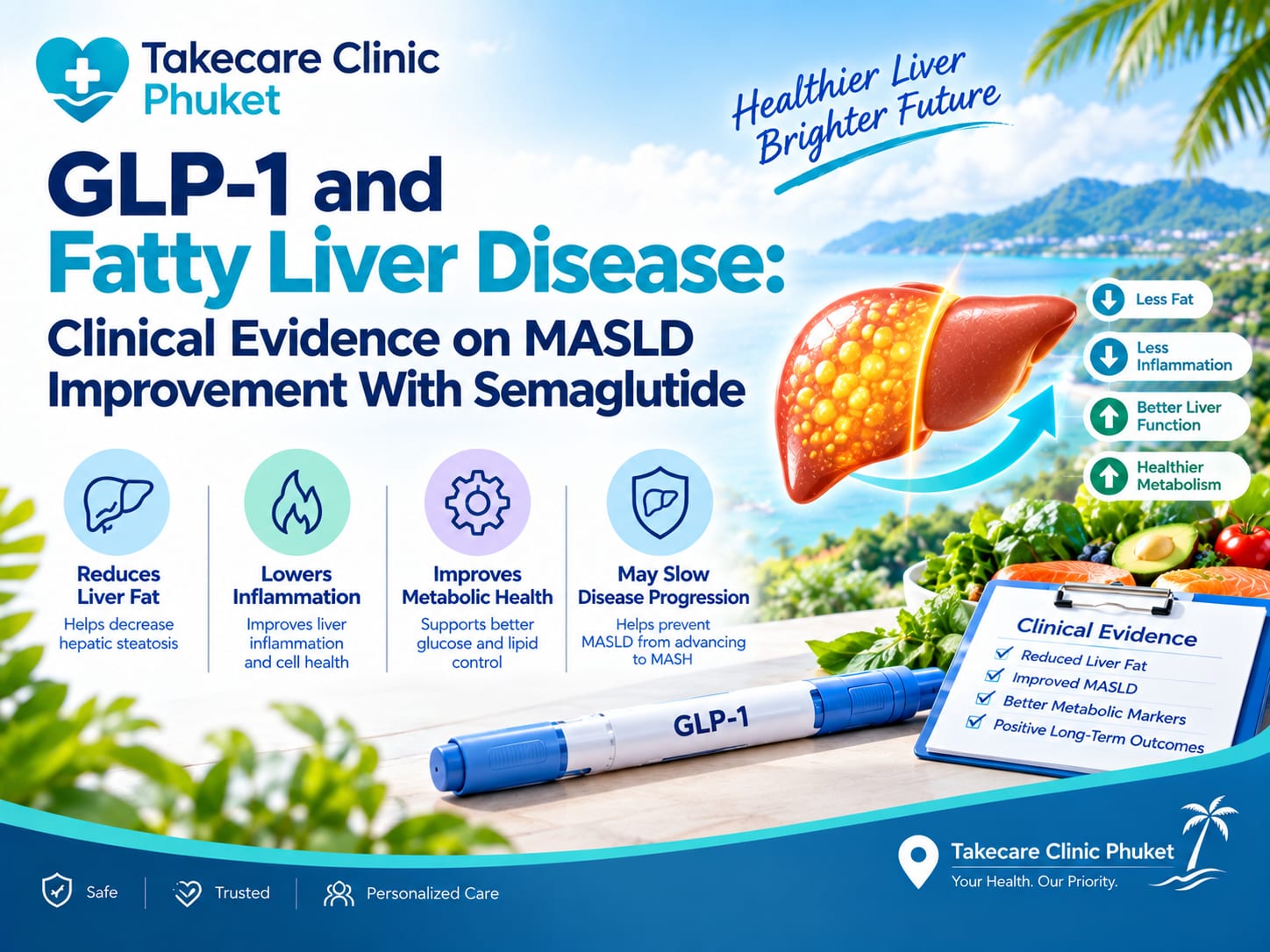
Semaglutide 2.4 mg per week received FDA accelerated approval in August 2025 for MASH with moderate to advanced fibrosis, based on the ESSENCE Phase 3 trial showing 62.9% of patients achieved MASH resolution versus 34.3% on placebo. This makes it the first GLP-1 receptor agonist approved for a liver-specific indication. If you have been told you have fatty liver and you also carry metabolic risk factors like high blood sugar, high triglycerides, or obesity, GLP-1 therapy may now be a clinical option worth discussing with a doctor.
Many expats who come in for routine care, a prescription refill or a blood pressure check, have liver enzymes that quietly tell a different story. Mildly elevated ALT. Slightly raised triglycerides. A history of weight gain since moving to Thailand. Most of them have heard the words "fatty liver" before, usually from a doctor back home who said to cut back on alcohol and lose some weight. Some did. Many did not. A few had no GP to follow up with once they settled here.
That picture changed in 2025. Semaglutide, the same once-weekly injection used for type 2 diabetes and obesity, received FDA accelerated approval for a specific liver disease called MASH. The evidence behind it is the strongest we have seen for any drug in this condition. This article explains what MASLD and MASH are, what the trial data showed, who qualifies, and how to get properly assessed if you are living or staying in Phuket.

What MASLD and MASH Mean and Why the Name Changed
Until 2023, you may have heard the terms NAFLD and NASH. The medical community replaced them because the old names defined the condition by what it was not, rather than what causes it.
MASLD stands for metabolic dysfunction-associated steatotic liver disease. It describes fat buildup in the liver linked to metabolic risk factors: excess body weight, insulin resistance, high blood pressure, high triglycerides, or raised blood sugar. MASH, metabolic dysfunction-associated steatohepatitis, is the more serious form. In MASH the liver is not just storing fat. It is inflamed and beginning to scar. That scarring is called fibrosis, and it drives the long-term risk of cirrhosis and liver failure.
The name change also shifted the diagnosis criteria. You no longer need to prove you do not drink alcohol. You need at least one metabolic risk factor. That matters because more people are correctly identified and offered care earlier.
Who Gets MASLD: Why Expats and Long-Stay Visitors in Phuket Face Elevated Risk
MASLD does not announce itself. It rarely causes symptoms until fibrosis is already advanced. The risk factors tend to accumulate quietly during a certain kind of life in Phuket.
Insulin resistance is the central driver. High-calorie meals heavy in white rice and sweet sauces, alcohol-heavy evenings in Patong, a sedentary routine between the beach and a desk: these are ordinary features of long-stay life here for a significant number of expats and frequent visitors. Add unmanaged blood pressure or cholesterol, and the liver is working in a metabolically hostile environment.
Visceral fat, stored around the abdominal organs rather than under the skin, is a particular risk for liver fat accumulation. It does not always show up as obvious obesity. A man of normal weight with a growing waistline and a desk job in Rawai carries real risk. So does the 50-something woman whose blood sugar has been creeping up for years. If you have not had a metabolic blood panel in over a year, that is where to start.

The ESSENCE Trial: What the Phase 3 Data Actually Showed
The ESSENCE trial is the study behind the 2025 FDA approval. At 72 weeks of treatment with semaglutide 2.4 mg per week, 62.9% of patients achieved MASH resolution without worsening fibrosis. In the placebo group, 34.3% reached the same outcome. Fibrosis improvement of at least one stage was seen in 36.8% of the semaglutide group versus 22.4% on placebo.
These are meaningful differences. The FDA’s accelerated approval is conditional. Confirmatory trials showing long-term clinical outcomes are still ongoing.
Liver enzyme improvements, ALT and AST falling toward normal range, tend to appear earlier than structural liver change. But enzyme improvement alone is not the same as MASH resolution. The full benefit requires sustained treatment. Stopping the drug may reverse what was gained.
How GLP-1 Receptor Agonists Work on the Liver
Most people hear "GLP-1" and think weight loss. That is part of the picture, but the liver effects go further.
GLP-1 receptors have been identified on liver sinusoidal endothelial cells in animal studies, though their expression in human liver cells remains a subject of ongoing research. The mechanism by which semaglutide benefits the liver likely involves both direct effects on liver cells and indirect effects through reduced visceral fat, improved insulin sensitivity, and lower triglycerides. Weight loss compounds this: as visceral fat decreases, the metabolic burden on the liver drops, insulin sensitivity improves, and triglycerides fall.
This is why GLP-1 therapy for MASH is not the same as prescribing it for weight management and hoping the liver benefits follow. The mechanism is directly relevant to the liver, and the monitoring requirements are different.
Who Qualifies for GLP-1 Fatty Liver Treatment and Who Does Not
Per AASLD 2025 practice guidance, semaglutide for MASH is indicated in adults with MASH and moderate to advanced fibrosis, specifically stage 2 or stage 3. The evidence does not support its use for stage 1 fibrosis or for patients without confirmed MASH outside a clinical trial.
Several groups should not use semaglutide for this indication. A personal or family history of medullary thyroid carcinoma or multiple endocrine neoplasia type 2 is a contraindication. Pregnancy and planned pregnancy are contraindications. Patients with MASH-related cirrhosis were excluded from the ESSENCE trial and the approval does not cover them. Active liver disease from a different cause, such as autoimmune or viral hepatitis, requires separate evaluation first.
Fibrosis staging should be performed with noninvasive tests. FibroScan, a type of ultrasound that measures liver stiffness, or validated blood-based fibrosis scores are preferred over liver biopsy where possible, per current AASLD guidance. A liver ultrasound can also confirm hepatic steatosis.
If you have been told you have fatty liver but have never had fibrosis staging, that assessment must happen before any treatment decision.
What to Expect on Semaglutide: Dose, Side Effects, and Monitoring
Semaglutide for MASH is given as a once-weekly subcutaneous injection at 2.4 mg. Dose titration, starting lower and increasing gradually, is standard practice to reduce gastrointestinal side effects.
Nausea is the most common side effect, particularly in the early weeks. Constipation, loose stools, and reduced appetite are also common. These tend to improve after the titration period. Serious but rare risks include pancreatitis and gallbladder disease. Anyone with a history of pancreatitis should discuss this clearly with their doctor before starting.
Monitoring during treatment includes periodic liver enzyme checks and metabolic marker assessment. This is not optional. It is how you and your doctor confirm the treatment is working and that no unexpected problems are developing.
Getting Assessed for GLP-1 Fatty Liver Treatment in Phuket
If you are living in Phuket and you do not have a regular GP managing your metabolic health, that is a practical gap worth closing. A blood panel covering ALT, AST, fasting glucose, HbA1c, and lipids will tell us a great deal. Liver ultrasound referral can be arranged on the island. Noninvasive fibrosis staging is accessible in Phuket without needing to fly home.
Takecare Clinic Phuket operates as a walk-in clinic in Patong with no appointment needed and an English-speaking physician available throughout. If you have had a fatty liver diagnosis and want to understand whether GLP-1 therapy is clinically appropriate for you, a consultation here is the right starting point. We can review your history, order the relevant blood tests, and refer for imaging where needed.
For expats who prefer not to come in immediately, a telemedicine consultation is also available. For those managing multiple long-term conditions alongside fatty liver, a health check-up gives a clearer overall picture before any treatment conversation begins.
If you have been told you have fatty liver, or if you have metabolic risk factors like raised blood sugar, high triglycerides, or central weight gain and have not been assessed recently, Takecare Clinic Phuket can help. No appointment needed. English-speaking physician care in Patong, available to tourists, expats, and residents across the whole island. We can order a same-day metabolic blood panel, arrange liver ultrasound referral, and discuss whether GLP-1 therapy is appropriate for your situation. Walk in or contact us at takecareclinicphuket.com.
Frequently Asked Questions
Dr. Ponlawat Pitsuwan
Physician, Takecare Medical Clinic Phuket
a walk-in medical clinic based in Patong with no appointment needed and English-speaking physician care for the whole island. He sees tourists, expats, and residents across Phuket for metabolic health assessment, chronic disease management, and GLP-1 therapy evaluation including fatty liver disease and MASLD. His focus is straightforward, evidence-based care delivered in plain language.
References
- Sanyal AJ, Newsome PN, Kliers I, et al. Phase 3 Trial of Semaglutide in Metabolic Dysfunction-Associated Steatohepatitis. N Engl J Med. 2025;392(17). doi:10.1056/NEJMoa2413258
- Bansal MB, et al. AASLD Practice Guidance Update on the Clinical Assessment and Management of MASLD, Including the Use of Semaglutide. Hepatology, 2025. doi:10.1097/HEP.0000000000001608
- Rinella ME, et al. A multisociety Delphi consensus statement on new fatty liver disease nomenclature. Hepatology. 2023;78(6):1966-1986.
- World Health Organization. Obesity and overweight: key facts. WHO Fact Sheet, 2024.
The information in this article is for educational purposes only and does not constitute medical advice. It should not be used to self-diagnose or replace a consultation with a qualified physician. If you have concerns about your health, contact a licensed medical professional. For appointments at Takecare Clinic Phuket, visit takecareclinicphuket.com.
