
Clinically reviewed by Dr. Ponlawat Pitsuwan, Physician, Takecare Clinic Phuket.
Last reviewed: October 2026
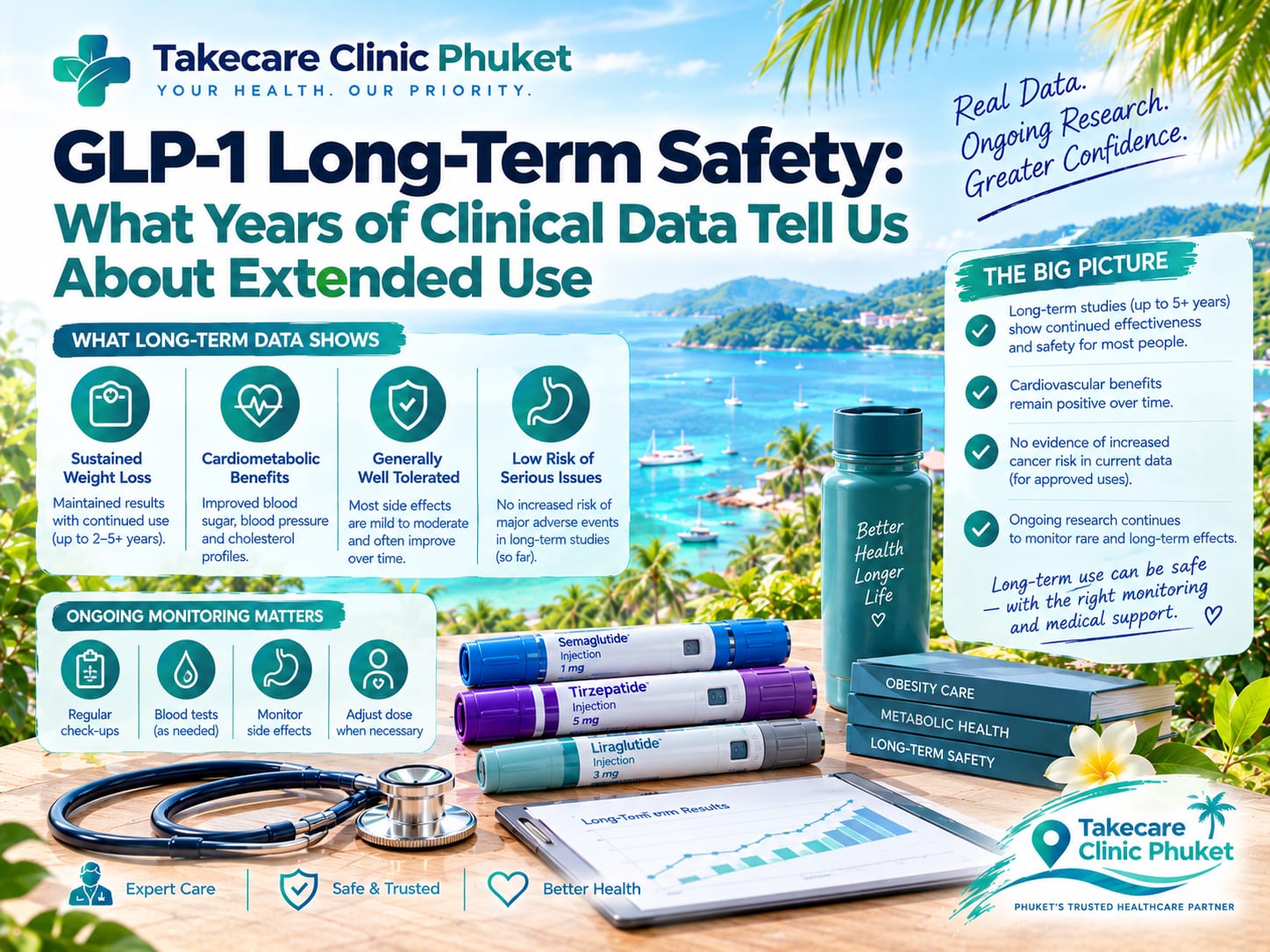
GLP-1 receptor agonists like semaglutide and liraglutide have multi-year cardiovascular trial data showing reduced rates of serious heart events. The main documented long-term concerns are gastrointestinal side effects, gallbladder disease, potential muscle and bone loss, and weight regain after stopping. What we do not have yet is robust randomised trial data beyond five years in people using these drugs purely for weight loss. That gap matters when deciding whether to continue, adjust, or stop.
You have been on a GLP-1 medication for a year, maybe two. It is working. Then you land in Phuket for a long stay, or you relocate here, and the question keeps returning: how long is it actually safe to keep doing this? Your prescriber is twelve time zones away. Booking a check-in is not straightforward. You search, and what you find either reassures you too quickly or frightens you without enough context.
The honest answer is that the long-term safety picture is better than many people expect, and more incomplete than the available data can yet resolve. Years of cardiovascular outcome trials give us real signal. Those trials were mostly three to five years, mostly in people with established disease, and mostly not designed to answer questions about decade-long use in otherwise healthy adults. This article covers what the data shows, what it does not, and what monitoring looks like when you are managing GLP-1 therapy in Phuket without regular access to a home GP.

What the Major Trials Actually Show
The cardiovascular outcome trials are the strongest evidence we have. The LEADER trial with liraglutide, SUSTAIN-6, and the SELECT trial with semaglutide all showed meaningful reductions in serious cardiovascular events compared to placebo. These were large, multi-year trials in people with type 2 diabetes or established cardiovascular disease.
The SELECT trial, published in 2023, is the most relevant to weight-loss patients. It followed adults with obesity and cardiovascular disease but without diabetes, and showed a reduction in major cardiovascular events over roughly three years. That is genuinely reassuring. But three to five years of trial data does not tell us what happens at year eight or ten.
The GI side effects, nausea, vomiting, and diarrhoea, are well-documented and tend to peak during dose escalation. For most people they ease over weeks to months. Persistent or severe GI symptoms after many months on a stable dose warrant a clinical review.
The Thyroid and Pancreatitis Questions
Thyroid C-cell tumours were found in rodent studies at high doses. No equivalent signal has emerged in human trials or post-market surveillance to date. The current label warnings for semaglutide and liraglutide reflect the animal data, not confirmed human risk. People with a personal or family history of medullary thyroid carcinoma or multiple endocrine neoplasia type 2 should not take these drugs. That contraindication stands regardless of how long they have been on the market.
Pancreatitis is more nuanced. There is a small absolute increase in acute pancreatitis cases in some trials. If you develop sudden, severe upper abdominal pain while on a GLP-1 drug, that needs same-day assessment. Do not wait to see whether it settles.

Muscle Loss, Bone Density, and Why This Matters More Than People Think
Weight loss on GLP-1 therapy is not purely fat loss. Studies suggest a meaningful proportion of the weight lost is lean mass, including muscle. The exact proportion depends on protein intake, activity level, and the individual patient.
Data from 2024 onward have shown measurable reductions in bone mineral density over 52 weeks of semaglutide use. Sarcopenia, significant muscle loss, is a particular concern for older adults already losing muscle with age. If you are in your fifties or sixties and on a GLP-1 long term, this is not a reason to stop. It is a reason to talk to a doctor about resistance training, adequate protein, and bone density monitoring over time.
Lean mass preservation improves with regular resistance exercise and sufficient protein. For long-term GLP-1 users, these are part of the treatment plan, not optional additions.
Gallbladder Disease and Kidney Considerations
Gallbladder disease, including gallstones and cholecystitis, is a documented risk with GLP-1 therapy and with rapid weight loss generally. Right upper abdominal pain, especially after eating, warrants investigation rather than symptom management.
The kidney picture differs by patient type. In people with type 2 diabetes, GLP-1 drugs appear to have a protective effect on kidney function. In otherwise healthy people, the main short-term concern is dehydration-related kidney stress. Reduced appetite means reduced fluid intake. Nausea and vomiting compound that. In Phuket’s heat and humidity, this pathway moves faster than patients from Northern Europe or North America typically expect. Staying well hydrated here takes active effort, not passive habit.
If you develop reduced urination, dizziness, or significant vomiting, that warrants same-day assessment. The gastritis treatment and diarrhea treatment pages on this site cover related GI presentations if you need them.
What Happens When You Stop
The STEP 1 extension trial followed participants who stopped semaglutide after 68 weeks of treatment. Within 12 months of stopping, approximately two-thirds of the weight lost had returned. Appetite, blood sugar markers, and cardiovascular risk factors also partially reversed.
This is not a reason to stay on the drug indefinitely without reassessment. It is a reason to make the decision to stop with a doctor rather than doing it unilaterally because your supply ran out mid-trip. Abrupt discontinuation while travelling is a different situation from planned cessation with a tapering plan and a monitoring check. If your medication has run out and you cannot reach your usual prescriber, that is a clinical conversation, not something to manage alone.
GLP-1 Use in Thailand: What Patients Here Need to Know
Injectable GLP-1 drugs, including semaglutide and liraglutide, are classified as special controlled medicines under Thai FDA regulation. You cannot buy them over the counter at a pharmacy in Phuket. Prescription and physician oversight are required.
This classification also means counterfeit products circulate. Online sources offering injectable GLP-1 drugs in Thailand without a prescription are not a safe option. Unverified products have no guaranteed potency, sterility, or accurate labelling. The safety data from major trials applies to licensed, verified pharmaceutical products, not to unlicensed alternatives.
For tourists and expats managing ongoing GLP-1 therapy in Phuket, the practical question is who to see here. Takecare Clinic Phuket operates as a walk-in clinic in Patong with English-speaking physician care and no appointment needed. A physician can review your history, assess your current status, and discuss prescription support options within Thai regulatory requirements. We can also run the blood tests relevant to long-term GLP-1 monitoring through our blood test service in Phuket, including kidney function, glucose markers, and a lipid panel.
What Long-Term Monitoring Should Look Like
Ongoing GLP-1 therapy without periodic review is not good clinical practice. The monitoring that matters at the one-year mark and beyond includes kidney function, blood glucose or HbA1c, a lipid panel, and gallbladder assessment if you have relevant symptoms. For longer-term users, especially older adults, a conversation about bone density assessment is part of standard care.
If you are a long-stay expat or a visitor spending months in Phuket without a regular GP, this check-up does not have to wait until you return home. An English-speaking doctor in Phuket can conduct a thorough review, request appropriate tests, and give you a clear picture of where you stand, without needing a pre-existing local relationship or an appointment booked weeks in advance.
For expats managing this from Chalong, Rawai, Bang Tao, or anywhere else on the island, a prescription refill in Phuket through a physician who has reviewed your record is how this works safely within Thai regulations. Running out and improvising is the risk, not the drug itself.
What We Still Do Not Know
We have five years of cardiovascular outcome data in high-risk populations. We do not have ten-year randomised trial data in otherwise healthy adults using these drugs primarily for weight management. Questions about very long-term bone density changes, lean mass trajectory, and signals in populations not represented in the original trials remain genuinely open.
This is not a reason to stop or not start. The benefit-risk profile, based on current evidence, is favourable for the populations studied. It is a reason to keep treatment under physician supervision, maintain regular monitoring check-ins, and understand that what is still unknown about long-term GLP-1 use is a legitimate part of the conversation, not a gap that should make you dismissive of the question or anxious about the answer.
Managing long-term GLP-1 therapy in Phuket? Takecare Clinic Phuket is a walk-in clinic in Patong with English-speaking physician care and no appointment needed. We see tourists, expats, and long-stay residents from across the island, from Bang Tao and Laguna to Rawai and Chalong. A clinical review of your GLP-1 therapy, including relevant monitoring blood tests, is available the same day you walk in.
FAQ
Dr. Ponlawat Pitsuwan
Physician, Takecare Medical Clinic Phuket
a walk-in medical clinic based in Patong with no appointment needed and English-speaking physician care for the whole island. He sees tourists, expats, and residents across Phuket for ongoing chronic disease management, weight loss medication oversight, prescription review, and general health monitoring. His focus is straightforward, evidence-based care delivered in plain language.
References
- Lincoff AM, et al. Semaglutide and Cardiovascular Outcomes in Obesity without Diabetes. N Engl J Med. 2023;389(24):2221-2232.
- Marso SP, et al. Liraglutide and Cardiovascular Outcomes in Type 2 Diabetes (LEADER). N Engl J Med. 2016;375(4):311-322.
- Marso SP, et al. Semaglutide and Cardiovascular Outcomes in Patients with Type 2 Diabetes (SUSTAIN-6). N Engl J Med. 2016;375(19):1834-1844.
- Rosengren BE, et al. Effects of subcutaneous semaglutide on bone mineral density and bone turnover in adults at increased risk of fracture: a 52-week randomised placebo-controlled trial. EClinicalMedicine. 2024.
- The Nation Thailand. Thailand makes GLP-1 injections prescription-only from September 15. 2026.
The information in this article is for educational purposes only and does not constitute medical advice. It should not be used to self-diagnose or replace a consultation with a qualified physician. If you have concerns about your health, contact a licensed medical professional. For appointments at Takecare Clinic Phuket, visit takecareclinicphuket.com.
