
Clinically reviewed by Dr. Ponlawat Pitsuwan, Physician, Takecare Clinic Phuket.
Last reviewed: October 2026
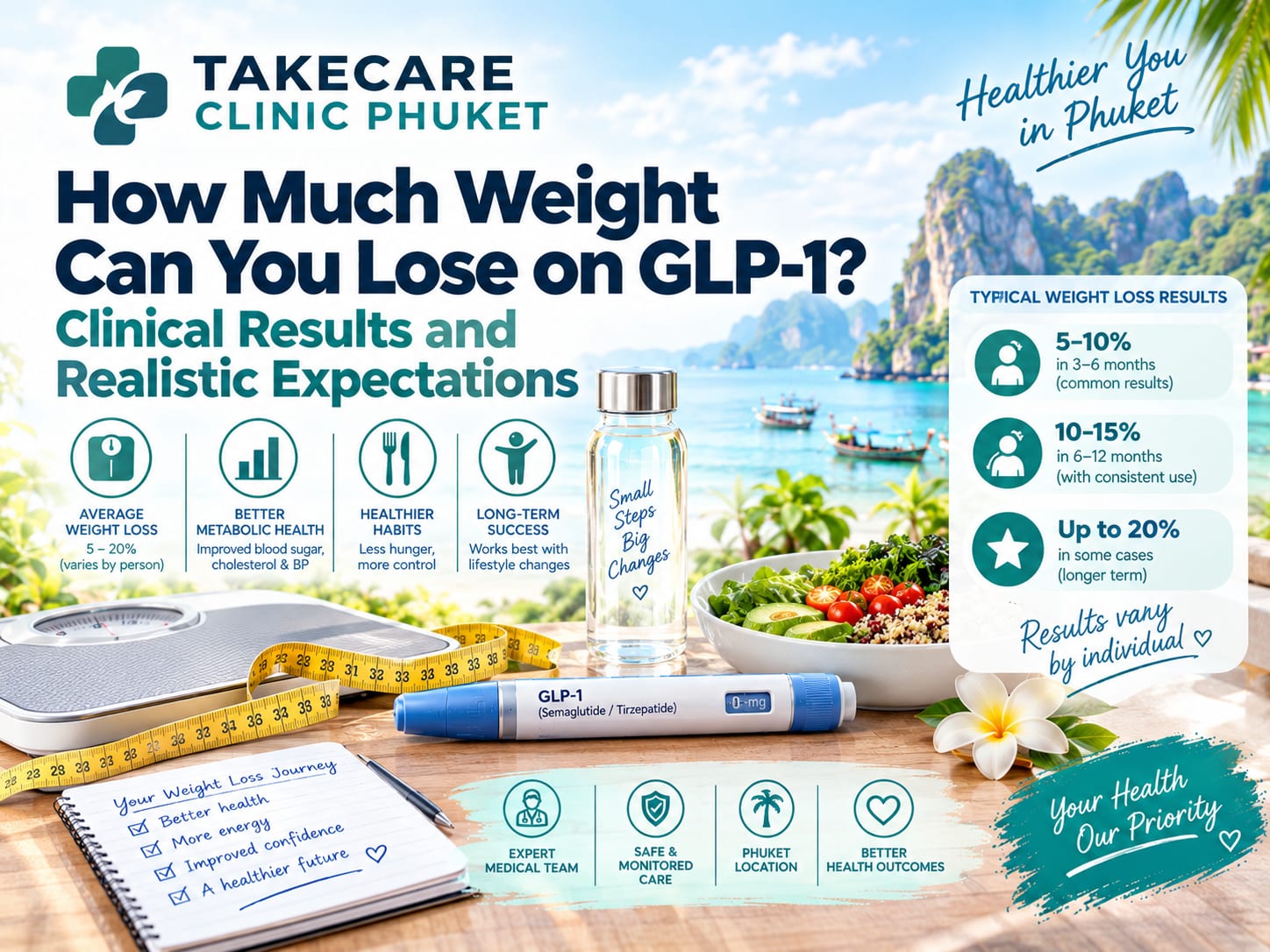
Clinical trials show semaglutide produces around 15% body weight loss and tirzepatide around 20% at maximum doses over roughly 72 weeks. Real-world results are lower. How much you lose depends on your starting weight, the dose you reach, how consistently you take it, and what you do alongside it. These are not short-term fixes. Stopping the medication without sustained lifestyle changes usually reverses most of the loss. GLP-1 medications are not suitable for everyone. People with a personal or family history of medullary thyroid carcinoma or multiple endocrine neoplasia type 2 should not use them, and anyone who develops severe abdominal pain, persistent vomiting, or signs of an allergic reaction while on treatment should seek medical care promptly.
A long-stay expat based in Laguna came in four months into semaglutide treatment. She had brought a two-month supply from home, topped it up through a pharmacy in Phuket Town, and was now asking a straightforward question: is 5 kg in four months normal, or is something wrong?
The honest answer is that it depends. Which drug, what dose, and how long you have been at that dose are the three questions that matter most. The trial percentages are real, but they come from patients on maximum doses after a year or more. Most people are not there yet at month four. This article explains what the trials actually showed, what those percentages mean in real kilograms, and what to do when progress slows.

What the Clinical Trials Actually Show
The two drugs most commonly prescribed for weight loss are semaglutide 2.4 mg weekly, sold as Wegovy, and tirzepatide 15 mg weekly, sold as Mounjaro. Both are GLP-1 receptor agonists. They reduce appetite and slow stomach emptying.
The STEP 1 trial of semaglutide 2.4 mg showed an average body weight loss of around 15% at 68 weeks. The SURMOUNT-1 trial of tirzepatide 15 mg showed around 21% at 72 weeks in the intention-to-treat analysis. The head-to-head SURMOUNT-5 trial, published in 2025, compared the two directly. Tirzepatide produced approximately 20% loss versus 14% for semaglutide at 72 weeks, with more GI-related discontinuations in the semaglutide group.
| Drug | Brand | Max Weekly Dose | Trial | Average Body Weight Loss |
|---|---|---|---|---|
| Semaglutide | Wegovy | 2.4 mg | STEP 1 | ~15% |
| Tirzepatide | Mounjaro | 15 mg | SURMOUNT-1 | ~21% |
| Tirzepatide vs Semaglutide | Head-to-head | 15 mg vs 2.4 mg | SURMOUNT-5 | ~20% vs ~14% |
These are averages at maximum tolerated doses after more than a year of treatment. Not every patient reaches the top dose. Not every patient achieves the average.
Percentages Into Real Kilograms
Trial papers report percentages. Patients want to know kilograms. Here is what 15% from semaglutide and 20% from tirzepatide look like at three common starting weights.
| Starting Weight | 15% Loss (Semaglutide) | 20% Loss (Tirzepatide) |
|---|---|---|
| 70 kg | 10.5 kg | 14 kg |
| 90 kg | 13.5 kg | 18 kg |
| 110 kg | 16.5 kg | 22 kg |
These are trial-level outcomes at maximum doses over 68 to 72 weeks. Real-world results tend to run lower, because trial participants are closely monitored with consistent dosing and structured lifestyle support.

GLP-1 Weight Loss Timeline in the First Year
Dose escalation is gradual by design, to reduce nausea and other side effects. For the first several weeks the dose is still climbing, and weight loss in this phase is modest. Early clinical data suggests roughly 5% body weight loss by around week 12 on semaglutide, though the STEP 1 trial’s primary endpoint was at week 68. For a 90 kg person, that is about 4.5 kg.
Weight loss typically accelerates as the dose reaches its maintenance level, then slows again as the body adjusts. This is not a sign that the drug has stopped working. It is a predictable phase. Most of the total loss in clinical trials occurred between months three and twelve.
The practical point: if you are at month four and the scale has barely moved in the last six weeks, that is worth reviewing with your prescribing physician. It is not necessarily a failure, but it does warrant a clinical look.
Why Some People Lose Less on GLP-1
Not everyone is a strong responder. Some people genuinely lose less than the trial average, and there are several reasons why.
The most common ones are not reaching the effective dose, taking the injection inconsistently, and eating around the drug’s appetite suppression with high-calorie liquids and processed food. Losing muscle mass rather than fat during rapid weight loss is also a real issue. If protein intake is too low and there is no resistance exercise during treatment, a significant portion of what the scale shows as weight loss may be muscle. That affects how you look, how you feel, and how your metabolism responds when doses change.
A plateau lasting more than four to six weeks on a stable dose, despite consistent adherence, is worth a clinical review. Understanding why GLP-1 weight loss plateaus happen is the first step, but acting on it means assessing the full picture: dose level, body composition, diet quality, and whether the medication is genuine.
Getting GLP-1 Treatment Safely in Phuket
Thailand’s FDA has proposed reclassifying GLP-1 drugs to special controlled-drug status, which would require a valid prescription for purchase. The regulatory change was under review as of early 2026. You should not purchase semaglutide or tirzepatide from a pharmacy in Thailand without a valid prescription from a licensed physician, and regulatory tightening is underway. Counterfeit pens have been reported in circulation. Buying from unlicensed sources puts you at real risk, not just of wasted money but of unknown contents, incorrect dosing, and no clinical oversight.
For tourists arriving mid-course with their own supply, a prescription refill in Phuket requires a physician consultation to confirm your current dose, review your health history, and issue a valid Thai prescription. That consultation is also the point where a doctor can assess whether your current dose and progress are appropriate.
For expats and long-stay residents, Takecare Clinic Phuket offers physician consultations for GLP-1 suitability, prescription, and ongoing monitoring, with no appointment needed. GLP-1 treatment without clinical oversight, across months of dose escalation, is where most problems develop quietly. A blood test in Phuket to check metabolic markers, including blood glucose, liver function, and lipid levels, is part of responsible long-term monitoring on these medications.
How to Get the Most From GLP-1 Treatment
The drug reduces appetite. What you do with that reduction determines the quality of the result. Patients who maintain adequate protein intake and include resistance training alongside the medication consistently preserve more muscle during weight loss. This is supported by evidence from controlled trials.
Sleep quality, stress levels, and alcohol intake all affect the result. A late night in Patong followed by a breakfast buffet you do not want but eat anyway is exactly the pattern that blunts the drug’s effect over time. Phuket’s lifestyle is not incompatible with GLP-1 treatment, but it does require some awareness.
If nausea or reflux is making it hard to eat enough protein, that is worth discussing with your doctor. Dose timing, injection site, and meal composition all influence how these side effects present. You do not have to just push through them. A walk-in doctor in Phuket can review your current regimen and make practical adjustments.
Takecare Clinic Phuket offers walk-in physician consultations for GLP-1 management, prescription review, and metabolic monitoring. No appointment needed. We see tourists arriving mid-course, expats managing long-term treatment, and new patients starting their assessment from scratch. Come in to Patong or contact us to find out what is available across the island.
Frequently Asked Questions
Dr. Ponlawat Pitsuwan
Physician, Takecare Medical Clinic Phuket
a walk-in medical clinic based in Patong with English-speaking physician care for the whole island and no appointment needed. He sees tourists, expats, and residents across Phuket for weight management consultations, GLP-1 prescription and monitoring, metabolic health assessments, and ongoing chronic disease management. His focus is straightforward, evidence-based care delivered in plain language.
References
- Wilding JPH et al. Once-Weekly Semaglutide in Adults with Overweight or Obesity. New England Journal of Medicine, 2021.
- Jastreboff AM et al. Tirzepatide Once Weekly for the Treatment of Obesity. New England Journal of Medicine, 2022.
- Wadden TA et al. Tirzepatide versus Semaglutide for Treatment of Obesity (SURMOUNT-5). New England Journal of Medicine, 2025.
- American College of Cardiology. SURMOUNT-5: Greater Loss of Weight, Waist Circumference With Tirzepatide Than Semaglutide. ACC Journal Scan, 2025.
- Nation Thailand. Thai FDA seeks to tighten controls on GLP-1 slimming pens, proposing special controlled-drug status. Nation Thailand, 2026.
- American College of Cardiology. Semaglutide Treatment Effect in People With Obesity – STEP 1. ACC Clinical Trials, 2021.
The information in this article is for educational purposes only and does not constitute medical advice. It should not be used to self-diagnose or replace a consultation with a qualified physician. If you have concerns about your health, contact a licensed medical professional. For appointments at Takecare Clinic Phuket, visit takecareclinicphuket.com.
