
Clinically reviewed by Dr. Ponlawat Pitsuwan, Physician, Takecare Clinic Phuket.
Last reviewed: November 2026
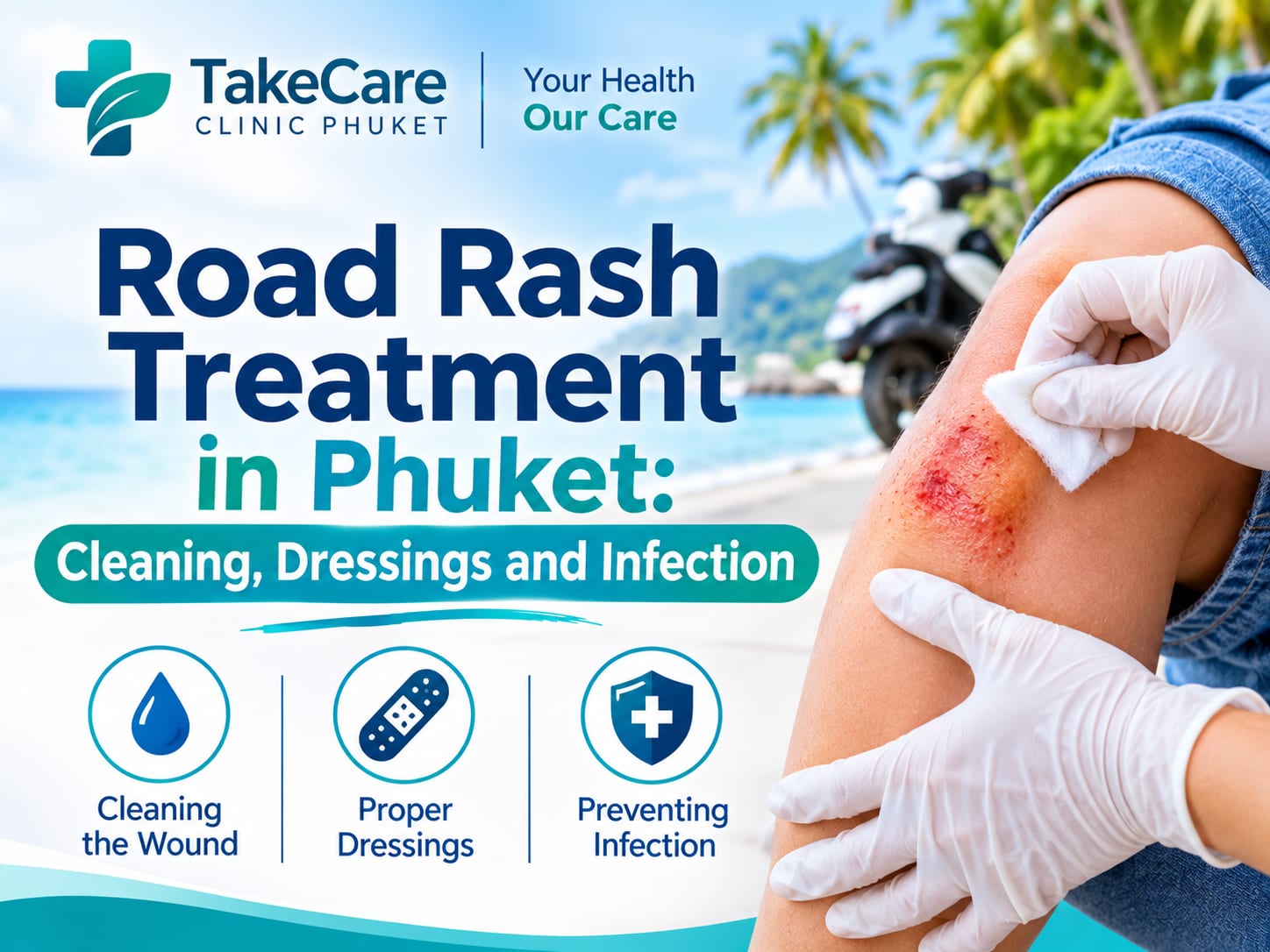
Road rash from a scooter accident in Phuket needs more than a rinse. Clean the wound thoroughly, remove all embedded grit, keep it covered with a non-adherent dressing, and watch closely for infection signs in the first 48 hours. In Phuket’s heat and humidity, wounds can turn infected faster than you would expect at home. If you see red streaking, swelling beyond the wound edges, or fever, get same-day care.
You were coming down the Patong hill road on Route 4028, where it bends sharply before the bottom, and the bike went out from under you. Now you are sitting on the kerb with gravel in your knee and your elbow torn up, wondering if this is a clinic situation or a pharmacy situation. That is exactly the right question, and the answer depends on how deep it is and what is in it.
Most road rash from Phuket scooter accidents can be managed well. What goes wrong is not usually the initial wound. It is the grit left behind, the wrong dressing choice for tropical heat, or the beach swim on day three that nobody warned against. Here is what you actually need to know: how to assess it, when to clean it yourself versus coming in, and what to watch for over the days that follow.

How Deep Is Your Road Rash
Depth matters because it changes what heals on its own and what needs clinical help.
A surface abrasion takes off the outer skin layer. It stings, bleeds lightly, and usually heals well at home with thorough cleaning and the right dressing. A deeper wound goes through both skin layers. It looks pale or white in parts, bleeds unevenly, and may not be painful at first because the nerve endings are damaged. That one needs a clinic.
If the wound is on a joint, over your knuckles, knee, or elbow, healing badly can affect your range of motion. That is another reason to get it assessed rather than managing it solo in your hotel room. Wound care in Phuket at Takecare Clinic covers same-day assessment with no appointment needed.
Cleaning Out Grit From Road Rash
This is where home treatment most often falls short.
Embedded road grit, asphalt particles, and dirt need to come out completely. If they do not, two things happen. First, the wound can get infected. Second, pigment from asphalt can get trapped permanently under new skin as it heals, causing traumatic tattooing: grey or black discolouration that does not fade.
For wounds with visible grit that does not rinse out, or any wound larger than a few centimetres, come in for proper irrigation and debridement. For smaller, cleaner wounds, rinse well with clean running water for several minutes. Do not use hydrogen peroxide or betadine directly on the wound surface. They damage healing tissue. Use plain saline or clean water, then a thin layer of antibiotic ointment, then a non-adherent dressing.
If you feel a gritty texture near the wound, or see dark speckling that will not wash away, that grit is embedded. Do not try to scrub it out with gauze. Come in.

Exhaust Pipe Burns After a Crash
Road rash and an exhaust pipe burn are different injuries and need different treatment.
An exhaust pipe produces a focused thermal burn, usually on the lower leg or calf, that can go deep quickly. If there is a blister, that is a second-degree burn. Breaking the blister exposes raw, damaged skin to infection.
Cool the burn immediately with running water for 20 minutes. Not ice, not ice water, just cool running tap water. Do not apply toothpaste, butter, or any home remedy. Do not wrap it tightly. After cooling, cover loosely with a clean non-stick dressing. If the burn has a blister larger than a small coin, if the skin looks white, grey, or charred, or if the burn covers a wide area, it needs clinical assessment that day.
Dressings in Phuket’s Heat and Humidity
Phuket runs at high humidity year-round. This changes how wounds behave under dressings compared to what you are used to at home.
Moist wound healing works well, but there is a balance. A wound that stays too wet under a sealed dressing in tropical heat can macerate: the surrounding skin goes white and soft and breaks down. When that happens, the effective wound area gets larger and infection risk goes up.
Use a non-adherent dressing, not standard gauze that sticks. Silicone-coated or paraffin-based non-adherent dressings are available at pharmacies and at the clinic. In high humidity, change the dressing daily, or any time it becomes wet, soaked through, or lifted at the edges. Keep the wound out of direct sun. Sun exposure on a fresh abrasion increases the risk of permanent pigmentation changes in the new skin.
When Road Rash Infection Signs Mean See a Doctor
Increasing redness expanding beyond the wound edge, swelling that is getting worse after day two, warmth around the wound, cloudy or yellow discharge, and fever all point to infection. The sign that needs same-day care without waiting is a red line tracking away from the wound toward your body. That is a bacterial infection moving through the lymphatic system and it needs antibiotics promptly.
In Phuket’s heat and humidity, infection signs can develop quickly, so do not wait to see whether things improve on their own. Do not wait until morning if you see red streaking. The walk-in service for road rash infection at Takecare Clinic is available with no appointment needed.
Tetanus and Vaccinations After a Crash
Road abrasions are tetanus-prone wounds. The road surface carries bacteria and contamination that create exactly the conditions where tetanus risk is real.
If your last tetanus booster was more than five years ago, you need to be assessed. Many travellers to Phuket have lapsed immunisation without realising it. A tetanus booster takes minutes and is available at the clinic on the same visit as wound care. For wounds involving an animal, such as a crash caused by a stray dog running into the road near Rawai or Kamala, rabies post-exposure treatment may also be relevant. You can read more about animal bite treatment in Phuket if that applies.
Swimming With Road Rash in Phuket
The sea around Phuket is warm, and it is not where your open road rash wound should be.
Warm tropical seawater carries bacteria that are not present in significant numbers in colder ocean environments. Vibrio vulnificus is one. It can cause a rapidly progressing wound infection in someone with an open abrasion, particularly in anyone who is not at full immune strength. Aeromonas hydrophila is another organism found in freshwater and brackish coastal water that causes real infections in open wounds.
Stay out of the sea until the wound has fully closed with new skin. The same applies to the hotel pool, which is lower risk due to chlorine but still not sterile. Once new skin has fully covered the raw area, swimming is generally safe again. If you are not sure whether your wound is healed enough, come in for a quick check at Takecare Clinic Phuket.
Road rash from a scooter accident in Phuket is a frequent reason for a clinic visit. Whether you need wound irrigation, grit removal, burn dressing, a tetanus booster, or an infection check, Takecare Clinic Phuket offers same-day motorbike accident care with no appointment needed. We see patients from across the island, including Patong, Kata, Karon, Kamala, Rawai, Bang Tao, and Phuket Town. Visit us at 34/14 Prachanukhro Rd, Patong, or see all services at takecareclinicphuket.com.
Frequently Asked Questions
Dr. Ponlawat Pitsuwan
Physician, Takecare Medical Clinic Phuket
a walk-in medical clinic based in Patong with no appointment needed and English-speaking physician care available across the island. He sees tourists, expats, and residents for wound care, scooter accident injuries, road rash treatment, burns, and post-accident infection assessment, with a focus on straightforward, evidence-based care in plain language.
References
- Centers for Disease Control and Prevention. Tetanus: For Clinicians. CDC Vaccines and Immunizations, 2024.
- NHS. Burns and scalds: Treatment. NHS.uk, 2024.
- Gupta S, Bhatt P, Bhoir RI. Principles of wound management. In: StatPearls. NCBI Bookshelf, 2024.
- Centers for Disease Control and Prevention. Wound Care After a Disaster or Emergency. CDC Emergency Preparedness, 2024.
- London and South East Burn Network. LSEBN Burns First Aid Guideline. Queen Victoria Hospital NHS Foundation Trust, 2024.
The information in this article is for educational purposes only and does not constitute medical advice. It should not be used to self-diagnose or replace a consultation with a qualified physician. If you have concerns about your health, contact a licensed medical professional. For appointments at Takecare Clinic Phuket, visit takecareclinicphuket.com.
