
Clinically reviewed by Dr. Ponlawat Pitsuwan, Physician, Takecare Clinic Phuket.
Last reviewed: October 2026
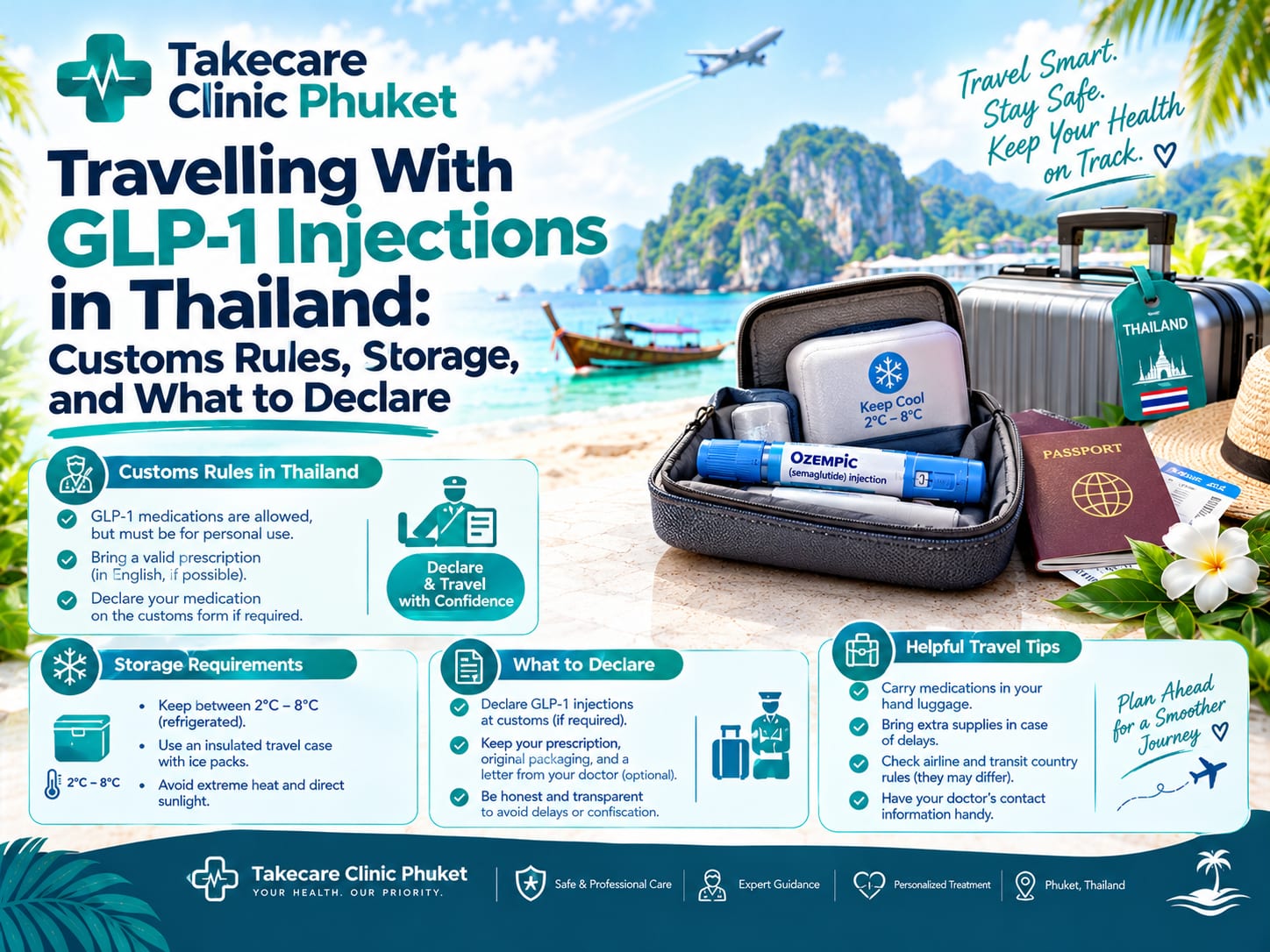
GLP-1 medications such as semaglutide (Ozempic, Wegovy) are not controlled or psychotropic substances under Thai law. You can bring a personal supply into Thailand without a special import permit, provided you carry the original packaging, a valid prescription, and a doctor’s letter. Keep unopened pens refrigerated between 2 and 8°C. An in-use Ozempic pen can be kept below 30°C for up to 56 days, and Phuket’s heat can breach that threshold faster than most travellers expect.
You clear immigration at HKT after a long-haul from London or Sydney, pen sitting in your carry-on, and somewhere between the baggage belt and the customs hall you start wondering whether you should have declared it, whether it survived the flight, and what happens if the hotel minibar runs too cold. That specific worry is what this guide is for.
Travelling with GLP-1 injections in Thailand is legal and straightforward. The problems that actually arise in Phuket are practical ones: heat, missed doses, and the occasional pen that ends up lost or heat-damaged with no obvious path to a replacement. This covers all of that, in plain terms, for the conditions you will actually face here.
Is a GLP-1 Injection a Controlled Substance in Thailand?
No. Semaglutide and tirzepatide are not classified as narcotics or psychotropic substances under Thai law. You do not need a Thai FDA import permit or any special authorisation for personal use. That is the question most travellers need answered first, and the answer is clean.
"Not controlled" does not mean bring however much you like with no paperwork. Thai customs can ask about any prescription medication. What matters is that you can show the medication is yours, it is prescribed, and the quantity is reasonable for personal use.
Thai Customs at HKT: Green Channel or Red Channel?
The advice online gets contradictory here. Some sources say declare any supply over 30 days. Others say 90 days is fine. The Thai FDA does not set a statutory day-cap for non-controlled prescription medications. A 90-day supply with proper documentation is generally unchallenged at HKT.
The green channel is for goods with nothing to declare. Carrying a personal supply in original packaging with supporting documents, and using the green channel, is reasonable. You are not legally required to declare it. If you are stopped, you want that documentation in your hand, not in your checked bag.
If an officer asks you to step aside, stay calm. Show the prescription label, the doctor’s letter, and the original packaging. HKT officers deal with tourists carrying medication regularly. Semaglutide is not on their list of substances requiring a permit.
What Your Doctor’s Letter Must Include
A doctor’s letter is your strongest protection at customs and your best tool if something goes wrong on the island. A generic note saying "this patient uses Ozempic" is not enough.
The letter should be on clinic letterhead. It needs your full name as it appears on your passport, the medication name and dose, the frequency and reason for use, a statement that the medication is for personal use only, and the prescribing doctor’s name and registration number. An English-language letter is accepted at Thai customs. Keep a digital copy on your phone. If the paper copy is lost with your bag, you still have it.
If you are already on the island and need documentation sorted quickly, our doctor on call service can help.
Keeping Your GLP-1 Pen Cold in Phuket’s Heat
This is where most travel advice falls short. Phuket’s ambient temperature regularly sits above 30°C, and that matters because an in-use Ozempic pen degrades above that threshold. Once the peptide is heat-damaged, re-refrigerating the pen does not fix it. The medication looks the same but may not work the same.
Unopened pens need to stay between 2 and 8°C until first use. Your hotel minibar fridge usually holds this range, but keep pens away from the fridge wall. Freezing damages the medication just as heat does, and a frozen-then-thawed pen should not be used.
For days out, a FRIO cooling wallet is the most practical solution. These activate with water and keep a pen at a safe temperature for hours without electricity. Do not leave a pen on a beach towel in Rawai, in a bag on a longtail out of Chalong pier, or in a scooter storage compartment on a 35°C afternoon.
One specific issue worth knowing: power cuts happen in Phuket, particularly during heavy rain. A pen in a guesthouse fridge during a short cut is probably fine. One that sat warm all afternoon while you were on a full-day island trip is a different situation. When in doubt, bring the pen with you in a FRIO wallet rather than trusting the power supply.
If Your Pen Is Lost, Damaged, or Heat-Compromised
Do not use a pen you suspect has been heat-damaged. Do not inject it and wait to see if it still works. Come in and get assessed first.
Replacing a GLP-1 pen in Phuket requires a local Thai prescription from a registered physician. You cannot buy one over the counter at a pharmacy. Ozempic is available at private hospital pharmacies in Phuket with a valid Thai prescription. Mounjaro (tirzepatide) is not currently registered in Thailand as of mid-2025. If you are on tirzepatide, this is the most important thing to know before you travel: carry more than you think you need, and protect each pen carefully, because there is no local replacement available.
If you need a same-day prescription or an assessment of whether your pen is still safe to use, walk into Takecare Clinic Phuket in Patong. Our prescription refill service is available for travellers and expats managing ongoing medication needs on the island.
If your supply is compounded semaglutide from the US or Australia, be aware that compounded products lack standard manufacturer packaging and batch numbers. Thai pharmacies cannot replace them like-for-like. Bring more than enough and document everything carefully.
Managing Your Injection Schedule Across Time Zones
Weekly injections and long-haul travel do not always line up. GLP-1 medications have some flexibility built in.
For semaglutide, the minimum gap between doses when shifting your injection day is two days. For tirzepatide, it is three days. So if you normally inject on Monday and want to move to Thursday, take that dose on Thursday provided at least two days have passed since the last one. Thursday then becomes your new day.
One practical note: GLP-1 nausea combined with long-haul flight fatigue and a sudden change in diet is a real combination. If your dose is due within a day or two of landing, keeping your usual injection day stable for the first week is often the simpler choice.
Flying Home From Phuket With GLP-1 Medication
Most guides stop at entering Thailand. Flying home matters too.
If you bought additional medication in Phuket, the pharmacy label needs to clearly show the dispensing pharmacy, your name, and the medication. Home-country customs in Australia, the UK, and most EU countries have their own personal import thresholds. A 90-day supply with documentation is generally accepted, but check your home country’s rules before departure. Australian travellers should look at the Therapeutic Goods Administration’s personal importation scheme specifically.
If you have more medication than you arrived with, be ready to explain why. A prescription from a Thai registered physician is legitimate documentation. Keep it with the medication.
For travellers who need documentation sorted before flying home, a fit-to-fly certificate or travel medical letter from Takecare Clinic Phuket can include a medication summary where needed. If you want broader travel health advice before or after your trip, our travel medicine service covers that too.
If your GLP-1 pen has been lost, heat-damaged, or you need a prescription to source a replacement in Phuket, Takecare Clinic Phuket in Patong is open with no appointment needed. We see travellers and long-stay expats managing ongoing medication needs from Bang Tao and Kamala down to Rawai and Nai Harn. Walk in, or contact us to arrange a doctor hotel visit if you cannot get to the clinic.
Frequently Asked Questions
Dr. Ponlawat Pitsuwan
Physician, Takecare Medical Clinic Phuket
a walk-in medical clinic based in Patong. He sees tourists, expats, and residents across Phuket for travel medicine, chronic disease management, prescription support, and medication concerns including GLP-1 therapy for patients managing weight or type 2 diabetes while living on or visiting the island. His approach is evidence-based care explained in plain language.
References
- Novo Nordisk. Ozempic (semaglutide) prescribing information and storage conditions. https://www.novo-pi.com/ozempic.pdf
- Australian Government Therapeutic Goods Administration. Personal importation scheme. https://www.tga.gov.au/personal-importation-scheme
- Eli Lilly. Mounjaro (tirzepatide) prescribing information. https://pi.lilly.com/us/mounjaro-uspi.pdf
- WHO. Guidelines for the storage of essential medicines and other health commodities. https://apps.who.int/iris/handle/10665/43607
The information in this article is for educational purposes only and does not constitute medical advice. It should not be used to self-diagnose or replace a consultation with a qualified physician. If you have concerns about your health, contact a licensed medical professional. For appointments at Takecare Clinic Phuket, visit takecareclinicphuket.com.
