
Clinically reviewed by Dr. Ponlawat Pitsuwan, Physician, Takecare Clinic Phuket.
Last reviewed: October 2026
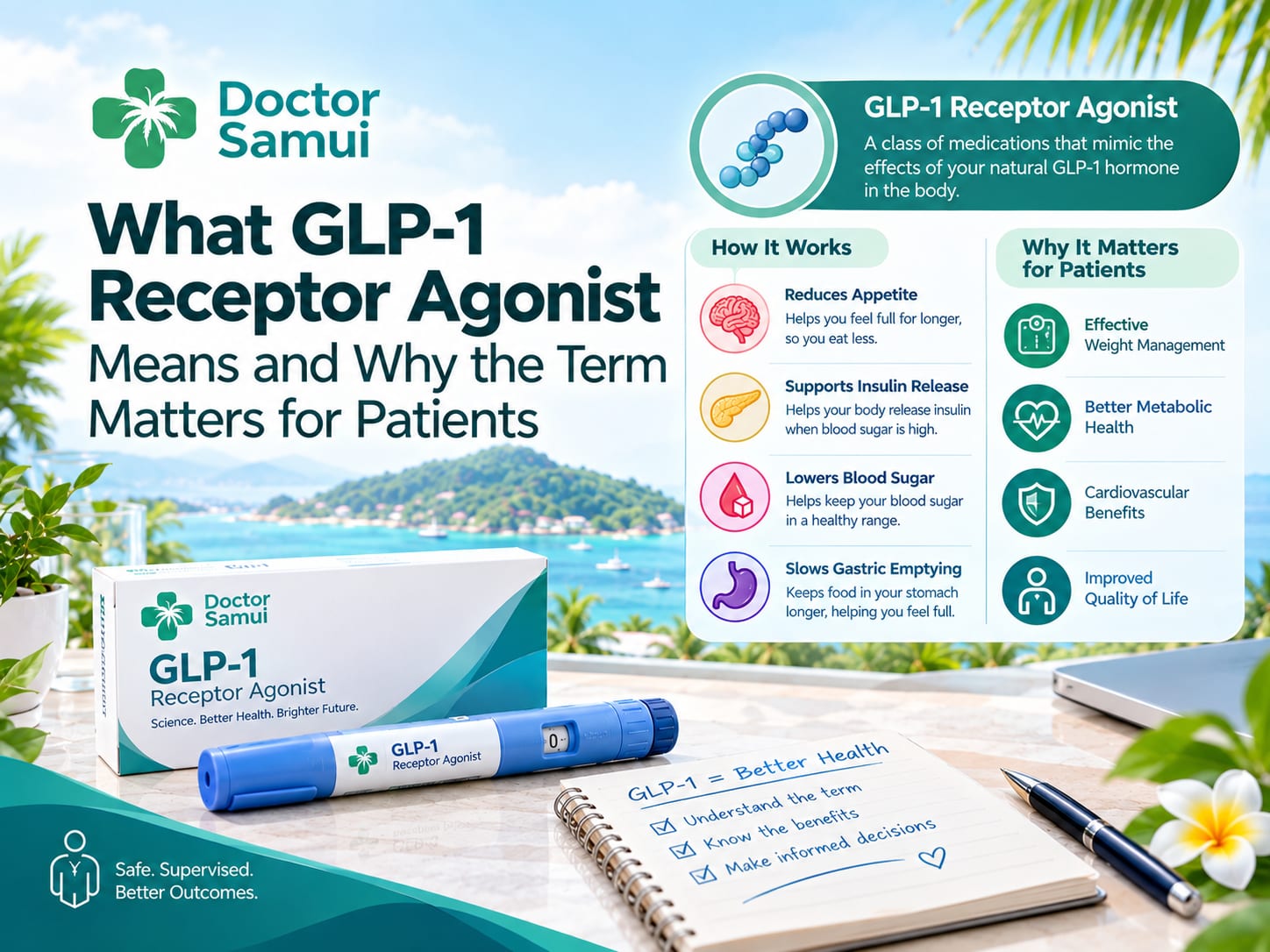
A GLP-1 receptor agonist is a prescription medication that mimics glucagon-like peptide-1, a hormone your gut releases after eating. The drug binds the same receptors as that hormone but resists breakdown, so it keeps working for hours or days instead of minutes. This class includes semaglutide and liraglutide, used for type 2 diabetes and weight management. Because it only stimulates insulin release when blood sugar is already elevated, the risk of low blood sugar is much lower than when using insulin alone.
You have been managing your weight and blood sugar for two years back home. Your doctor started you on semaglutide, your numbers improved, and then you moved to Phuket long-term or booked a three-month stay. Now your supply is running low, your home GP is ten time zones away, and a Thai pharmacist is asking whether you have a local prescription. The drug name is on the box. The term on the box is "GLP-1 receptor agonist." You want to know what that actually means before walking into any clinic here.
That term is not just a label. It tells you how the drug works, why it behaves differently from insulin, and what to expect when you start, stop, or change doses. Understanding it helps you have a better conversation with any doctor, whether at home or at a walk-in clinic in Patong.

Why "Agonist" Is the Key to Understanding This Drug Class
An agonist is a molecule that binds to a receptor and activates it. GLP-1, short for glucagon-like peptide-1, is a hormone your gut makes after you eat. It binds GLP-1 receptors in the pancreas and brain, triggering insulin release and reducing appetite. The problem is it breaks down within minutes. It does not last long enough to be useful as a medicine.
A GLP-1 receptor agonist is a synthetic molecule engineered to bind that same receptor and activate it, but resist the enzyme that destroys natural GLP-1. That resistance is what makes the drug work. Weekly semaglutide stays active for days. Daily liraglutide stays active for roughly 24 hours.
The word "agonist" matters practically because the drug only stimulates insulin release when your blood glucose is already elevated. It does not force insulin out at a fixed rate the way some older diabetes drugs do. This is why low blood sugar, called hypoglycaemia, is uncommon when a GLP-1 receptor agonist is used on its own.
The Drugs in This GLP-1 Receptor Agonist Class
The class includes several approved medications. Semaglutide is available as a weekly subcutaneous injection under brand names including Ozempic for type 2 diabetes and Wegovy for weight management. Liraglutide is a daily injection, sold as Victoza for diabetes and Saxenda for weight management. Dulaglutide and exenatide are also in this class.
Oral options now exist. Oral semaglutide at lower doses has been available for several years under the brand Rybelsus. A higher-dose oral semaglutide formulation received approval in late 2025. Orforglipron, the first oral non-peptide small molecule GLP-1 receptor agonist, received regulatory approval in 2026. This matters for patients who cannot or prefer not to inject.
All of these are prescription-only in Thailand. Availability in Phuket varies by pharmacy and clinic stock. A prescription refill in Phuket requires a clinical assessment first, not just the box from your home country.

What the Drug Does, in Plain Terms
After a dose, GLP-1 receptors in your pancreas receive a signal. Your pancreas releases insulin in response to the glucose already in your blood. At the same time, glucagon, the hormone that raises blood sugar, gets suppressed. Your stomach empties more slowly. Your brain receives a satiety signal, and your appetite falls.
You are not adding a chemical that forces a fixed response. You are prolonging a signal your body already uses. The slower stomach emptying is also why nausea is the most common side effect, especially early on. For most patients this settles within a few weeks of each dose increase.
Benefits Beyond Blood Sugar and Weight
The evidence for this class has grown well past diabetes control and the number on the scale. Large cardiovascular outcome trials, including LEADER for liraglutide and SUSTAIN-6 and SELECT for semaglutide, showed reductions in major cardiovascular events in high-risk patients. The FLOW trial reported kidney-protective effects for semaglutide in people with type 2 diabetes and chronic kidney disease.
Liver fat reduction in metabolic-associated steatotic liver disease has also been documented in clinical trials for semaglutide. These findings are real factors in a prescribing decision, not a side bonus. They are not, on their own, a reason to start without specialist guidance.
Who Is a Candidate and Who Should Not Use These Drugs
GLP-1 receptor agonists are approved for adults with type 2 diabetes where lifestyle changes and other medications have not been sufficient. Higher-dose formulations are approved for chronic weight management in adults with obesity, or with overweight plus at least one weight-related condition such as high blood pressure or metabolic syndrome, even without diabetes.
People with a personal or family history of medullary thyroid carcinoma or multiple endocrine neoplasia syndrome type 2 should not use this class. Those with a history of pancreatitis should discuss the risk carefully with a physician before starting. These drugs are not approved for type 1 diabetes. Pregnancy and breastfeeding are contraindications.
If you are considering starting this medication while in Phuket, a health check-up at Takecare Clinic Phuket gives a physician the baseline picture needed to make that call safely.
Side Effects and When to Get Medical Review
Nausea, vomiting, and diarrhea are most pronounced during dose escalation. Eating smaller meals, avoiding high-fat food around injection time, and staying well hydrated all reduce the severity. For most patients these symptoms ease within several weeks.
Vomiting that persists beyond 48 hours, severe abdominal pain, or any sign of dehydration in Phuket’s heat are reasons to seek same-day care. Dehydration can progress faster here than in a temperate climate. What feels manageable on day one can become significant by day two if you are not replacing fluids.
Serious but uncommon risks include pancreatitis and gallbladder disease. Severe upper abdominal pain radiating to the back, often with nausea, warrants urgent assessment. If you are unsure, an emergency doctor in Phuket can assess you quickly.
Starting or Continuing GLP-1 Therapy in Phuket
Long-stay expats in Chalong or Bang Tao without a registered GP in Thailand face a real gap here. Most pharmacies will not dispense semaglutide or liraglutide without a local prescription. Bringing documentation from your home doctor, including your diagnosis, current dose, and prescription history, helps significantly.
Tourists who run out mid-trip and long-stay residents needing ongoing management can walk into Takecare Clinic Phuket in Patong without an appointment. An English-speaking doctor in Phuket can review your history, confirm whether continuing or initiating this class is appropriate, and where the medication is available locally, assist with a prescription. For anyone starting for the first time, a blood test in Phuket covering glucose, HbA1c, kidney function, and lipids is the normal first step before any GLP-1 prescription is written.
Need to continue a GLP-1 prescription in Phuket, start a clinical assessment, or get a blood test before your first dose? Takecare Clinic Phuket is open for walk-in visits in Patong, no appointment needed. Our English-speaking physician team serves patients from Bang Tao and Kamala to Rawai and Phuket Town. Bring your existing prescription or medication box if you have it. We will take it from there.
Frequently Asked Questions
Dr. Ponlawat Pitsuwan
Physician, Takecare Medical Clinic Phuket
a walk-in medical clinic based in Patong with no appointment needed and English-speaking physician care for the whole island. He sees tourists, expats, and long-stay residents across Phuket for chronic disease management, metabolic health, and ongoing prescription support including GLP-1 receptor agonist therapy. His focus is straightforward, evidence-based care delivered in plain language.
References
- Marso SP, et al. Liraglutide and Cardiovascular Outcomes in Type 2 Diabetes (LEADER Trial). N Engl J Med. 2016;375(4):311-322.
- Marso SP, et al. Semaglutide and Cardiovascular Outcomes in Patients with Type 2 Diabetes (SUSTAIN-6). N Engl J Med. 2016;375(19):1834-1844.
- Lincoff AM, et al. Semaglutide and Cardiovascular Outcomes in Obesity without Diabetes (SELECT Trial). N Engl J Med. 2023;389(24):2221-2232.
- Perkovic V, et al. Semaglutide and Kidney Outcomes in Patients with Type 2 Diabetes and Chronic Kidney Disease (FLOW Trial). N Engl J Med. 2024;391(2):109-121. DOI: 10.1056/NEJMoa2403347
The information in this article is for educational purposes only and does not constitute medical advice. It should not be used to self-diagnose or replace a consultation with a qualified physician. If you have concerns about your health, contact a licensed medical professional. For appointments at Takecare Clinic Phuket, visit takecareclinicphuket.com.
