
Clinically reviewed by Dr. Ponlawat Pitsuwan, Physician, Takecare Clinic Phuket.
Last reviewed: October 2026
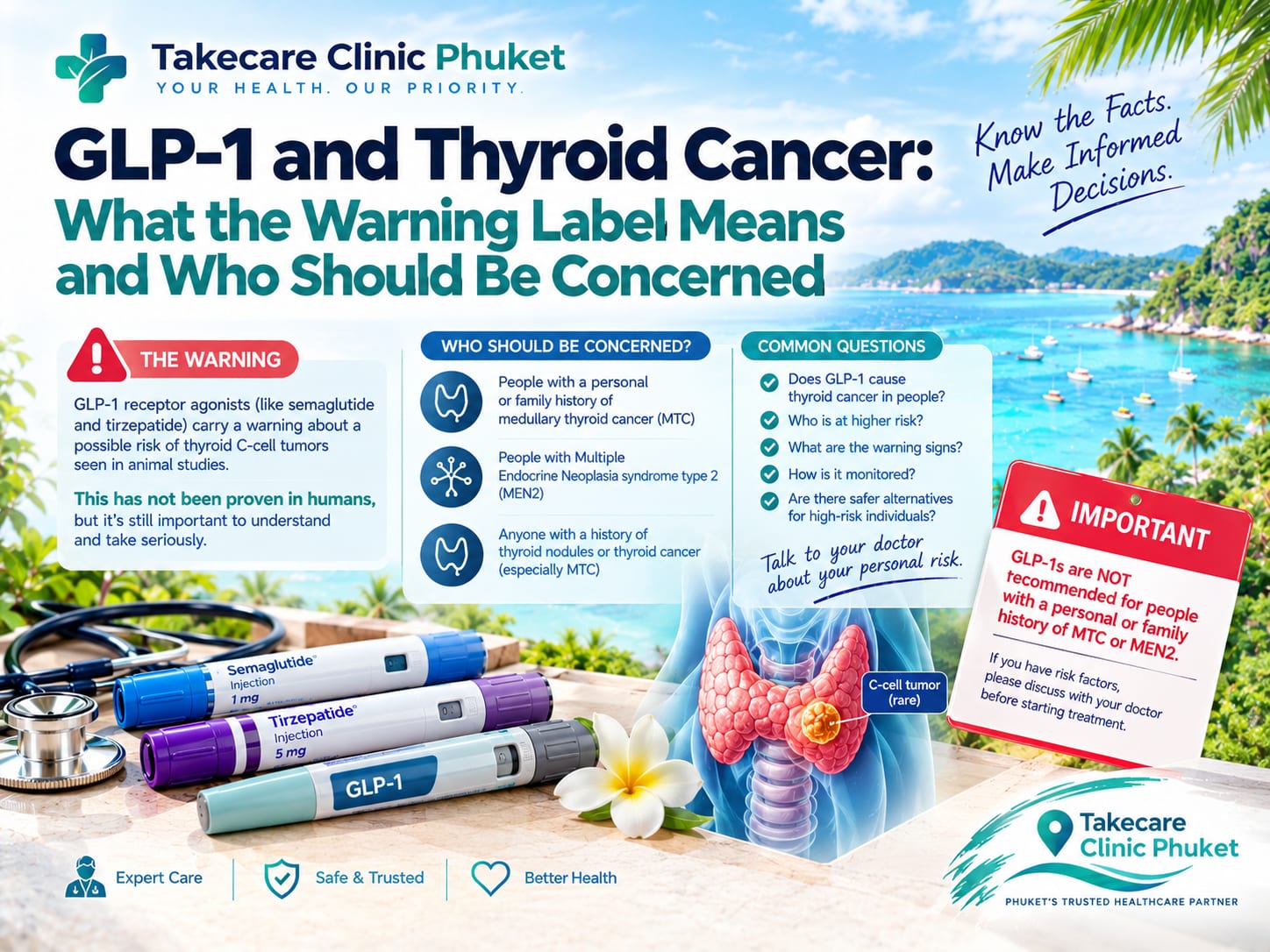
The GLP-1 thyroid cancer black box warning covers one specific and rare cancer type: medullary thyroid carcinoma. It does not apply to papillary or follicular thyroid cancer, which account for the large majority of all thyroid cancer diagnoses. The warning is based on animal studies, and current human evidence does not show an increased risk of medullary thyroid carcinoma in people using GLP-1 drugs. Anyone with a personal or family history of medullary thyroid carcinoma or multiple endocrine neoplasia type 2 should not use these medications.
You are three weeks into a longer stay in Phuket, managing your weight with semaglutide prescribed before you left home. The medication is working. Then you actually read the label, properly, for the first time. There it is: a warning about thyroid cancer, right at the top. You are sitting in your villa in Rawai wondering whether to stop the injections before your next dose.
Most people who read that warning are not in the group it was written for. But "most" is not the same as "all," and a label warning deserves a proper explanation. Here is what it actually says, why it exists, and what it means depending on your own thyroid history.

Which Types of Thyroid Cancer Does the GLP-1 Warning Actually Cover
This is the part most people miss, and it matters.
The thyroid has different cell types. The most common thyroid cancers, papillary and follicular carcinoma, arise from follicular cells and together account for the large majority of all thyroid cancer diagnoses. The GLP-1 black box warning has nothing to do with these.
The warning targets medullary thyroid carcinoma, a rare cancer that arises from C-cells, a different cell type entirely. If you had papillary thyroid cancer in the past, the warning is not describing you.
The warning also covers multiple endocrine neoplasia type 2, known as MEN2. This is a genetic condition that carries a strongly elevated lifetime risk of medullary thyroid carcinoma. A personal diagnosis of MEN2, or a first-degree family member with it, puts you in the contraindicated group.
Why the GLP-1 Thyroid Cancer Warning Exists
The warning came from pre-approval animal studies. When rodents were given liraglutide and similar GLP-1 drugs at high doses, they developed C-cell tumors and eventually medullary thyroid carcinoma.
The reason this did not end drug development is that rat C-cells behave differently from human C-cells. Rats have a far higher density of GLP-1 receptors on their C-cells than humans do. The stimulus that drives tumor growth in a rat thyroid does not map directly onto human thyroid biology.
The FDA required the black box warning because the animal signal was real and because medullary thyroid carcinoma, though rare, is serious. That was the right call. It does not mean the risk has been confirmed in humans.

What the Human Evidence Shows
Large-scale human studies have not shown an increased risk of medullary thyroid carcinoma in GLP-1 users. A Scandinavian registry cohort study published in the BMJ in 2024 found no elevated risk of thyroid cancer overall in people using GLP-1 receptor agonists, though the authors noted that small risk increases could not be fully ruled out.
An earlier French observational study did report an apparent thyroid cancer signal, including for the medullary subtype. Detection bias has been proposed as one explanation: patients starting a GLP-1 drug receive more medical monitoring overall, so cancers that might otherwise have gone undetected for years are found earlier. Residual confounding from obesity, a thyroid cancer risk factor more common in GLP-1 users, has also been raised. The signal remains debated. Patients starting a GLP-1 drug receive more medical monitoring overall, so neck imaging and blood tests are ordered more often. Cancers that might otherwise have gone undetected for years are found earlier. That is a surveillance effect, not a causal one.
No randomized controlled trial of a GLP-1 drug, including the large cardiovascular outcome trials for semaglutide and liraglutide, has reported a confirmed case of medullary thyroid carcinoma in a study participant.
Which GLP-1 Drugs Carry the Warning
All approved GLP-1 receptor agonists carry the same boxed warning. This includes semaglutide (Ozempic, Wegovy, Rybelsus), liraglutide (Victoza, Saxenda), dulaglutide (Trulicity), and tirzepatide (Mounjaro, Zepbound), which acts on both GLP-1 and GIP receptors.
The warning is a drug-class label requirement, not a finding tied to one molecule. Switching between these drugs to avoid the warning is not a solution. They all carry it.
If You Already Have a Thyroid Condition
Having a thyroid condition does not automatically rule out GLP-1 treatment. The type is what matters.
If you have hypothyroidism managed with levothyroxine, there is a practical issue. GLP-1 drugs slow gastric emptying. This can delay how quickly levothyroxine is absorbed, which may shift your thyroid hormone levels. Take your levothyroxine on an empty stomach, well before any other medication or food, and have your TSH checked around six to eight weeks after starting a GLP-1 drug. Takecare Clinic Phuket can arrange a blood test in Phuket the same day, walk-in, no appointment needed.
If you have benign thyroid nodules or a history of Hashimoto’s thyroiditis, these are not automatic contraindications. A physician should still review your case before prescribing.
If you have a personal or family history of medullary thyroid carcinoma, or a confirmed MEN2 diagnosis, do not take GLP-1 drugs. This is an absolute contraindication on every current label.
Do You Need Routine Calcitonin Monitoring While on a GLP-1
Calcitonin is a hormone produced by C-cells. Elevated calcitonin can be a marker for medullary thyroid carcinoma, so the question of routine monitoring comes up often.
Current clinical guidelines do not recommend routine calcitonin screening for all GLP-1 users. The standard pre-treatment step is a history check for MEN2 and medullary thyroid carcinoma, which a physician does before prescribing. Routine calcitonin testing is not standard unless there is a specific clinical reason.
What does warrant prompt review: a new lump in your neck, persistent hoarseness, difficulty swallowing, shortness of breath, or neck pain that radiates toward your ear. These are uncommon in GLP-1 users, but they should not be waited out at home. A calcitonin blood test and a clinical neck exam can be arranged the same day, walk-in, at Takecare Clinic Phuket in Patong.
What This Means for Expats and Longer-Stay Visitors in Phuket
It is not uncommon for someone to arrive in Phuket having sourced a GLP-1 prescription online or from a clinic abroad, with their thyroid history never reviewed in person. They are a few months into treatment, the weight loss is going well, and they are reading the warning label for the first time because a friend mentioned it.
If that describes your situation, the practical steps are straightforward. Have a physician review your personal and family history for MEN2 and medullary thyroid carcinoma. If you have thyroid nodules previously seen on imaging, bring those records. If you take levothyroxine, have your TSH checked here. If you have no relevant thyroid history at all, you are almost certainly not in the contraindicated group, but that should be confirmed by a doctor, not assumed from reading online.
For anyone needing a prescription refill in Phuket for a GLP-1 medication started legally abroad, the clinic can review and arrange continuation once the relevant screening steps are completed. For patients across the island, from Surin and Bang Tao in the north to Chalong and Nai Harn in the south, the same consultation is available through our doctor on-call service in Phuket, with an English-speaking physician and no prior appointment required.
A health check-up in Phuket that includes thyroid function, calcitonin where clinically indicated, and a medication review is a sensible baseline for anyone managing a chronic condition during a longer stay on the island.
Taking a GLP-1 drug and unsure whether your thyroid history has been properly reviewed? Takecare Clinic Phuket offers walk-in consultations with an English-speaking physician, no appointment needed. We can review your history, arrange same-day blood tests including calcitonin and TSH where clinically appropriate, and confirm whether your current treatment is suitable. Serving patients across the island, from Patong and Kata to Rawai, Chalong, Bang Tao, and Phuket Town. Visit us at takecareclinicphuket.com or call to reach our on-call physician from anywhere on the island.
FAQ
Dr. Ponlawat Pitsuwan
Physician, Takecare Medical Clinic Phuket
a walk-in medical clinic based in Patong with English-speaking physician care available across the whole island. He sees tourists, expats, and residents for ongoing chronic disease management, GLP-1 suitability assessments, thyroid-related concerns, and general medical care. His approach is straightforward, evidence-based care explained in plain language.
References
- Pasternak B, et al. Glucagon-like peptide 1 receptor agonist use and risk of thyroid cancer: Scandinavian cohort study. BMJ. 2024 Apr 10;385:e078225.
- Bezin J, et al. GLP-1 Receptor Agonists and the Risk of Thyroid Cancer. Diabetes Care. 2023;46(2):384-390.
- U.S. Food and Drug Administration. Mounjaro (tirzepatide) injection — Prescribing Information. FDA.gov, 2026.
The information in this article is for educational purposes only and does not constitute medical advice. It should not be used to self-diagnose or replace a consultation with a qualified physician. If you have concerns about your health, contact a licensed medical professional. For appointments at Takecare Clinic Phuket, visit takecareclinicphuket.com.
