
Clinically reviewed by Dr. Ponlawat Pitsuwan, Physician, Takecare Clinic Phuket.
Last reviewed: October 2026
2.4 mg weekly is the maximum approved dose of Wegovy (semaglutide). Once you reach it, you stay there. Weight loss often continues for months at this dose, but most people eventually plateau. That plateau is not treatment failure. It is the body finding a new defended weight, and it signals the start of a maintenance phase, not the end of treatment. What you do next depends on how much you lost, how you feel, and whether you have medical support managing the next step.
You have been on Wegovy for almost a year. You started at 0.25 mg, worked your way up through each dose step, and you have been injecting 2.4 mg every week for the last few months. You are sitting in your villa in Laguna, or a long-stay apartment in Rawai, and the scale has barely moved in six weeks. Your appetite is still suppressed. You are eating less than you ever have. And yet the number is stuck.
You are wondering if the medication has stopped working, if there is a higher dose you can request, or whether you should just stop.
Those are exactly the right questions. The plateau you are hitting at the Wegovy maximum dose is expected, documented in the clinical trials, and manageable. The decisions you make from here matter more than the plateau itself.

The Titration Path to 2.4 mg
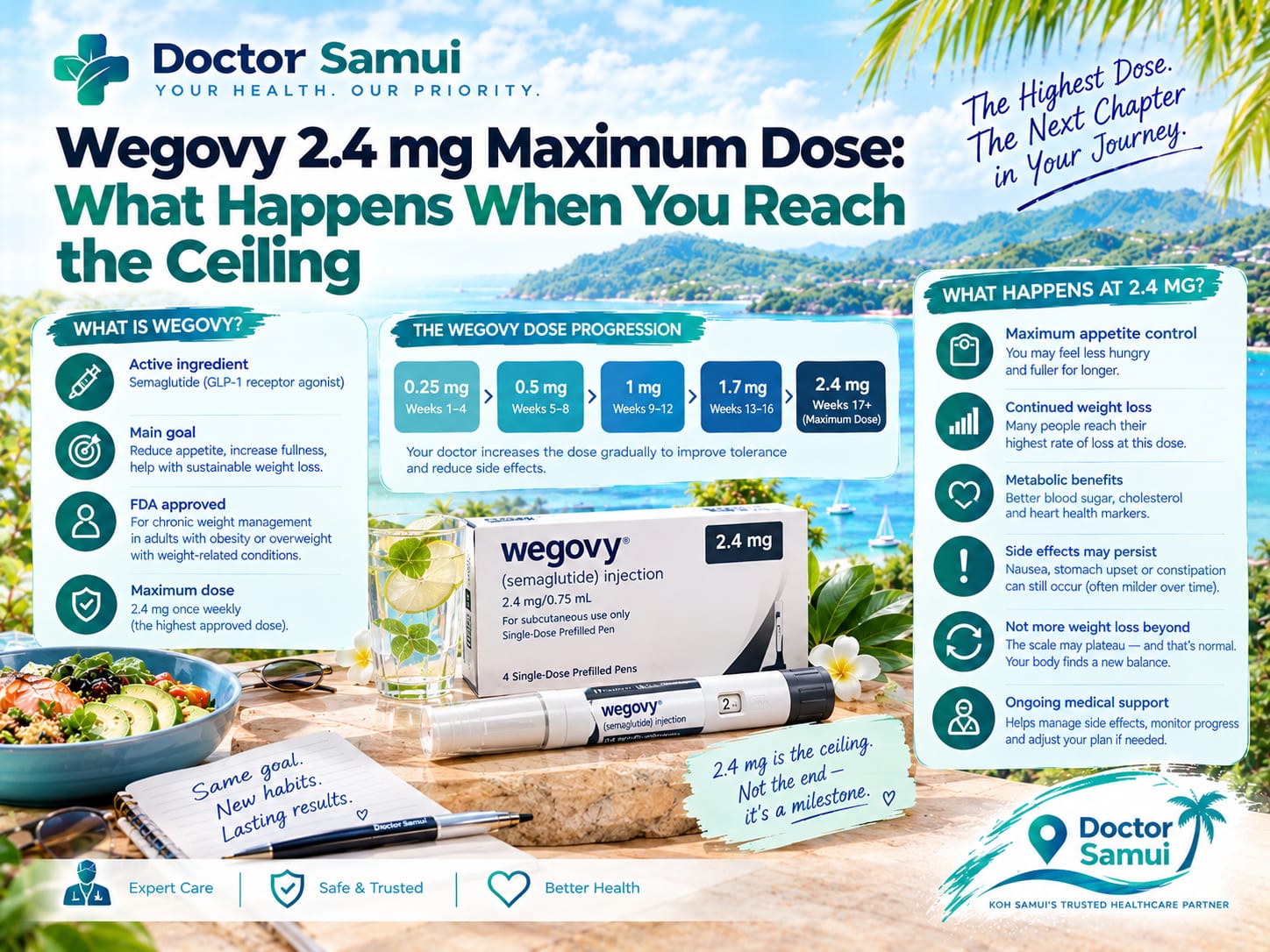
You do not start Wegovy at 2.4 mg. The prescribing label sets out a stepwise escalation: 0.25 mg weekly to start, increasing every four weeks through 0.5 mg, 1.0 mg, 1.7 mg, and finally to 2.4 mg. The slow escalation is deliberate. It reduces nausea, vomiting, and the GI side effects that push many people to stop early.
Most people reach the maintenance dose somewhere between weeks 16 and 20, depending on tolerability. If nausea or vomiting made a step difficult, holding that dose for an extra four weeks before escalating is reasonable. Rushing the schedule does not improve weight loss and increases side effects meaningfully.
2.4 mg is both the ceiling and the target. There is no step above it.
What the STEP Trials Show at the Wegovy Maximum Dose
The STEP 1 trial followed adults with obesity or overweight over 68 weeks on 2.4 mg semaglutide alongside lifestyle intervention. Mean body weight loss was approximately 15% of starting weight in the active treatment group, compared to around 2.4% in the placebo group.
STEP 5 extended this out to two years. Weight loss continued beyond the first year, though at a slower pace. Most of the total weight loss had occurred by weeks 60 to 68, and the curve flattened after that.
Two things worth understanding here. The trials show averages, and individual results vary considerably. The plateau in the second year is not a sign that semaglutide has lost its effect. It reflects the body reaching a new defended weight.

Why Weight Loss Slows at the 2.4 mg Ceiling
This is the part most people are not told clearly. Your body does not passively accept weight loss. As you lose weight, your resting metabolic rate drops, your body becomes more efficient with calories, and hormones that drive hunger increase. These responses are physiological, not psychological.
Semaglutide works partly by reducing appetite signals and slowing gastric emptying. At 2.4 mg, it is already at the maximum dose for the subcutaneous injection formulation. Your body’s counter-response eventually balances the drug’s effect, and you reach a new weight set point.
Staying at that set point while on 2.4 mg is not failure. It is the medication doing what it was designed to do.
Side Effects That Become More Prominent at 2.4 mg
Nausea is the most commonly reported side effect at the maximum dose. In the STEP trials, most participants described it as mild to moderate and time-limited. For most people it settles within the first few weeks at each new dose step.
Constipation is also frequently reported at the maintenance dose. Eating less reduces gut motility, and semaglutide slows gastric emptying further. Staying hydrated and keeping up dietary fibre matters more at this dose than at lower ones.
One risk that does not get enough attention: under-eating at 2.4 mg can lead to muscle mass loss alongside fat loss. If your total calorie intake drops very low and protein intake is inadequate, a meaningful portion of what you lose may be lean muscle rather than fat. This is worth discussing with your prescribing clinician, particularly if you are not already tracking protein intake.
Your Options After the Ceiling: Stay, Shift, or Stop
A plateau at 2.4 mg is the moment most people need a proper clinical review, not a self-directed decision. There are three real paths.
The first is staying on 2.4 mg as a maintenance dose. If you have lost a clinically meaningful amount of weight and your health markers have improved, continuing at this dose preserves those gains. The STEP 1 extension data showed that people who stopped semaglutide after 68 weeks regained approximately two thirds of their lost weight within one year of stopping. Stopping without a plan carries real risk. Wegovy should not be used by people with a personal or family history of medullary thyroid carcinoma or multiple endocrine neoplasia syndrome type 2, and anyone who develops severe or persistent abdominal pain should be assessed by a doctor promptly.
The second is adjusting lifestyle alongside the current dose. Resistance training during semaglutide therapy has evidence supporting muscle mass preservation and can improve body composition even when the scale is not moving. A review of protein intake and exercise patterns is often productive at this stage.
The third path, for patients who have responded poorly or plateaued early, is considering a switch to tirzepatide, which acts on both GLP-1 and GIP receptors. Head-to-head trial data has shown greater mean weight loss with tirzepatide. A switch is a clinical decision: dosing restarts from the beginning of the escalation schedule, and a prescribing clinician needs to assess whether the switch is appropriate for your history. You can read more about what a Wegovy plateau at 2.4 mg means for your options if you are considering what to do next.
Managing Your Wegovy 2.4 mg Prescription in Phuket
This matters specifically if you are living in or visiting Thailand. Wegovy has received Thai FDA approval and is available by prescription at licensed private clinics. A regulation introduced in 2025 made weight-loss injection pens prescription-only, responding to a growing supply of counterfeit products. If you are sourcing semaglutide through any channel that does not involve a doctor’s prescription and a licensed pharmacy, you are taking a risk that goes beyond efficacy.
For long-stay expats in areas like Cherng Talay, Bang Tao, or Chalong who reached 2.4 mg under a home-country doctor, the practical question is continuity of care without flying home. Takecare Clinic Phuket offers prescription refill consultations for ongoing medical treatment and can review your GLP-1 treatment plan at a walk-in visit. Bring your dosing records and any blood work from your previous provider.
If you are experiencing symptoms at the maximum dose that are not settling, persistent nausea, significant fatigue, or GI symptoms that are getting worse rather than better, a walk-in doctor in Phuket can assess whether a medication review is warranted before your next scheduled check-in. A blood test in Phuket may also be appropriate if you have not had baseline labs reviewed since starting GLP-1 therapy.
Need your Wegovy 2.4 mg managed while living in or visiting Phuket? Walk in to Takecare Clinic Phuket at 34/14 Prachanukhro Rd, Patong, no appointment needed. Speak directly with an English-speaking physician who can review your current treatment plan, assess whether a medication or lifestyle adjustment is appropriate, and provide prescription support for ongoing GLP-1 therapy. We see patients from across the island, from Bang Tao and Laguna to Rawai and Chalong.
Frequently Asked Questions
Dr. Ponlawat Pitsuwan
Physician, Takecare Medical Clinic Phuket
a walk-in medical clinic based in Patong with no appointment needed and English-speaking physician care for the whole island. He sees tourists, expats, and residents across Phuket for chronic disease management, prescription reviews, and ongoing treatment planning including GLP-1 weight management therapy. His focus is straightforward, evidence-based care delivered in plain language.
References
- Wilding JPH et al. Once-Weekly Semaglutide in Adults with Overweight or Obesity. New England Journal of Medicine. 2021;384(11):989-1002.
- Wilding JPH et al. Weight regain and cardiometabolic effects after withdrawal of semaglutide: The STEP 1 trial extension. Diabetes Obesity and Metabolism. 2022;24(8):1553-1564.
- Rubino DM et al. Effect of Continued Weekly Subcutaneous Semaglutide vs Placebo on Weight Loss Maintenance in Adults With Overweight or Obesity: The STEP 4 Randomized Clinical Trial. JAMA. 2021;325(14):1414-1425.
- Garvey WT et al. Two-year effects of semaglutide in adults with overweight or obesity: the STEP 5 trial. Nature Medicine. 2022;28:2083-2091.
- Novo Nordisk. Wegovy (semaglutide) Prescribing Information. US FDA. 2023.
- Patikorn C et al. / News coverage: Tirzepatide vs Semaglutide head-to-head SURMOUNT-5 trial results. NEJM. 2025. Reported by Healio Endocrinology, May 2025.
The information in this article is for educational purposes only and does not constitute medical advice. It should not be used to self-diagnose or replace a consultation with a qualified physician. If you have concerns about your health, contact a licensed medical professional. For appointments at Takecare Clinic Phuket, visit takecareclinicphuket.com.
