
Clinically reviewed by Dr. Ponlawat Pitsuwan, Physician, Takecare Clinic Phuket.
Last reviewed: October 2026
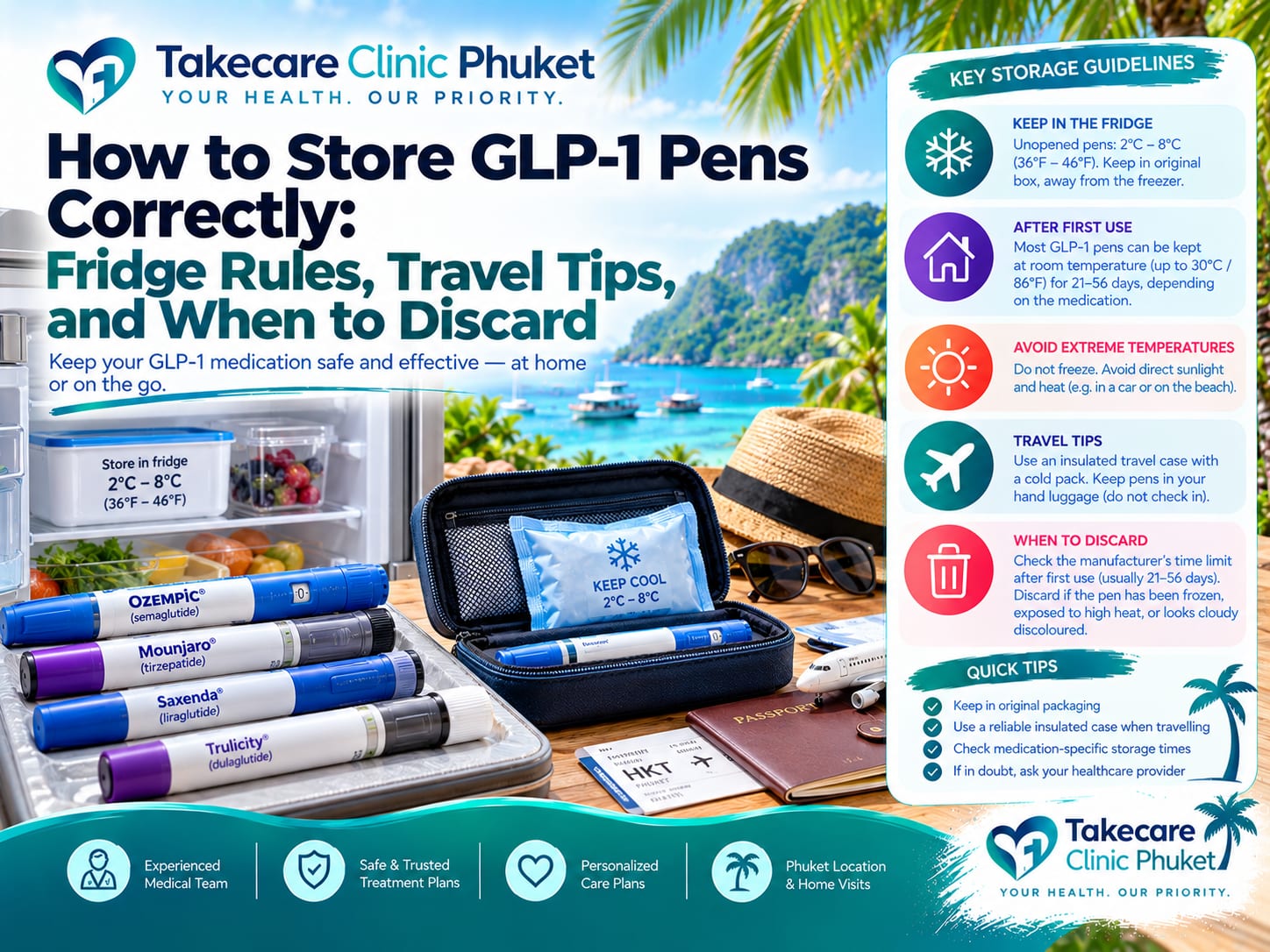
GLP-1 pens like semaglutide (Ozempic, Wegovy) and tirzepatide (Mounjaro) must be kept refrigerated at 2 to 8°C until first use. Once opened, they can be stored at room temperature below 30°C for a product-specific window: up to 56 days for Ozempic, 28 days for Wegovy, and 21 days for Mounjaro. In Phuket’s heat, that room-temperature window shrinks fast. If a pen has been frozen, left in a hot car, or kept in an unreliable hotel mini-fridge, discard it and get a replacement before injecting.
A long-stay resident from Chalong came in with her Ozempic pen, asking whether it was still usable. She had left it in her car outside Lotus’s Thalang for about two hours that morning. The pen looked fine. The liquid was clear. But the car had been sitting in direct sun, and she already knew the answer before she asked.
This kind of situation is worth taking seriously. Not just with residents in Chalong or Thalang, but with medical tourists who flew in from Europe with a month’s supply, expats in Bang Tao managing their weight without a home GP, and visitors who spent an afternoon at Kata beach with their medication bag in an open locker. GLP-1 pens are temperature-sensitive in a way that matters here, and Phuket’s heat adds risks that a temperate-climate pharmacy label simply does not cover.
Why Phuket’s Heat Damages Your GLP-1 Pen
GLP-1 medications are built from protein chains. Heat and freezing both break those chains down in ways you cannot see with the naked eye. People with a personal or family history of medullary thyroid carcinoma or multiple endocrine neoplasia syndrome type 2 should not use GLP-1 receptor agonists. Always confirm suitability with a doctor before starting.
That is the part that catches people out. A damaged pen usually looks fine. The liquid stays clear. The pen clicks and doses normally. But the active molecule has degraded, and the injection you give yourself delivers a weakened or inactive dose. No immediate side effects. No change at the injection site. Your medication has simply stopped working.
Outdoor temperatures in Phuket sit at 30 to 35°C year-round. A parked car, even in the shade, can exceed 40°C within minutes. If you are on a motorbike or a songthaew, there is no temperature-controlled space for your bag. Humidity regularly exceeds 80%. The conditions for protein degradation are present every single day on this island, not just during a heatwave.
How to Store a GLP-1 Pen: Rules by Pen Type
These figures come from manufacturer prescribing information. Always check the label for your specific product, as batch instructions can vary.
| Pen | Unopened storage | In-use room-temperature window | Maximum room temperature |
|---|---|---|---|
| Ozempic (semaglutide) | 2-8°C refrigerated | Up to 56 days | Below 30°C |
| Wegovy (semaglutide) | 2-8°C refrigerated | Up to 28 days | Below 30°C |
| Mounjaro (tirzepatide) | 2-8°C refrigerated | Up to 21 days | Below 30°C |
| Zepbound (tirzepatide) | 2-8°C refrigerated | Up to 21 days | Below 30°C |
Compounded semaglutide, which some Phuket expats and medical tourists source through Thai compounding pharmacies, does not follow the same rules. Compounded products typically have refrigeration-only requirements and shorter use-by windows. Keep a compounded product refrigerated at all times and check its label for the specific expiry.
One thing most people miss: for Ozempic, the in-use clock starts from the date of first injection, not from when the pen first leaves the fridge. Discard the pen 56 days after that first use, whether kept at room temperature or back in the fridge. For Ozempic, the 56-day clock starts at first injection. For Wegovy, which comes as a single-dose pen, the pen should be discarded after use; if kept unrefrigerated before use, discard it after 28 days at room temperature even if unused.

Phuket Hotel Fridges Are Not Reliable Storage
Hotel mini-fridges are a separate problem worth knowing about. Many are set colder than 2°C, or they cycle unpredictably. Placing your pen against the back wall or near the cooling element risks freezing it.
A frozen pen is a discarded pen. Do not inject from a pen that has frozen and thawed, even if it looks completely normal.
If you are in a villa or guesthouse with an unreliable power supply, overnight power cuts mean the pen may have been sitting at ambient temperature for hours without you knowing. The practical fix is simple: buy a small thermometer at any pharmacy in Patong or Phuket Town, check the fridge temperature before storing medication, and ask the front desk for access to a standard bar fridge if the mini-fridge is not reliable. Keep the pen in an insulated travel pouch with a cool pack that does not touch the pen directly. Take it out about an hour before injection so it warms gradually.
Airport and In-Flight Rules for Travelling with a GLP-1 Pen
Always carry your GLP-1 pen in your carry-on luggage. Never in checked bags. Aircraft cargo holds are not temperature-controlled. They can drop below freezing on long-haul routes and rise above 30°C on the ground. A flight from Europe or Australia to Phuket via Bangkok is more than enough time to freeze or overheat an unprotected pen in the hold.
At Phuket International or Suvarnabhumi, injectable pens are allowed through Thai customs with an original pharmacy label in your name or a prescription from your doctor. Carry a brief letter from your doctor if you are bringing more than one pen. Thai customs generally allows quantities consistent with personal use for the trip duration. Compounded semaglutide may receive closer scrutiny: carry documentation from the compounding pharmacy alongside your doctor’s letter.
GLP-1 pens are medical liquids and are generally exempt from the 100ml carry-on rule with the right documentation. Screening procedures vary by country of departure, so check with your airline before you fly.
When to Discard Your GLP-1 Pen
Do not inject from a pen if any of the following apply. The pen has been frozen, even once. The liquid appears cloudy, discoloured, or has visible particles. It should be clear and colourless or nearly so. The pen was stored above 30°C for any period, including a car, a beach bag left in the sun at Kata, or an outdoor locker. The in-use window has expired from the date it first left the fridge. The pen is past its printed expiry date. The pen was dropped and the cartridge or mechanism may be damaged.
If you are unsure, that uncertainty is reason enough not to inject. A degraded dose does not usually cause immediate harm, but it means your medication is not working. For someone managing blood sugar or a metabolic condition, a missed effective dose matters.
Getting Help in Phuket When Something Goes Wrong
If you think your pen has been compromised, come in to Takecare Clinic Phuket in Patong. No appointment needed. An English-speaking doctor can review your situation, confirm whether it is safe to continue on your current supply, and help with next steps.
For patients who cannot easily get to Patong from Nai Harn, Kamala, or Laguna, you can find out about how to keep your GLP-1 pen cool in Thailand via the clinic’s doctor-on-call service. If the advice is that you need a replacement, a prescription refill in Phuket through Takecare Clinic gives you a documented, pharmacy-valid prescription on the island. Patients managing a chronic condition with GLP-1 therapy may also want to arrange a health check-up in Phuket while they are here rather than waiting until they return home.
Disposal matters too. Used needles should never go into a hotel bin. Use a portable sharps container or a sealed hard-sided bottle. Ask at the clinic or a local pharmacy about safe sharps disposal in Phuket.
If your GLP-1 pen has been exposed to heat, frozen, or you are not sure whether it is still safe to use, come in to Takecare Clinic Phuket in Patong. No appointment needed. An English-speaking doctor can advise on your pen’s safety, help with a prescription refill, and support ongoing GLP-1 management during your time in Phuket. Walk-in care is available for tourists, expats, and residents across the island.
FAQ
Dr. Ponlawat Pitsuwan
Physician, Takecare Medical Clinic Phuket
a walk-in medical clinic based in Patong with no appointment needed and English-speaking physician care available to the whole island. He sees tourists, expats, and residents for prescription management, ongoing chronic disease support, and GLP-1 therapy guidance including storage advice, prescription refills, and follow-up care during a stay in Phuket. His approach is straightforward, evidence-based care delivered in plain language.
References
- Novo Nordisk. Ozempic (semaglutide) US Prescribing Information. Novo Nordisk, current label (DailyMed summary verified 2026-07-12).
- Eli Lilly and Company. Mounjaro (tirzepatide) storage information. Lilly Medical, US label.
- Zepbound (tirzepatide) US Prescribing Information, storage section. MedLibrary reproduction of FDA label.
- Ozempic (semaglutide) storage, in-use guidance. MedLibrary reproduction of FDA label.
- Novo Nordisk. Wegovy (semaglutide) storage. GoodRx summary citing US prescribing information.
The information in this article is for educational purposes only and does not constitute medical advice. It should not be used to self-diagnose or replace a consultation with a qualified physician. If you have concerns about your health, contact a licensed medical professional. For appointments at Takecare Clinic Phuket, visit takecareclinicphuket.com.
