
Clinically reviewed by Dr. Ponlawat Pitsuwan, Physician, Takecare Clinic Phuket.
Last reviewed: October 2026
Switching GLP-1 medications requires restarting at the lowest dose of the new drug, regardless of how long you have been on your previous one. No validated dose conversion exists between semaglutide and tirzepatide. The gap between your last injection and your first new one depends on your specific switch and clinical history, and should be confirmed by a prescriber who knows your full picture.
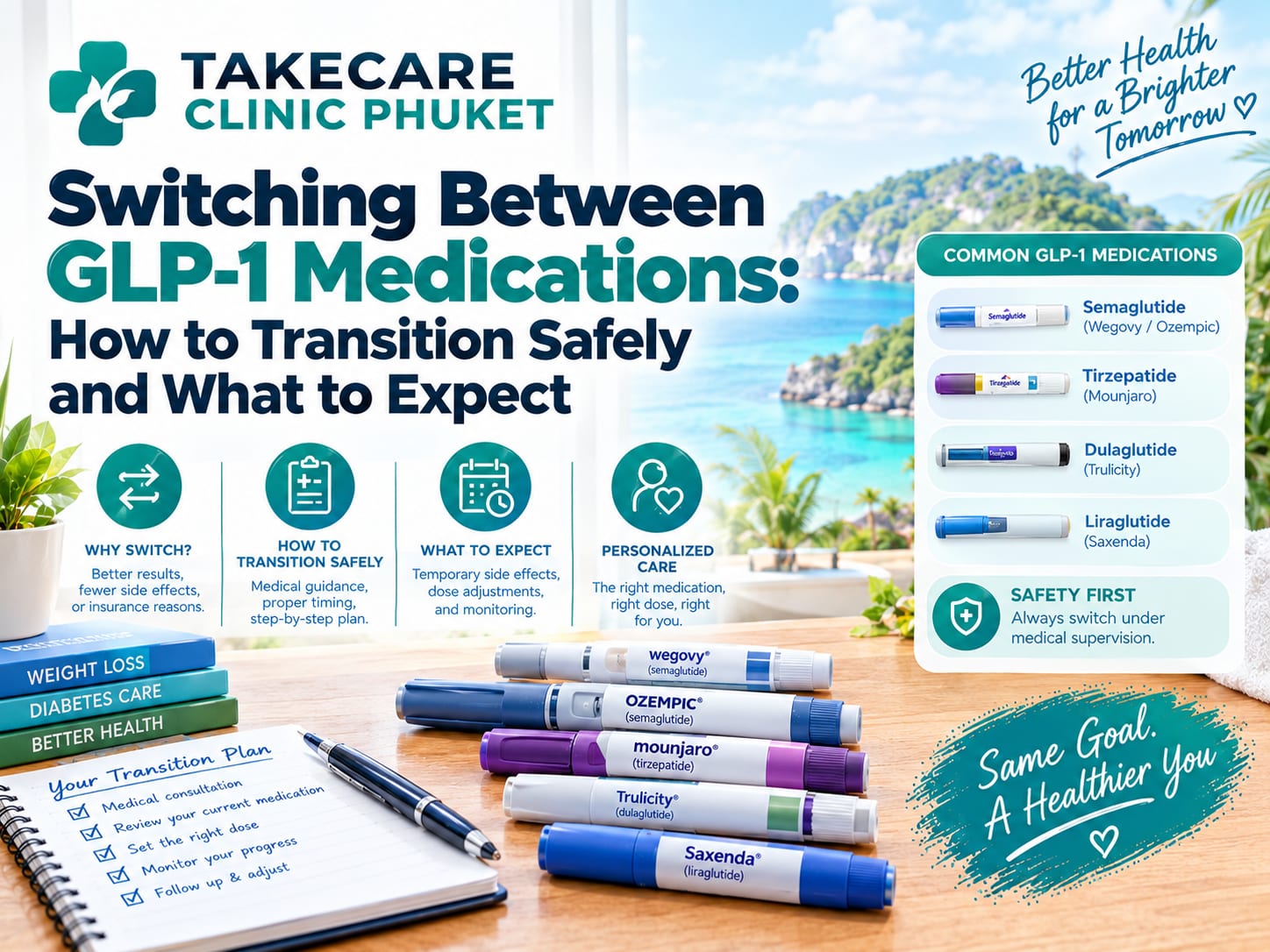
This situation is common. Someone has been on Ozempic or Wegovy for months, it worked, then it stopped working as well. Or the supply dried up. Or they moved to Phuket and the medication they used at home is simply not on the shelf here. They are holding a different injection pen and wondering whether to just start it, how much to take, and whether the nausea they spent weeks pushing through is about to come back.
The direct answer: yes, you restart at the lowest dose. No, there is no conversion chart that safely maps your old dose to a new one. The first few weeks on a new GLP-1 may feel like going back to the beginning, but that does not mean you are losing ground.
Why People Switch GLP-1 Medications
Weight-loss plateaus are the most common reason. After months on semaglutide, some patients stop responding as clearly and move to tirzepatide, which acts on an additional receptor and may produce stronger appetite suppression for some people.
Supply is the other big driver, and this is particularly true in Phuket. Ozempic and Wegovy have had well-documented global shortages. If you arrived here from the US, UK, or Australia managing an ongoing prescription, your exact brand may not be available at local pharmacies this month. Thailand has its own registered formulary, and what your home GP prescribed may not have a direct match here.
Some patients switch because of persistent side effects they never fully shook on their first medication. Others switch because their indication changed. Diabetes management and weight loss use different brand names even when the active ingredient is the same drug.
What Makes Tirzepatide Different from Semaglutide
Semaglutide acts on one receptor type. Tirzepatide activates both GIP and GLP-1 receptors. These are not equivalent mechanisms, and they do not have equivalent potency profiles.
This is why a milligram-for-milligram conversion between the two does not exist. A tirzepatide dose that appears numerically similar to your semaglutide dose is not clinically equivalent. Online dose conversion charts that claim otherwise are not validated, and using one without prescriber guidance risks real over- or under-dosing.
The different receptor mechanism also means your GI tolerance does not transfer. Your gut adapted to semaglutide. It has not adapted to tirzepatide, and that matters for how the switch is managed.

How Dosing Works When You Switch GLP-1 Medications
You always restart at the lowest available dose of the new drug. This is not a punishment for switching. It reflects the fact that your tolerance was built for a specific drug acting on specific receptors, and a new drug resets that curve.
Starting low protects you from the worst GI side effects. Nausea, vomiting, and diarrhoea can return even if you sailed through them on your previous medication. Jumping to a higher dose because you feel experienced with GLP-1s is a well-recognised risk in self-managed transitions.
Your dose is then titrated upward on the standard schedule for the new drug, which your prescriber confirms. Do not skip titration steps to catch up to where you were.
Timing the Switch: Gap Between Your Last Injection and Your First New One
| Switch | Commonly Cited Gap | Key Consideration |
|---|---|---|
| Semaglutide (weekly) to tirzepatide (weekly) | 7 to 14 days after last semaglutide dose | Published guidance varies; prescriber decides based on your side-effect history |
| Tirzepatide (weekly) to semaglutide (weekly) | 7 to 14 days after last tirzepatide dose | Allow prior drug activity to reduce before starting new drug |
| Higher-dose semaglutide to tirzepatide | Prescriber may extend gap | Higher residual drug activity at higher doses warrants clinical assessment |
| Any switch with recent severe GI side effects | Gap may be longer | Allow GI recovery before introducing a new drug |
These are reference ranges from published clinical guidance. Your actual gap must be confirmed by a prescriber who knows your current dose and history. Do not treat this table as a personal prescription.
What to Expect in the First Few Weeks After Switching
Nausea can return. Even patients who felt nothing after their first few weeks on semaglutide may experience renewed nausea on low-dose tirzepatide. This is a known effect of starting a new drug, not a sign the medication is wrong for you.
Some patients notice a temporary increase in hunger or a small weight fluctuation in the first few weeks. Your previous drug was still suppressing appetite up to its last dose. As the new drug builds toward its therapeutic dose, that suppression may briefly dip. This is pharmacology, not failure.
The part that surprises most people is the psychological side. Feeling like you are going backwards after months of progress is genuinely hard. Know that this window is short, and your prescriber can confirm you are on the right track.
Who Should Be Extra Careful When Switching GLP-1 Medications
A switch does not reset contraindications. If you or a close family member has a personal or family history of medullary thyroid carcinoma or multiple endocrine neoplasia syndrome type 2, these drugs are contraindicated regardless of which one you are moving to.
A history of pancreatitis requires careful clinical assessment before starting any GLP-1 medication, including a new one. The same applies to significant chronic kidney disease, where dosing and monitoring need closer oversight.
If you are managing type 2 diabetes alongside weight loss, your blood sugar monitoring plan may need to change when you switch. This is especially important if you are also on other medications that affect glucose levels.
Practical Considerations for Switching GLP-1 Medications in Phuket
Medication availability varies here, and it changes. Ozempic and Mounjaro have had registered availability in Thailand, but stock fluctuates. Wegovy and Zepbound have different regulatory status here than in the US or UK. What your home pharmacy stocked reliably may not be what Phuket pharmacies carry this month.
Cold-chain storage matters too. GLP-1 injections require refrigeration. If you are moving between accommodation or arriving after a long haul, check that your supply has been kept correctly before injecting. This is not a step to skip.
Compounded GLP-1 medications, which are common in the US market, are not legally available in Thailand. If you arrived with compounded semaglutide and need to transition to a registered brand-name product here, that switch requires prescriber oversight to assess your dose history and restart you safely.
If you are a long-stay resident in Chalong, Bang Tao, or Rawai managing ongoing treatment away from your home GP, an English-speaking doctor in Phuket at Takecare Clinic Phuket can review your history, confirm which registered products are currently available, and set a titration plan you can actually follow while you are here. If getting to Patong is not practical, you can also access a prescription refill consultation to arrange a bridge while your regular supply is sorted.
Managing the Switch Without Your Home GP
The two decisions that go wrong most often are using an online dose conversion chart and skipping the lowest starting dose because you feel experienced. Both carry real GI and metabolic risk.
If you develop severe abdominal pain, persistent vomiting, signs of dehydration, or a noticeably rapid heart rate after switching, do not wait to contact your home doctor across time zones. These warrant same-day clinical assessment. The walk-in doctor service at Takecare Clinic Phuket is available without an appointment in Patong. A blood test can also help confirm your metabolic picture if there is any concern about how the transition is affecting your glucose or kidney function.
Managing a GLP-1 medication switch in Phuket, whether you are a long-stay expat, a visitor whose supply changed, or someone transitioning from a compounded product to a registered brand, requires a prescriber who understands your full history. Takecare Clinic Phuket offers walk-in, no-appointment physician care in Patong with English-speaking doctors who can review your GLP-1 history, confirm what is currently available in Phuket, and set a safe re-titration plan. Visit us at 34/14 Prachanukhro Rd, Patong, or contact us through takecareclinicphuket.com.
Frequently Asked Questions
Dr. Ponlawat Pitsuwan
Physician, Takecare Medical Clinic Phuket
a walk-in medical clinic based in Patong with no appointment needed and English-speaking physician care available island-wide. He sees tourists, expats, and residents across Phuket for ongoing chronic disease management, prescription continuity, and treatment decisions including GLP-1 medication transitions for patients managing weight loss or type 2 diabetes away from their home GP. His focus is straightforward, evidence-based care delivered in plain language.
References
- Frías JP, Davies MJ, Rosenstock J, et al. Tirzepatide versus Semaglutide Once Weekly in Patients with Type 2 Diabetes. N Engl J Med. 2021;385(6):503–515.
- Wilding JPH, Batterham RL, Calanna S, et al. Once-Weekly Semaglutide in Adults with Overweight or Obesity. N Engl J Med. 2021;384(11):989–1002.
- Jastreboff AM, Aronne LJ, Ahmad NN, et al. Tirzepatide Once Weekly for the Treatment of Obesity. N Engl J Med. 2022;387(3):205–216.
- Pharmaceutical Journal. Switching between weight-loss medications. 2024.
The information in this article is for educational purposes only and does not constitute medical advice. It should not be used to self-diagnose or replace a consultation with a qualified physician. If you have concerns about your health, contact a licensed medical professional. For appointments at Takecare Clinic Phuket, visit takecareclinicphuket.com.
