
Clinically reviewed by Dr. Ponlawat Pitsuwan, Physician, Takecare Clinic Phuket.
Last reviewed: November 2026
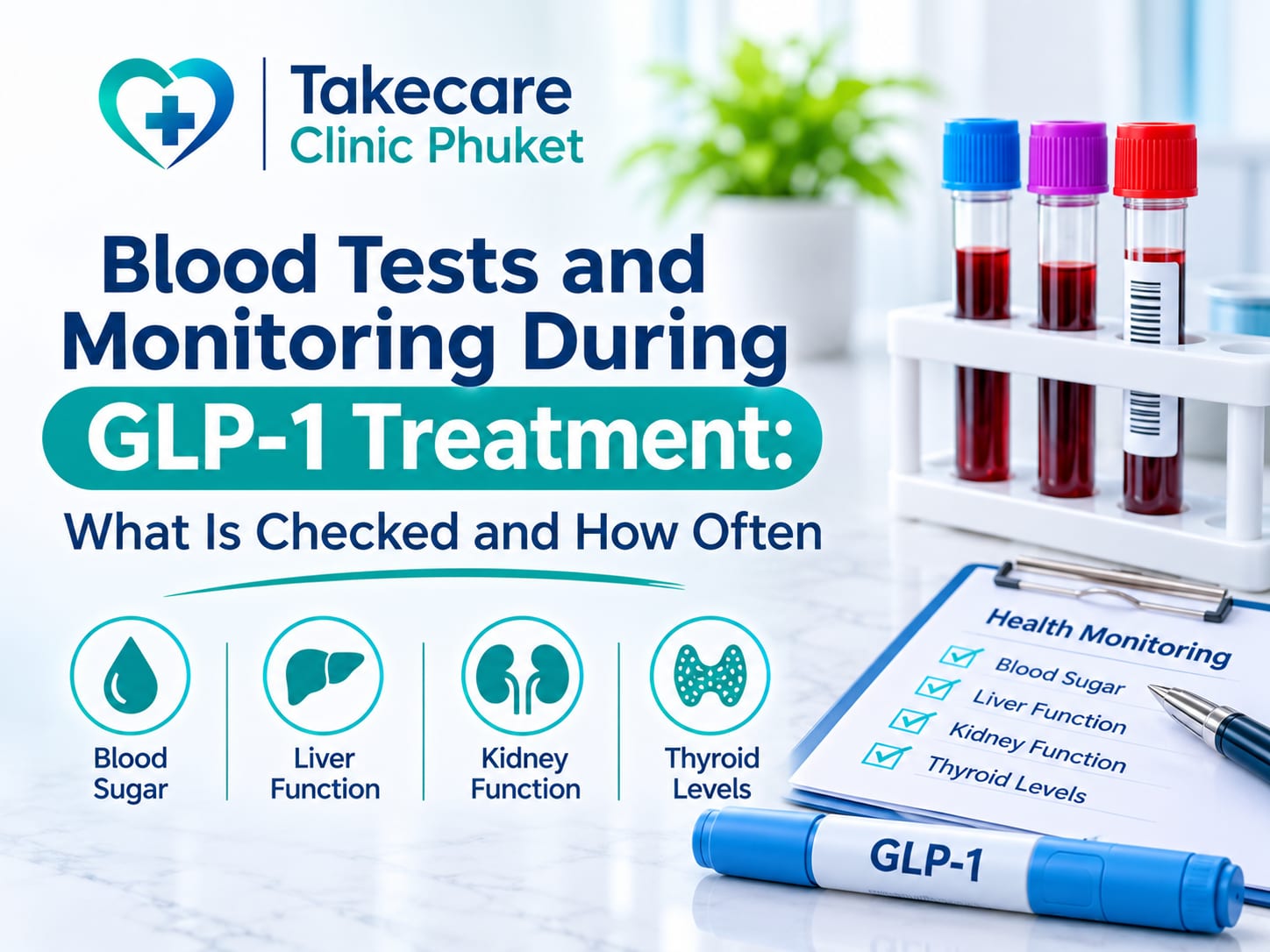
GLP-1 medications like semaglutide and tirzepatide require blood tests before you start and at regular intervals after. The standard panel covers kidney function, liver enzymes, blood glucose, HbA1c, and a lipid panel. Most stable patients need monitoring roughly every three months. If you are managing this in Phuket without a home GP, a walk-in clinic can run the full panel and review results with you the same day, no appointment needed.
You packed your semaglutide doses, your prescription was sorted before you left, and your last blood test was done three months ago back home. Now you are three weeks into a longer stay in Bang Tao or Chalong, and that next monitoring check is overdue. Your GP is in London or Stockholm or Sydney. The time zone difference makes a phone call awkward. And you are genuinely not sure whether the monitoring schedule matters or whether it is just routine admin.
It matters. GLP-1 medications are not high-risk when managed properly, but the monitoring exists for specific reasons, and letting it slip because you are mid-trip is a real risk for anyone managing treatment away from their usual doctor. This article explains what blood tests are needed, when they are needed, and what each one is actually checking for.
What Blood Tests Are Done Before Starting GLP-1
The baseline panel is done before your first dose. Its job is to establish your starting point and screen for anything that would change the prescribing decision.
The standard baseline includes fasting glucose and HbA1c, your average blood sugar over roughly three months. Kidney function tests covering creatinine and eGFR show how well your kidneys are filtering. Liver enzymes, specifically ALT and AST, are part of the picture too. A full lipid panel, a complete blood count, and thyroid function via TSH complete most baseline panels. Thyroid disease affects both weight and how you respond to treatment.
An electrolyte panel, covering sodium, potassium, and bicarbonate, is added for most patients. These levels can shift if nausea and vomiting become significant during dose titration. Having a starting point makes any later comparison meaningful.
If you are already managing type 2 diabetes, a urine albumin-to-creatinine ratio is typically added. This screens for early kidney involvement and affects both the prescribing decision and how closely you need to be monitored going forward.
How Often Are Blood Tests Needed on GLP-1
The monitoring schedule has two phases, and knowing which phase you are in matters.
During dose titration, when your dose is being stepped up, your body is adjusting to the medication. This is when nausea, vomiting, and reduced food intake are most likely. A check at around four to six weeks into titration, or sooner if you are having significant symptoms, makes sense specifically for kidney function and electrolytes. Dehydration from persistent nausea can transiently raise creatinine, and catching that early prevents a small issue from becoming a larger one.
Once you are on a stable maintenance dose and tolerating it well, most clinical guidance supports a check every three to six months, with some guidelines recommending moving to every six months once targets are met and the dose is stable. That interval covers HbA1c, kidney function, liver enzymes, and lipids. At the annual mark, the panel broadens again to include thyroid function, nutritional markers, and a full metabolic review.
Patients with diabetes, pre-existing kidney disease, or liver conditions should not wait until three months after any dose change. An earlier check at four to six weeks is appropriate. If that describes you and you are in Phuket without easy access to your usual doctor, this is one of the clearest reasons to come in rather than wait. Questions about how often are blood tests needed on GLP-1 are best answered in the context of your specific situation, not a general rule.

Kidney and Liver Tests: What You Are Actually Watching For
Kidney function monitoring on GLP-1 is not because the medication damages kidneys. Trial data, including the FLOW trial published in 2024, shows kidney-protective effects for semaglutide in patients with type 2 diabetes and chronic kidney disease. The concern is indirect.
If nausea or vomiting leads to poor fluid intake and mild dehydration, creatinine and eGFR can shift. In Phuket’s heat, that process moves faster than it would in a cooler climate. A patient who is mildly dehydrated at home in northern Europe might take two or three days to feel it. Here, a full afternoon at a beach club in Kata can do it in hours.
Liver enzyme monitoring is relevant for a different reason. Significant weight loss, independent of any medication, can temporarily raise liver enzymes as fat stored in the liver is broken down. This is usually transient, but a rising trend that does not settle warrants a closer look. Patients with pre-existing liver conditions need more frequent checks.
Lipase, an enzyme associated with pancreatic inflammation, is not part of routine monitoring but becomes relevant if you develop persistent upper abdominal pain, pain that radiates to the back, or nausea and vomiting out of proportion to your dose. Those symptoms need same-day clinical assessment. People with a personal or family history of medullary thyroid carcinoma, or the genetic condition MEN 2, should not use GLP-1 receptor agonists at all and should discuss this with a physician before starting.
Nutritional Monitoring on GLP-1: B12, Iron, and More
GLP-1 medications reduce appetite significantly. That is the point. But eating considerably less over several months creates a real risk of nutrient gaps, and this is an area where monitoring often falls short.
Vitamin B12 is the most established concern. Many patients on GLP-1 for type 2 diabetes are also on metformin, which reduces B12 absorption. Reduced food intake, particularly of animal protein, compounds the risk. A B12 check at baseline and annually is reasonable practice. B12 deficiency develops slowly, but tingling, numbness, and fatigue can be subtle until they are not.
Iron and ferritin are worth checking at baseline and at the annual review, particularly in premenopausal women and in patients who have substantially reduced their protein intake. If you are losing weight quickly and feeling fatigued in ways that do not match your activity level, a broader nutritional panel is worth discussing when you come in. A full blood test in Phuket can cover these markers without needing to see your home doctor first.
Additional Tests for Specific Patient Groups
Not everyone on a GLP-1 medication has the same monitoring needs. A patient using semaglutide purely for weight management with no other medical conditions needs less intensive follow-up than a patient managing type 2 diabetes with early kidney involvement.
For patients on insulin or sulfonylureas alongside a GLP-1, low blood sugar monitoring is part of the picture. The GLP-1 component is glucose-dependent and does not cause low blood sugar on its own, but combining it with insulin or a sulfonylurea changes that. Fasting glucose and symptom review at every monitoring visit are appropriate.
For patients on other medications affecting liver or kidney function, drug interaction monitoring matters. Some cholesterol-lowering medications, blood pressure treatments, and over-the-counter supplements affect the same pathways. When you come in for a GLP-1 monitoring review, bring a full medication list, including anything bought at a pharmacy here in Phuket.
Tirzepatide, which acts on both GLP-1 and GIP receptors, follows the same general monitoring framework as semaglutide. The same baseline and follow-up intervals apply.
What Abnormal Results Mean and When to Act
A mildly elevated liver enzyme in someone who has recently started losing weight rapidly is not automatically a reason to stop treatment. It needs context, a clinical review, and a repeat test to see whether it is trending up or down. The same applies to a mild rise in creatinine in a patient who came in dehydrated after a full day at a Kata beach club.
Certain results do require action. A significant rise in creatinine alongside symptoms, a rising ALT or AST that does not plateau over successive tests, or a lipase result alongside upper abdominal pain all warrant pausing treatment and getting a clinical review before continuing. These are decisions made with a physician, not from a results printout alone.
If your results come back flagged as abnormal mid-titration, the right next step is a consultation. At Takecare Clinic Phuket, a doctor can review your results on the same visit as your blood draw and discuss whether any dose or timing adjustment is needed.
Getting Your GLP-1 Blood Tests Done in Phuket
Patients managing GLP-1 treatment from Phuket commonly fall into one of two situations. Either they started the medication before arriving and have run out of time between doses and check-ups, or they are long-stay expats in Chalong, Bang Tao, Kamala, or Rawai who need reliable ongoing monitoring without flying elsewhere for a blood test.
Both are straightforward at Takecare Clinic Phuket. Walk in, no appointment needed. An English-speaking doctor in Phuket can review what the numbers mean and whether any adjustment to your treatment plan is warranted, on the same visit.
If you need a fasting panel, plan your visit for the morning and avoid eating after midnight. Fasting glucose and a full lipid panel both require a fast for accurate results. If you are not sure what your panel should include, bring whatever documentation you have from your prescribing doctor and we can work from there.
For patients who need ongoing health check-up monitoring in Phuket as part of a longer-term plan, this is exactly the kind of continuity we provide across the whole island, not just Patong.
Managing GLP-1 treatment in Phuket? Whether you need a baseline panel before starting, a routine three-month check, or a results review after an abnormal result, Takecare Clinic Phuket runs the full GLP-1 monitoring blood panel with same-day physician review. No appointment needed. Walk in to our clinic at 34/14 Prachanukhro Road, Patong, or contact us to arrange. We see patients across Phuket including Kata, Karon, Kamala, Bang Tao, Cherng Talay, Chalong, Rawai, Nai Harn, and Phuket Town.
Frequently Asked Questions
Dr. Ponlawat Pitsuwan
Physician, Takecare Medical Clinic Phuket
a walk-in medical clinic based in Patong with no appointment needed and English-speaking physician care for the whole island. He sees tourists, expats, and residents across Phuket for ongoing management of chronic conditions including GLP-1 treatment monitoring, metabolic health screening, and prescription continuity for patients away from their home GP. His focus is straightforward, evidence-based care delivered in plain language.
References
- Davies MJ, Aroda VR, Collins BS, et al. Management of hyperglycemia in type 2 diabetes, 2022. A consensus report by the ADA and EASD. Diabetes Care. 2022.
- Wilding JPH, Batterham RL, Calanna S, et al. Once-weekly semaglutide in adults with overweight or obesity (STEP 1). NEJM. 2021.
- Perkovic V, Tuttle KR, Rossing P, et al. Effects of semaglutide on chronic kidney disease in patients with type 2 diabetes (FLOW trial). NEJM. 2024.
- MHRA Drug Safety Update. Metformin and reduced vitamin B12 levels: new advice for monitoring patients at risk. UK MHRA. 2022.
- World Health Organization. Obesity and overweight: fact sheet. WHO. 2024.
The information in this article is for educational purposes only and does not constitute medical advice. It should not be used to self-diagnose or replace a consultation with a qualified physician. If you have concerns about your health, contact a licensed medical professional. For appointments at Takecare Clinic Phuket, visit takecareclinicphuket.com.
