
Clinically reviewed by Dr. Ponlawat Pitsuwan, Physician, Takecare Clinic Phuket.
Last reviewed: November 2026
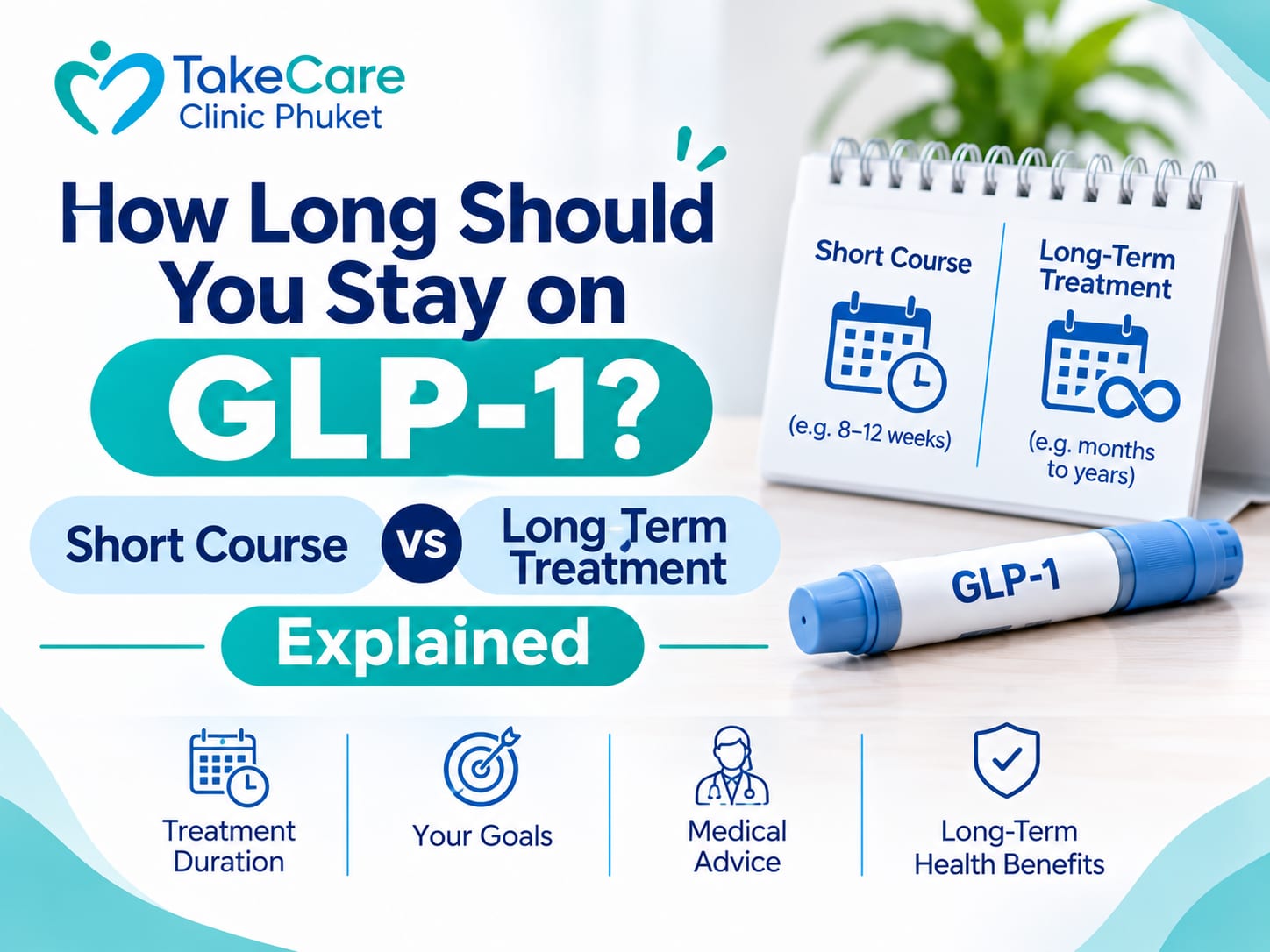
Most people starting GLP-1 medications like semaglutide or tirzepatide need long-term treatment to maintain their results. Short courses can produce real weight loss, but stopping without a plan leads to significant weight regain for most patients. The right duration depends on your goal, your metabolic health, and whether you have built lasting lifestyle habits alongside the medication.
You have been in Phuket for three months. The weight has come off. You feel better. Your next injection is due and you are wondering whether you actually need to keep going, or whether this is a good place to stop. It is a question that comes up often for long-stay visitors and expats managing GLP-1 treatment while based here.
The honest answer is: it depends, but the biology leans strongly toward continuing. GLP-1 medications are not suitable for everyone. People with a personal or family history of medullary thyroid cancer or multiple endocrine neoplasia type 2 should not use them, and anyone with a history of pancreatitis should discuss the risks with their doctor before starting or continuing. GLP-1 receptor agonists, the drug class that includes semaglutide and tirzepatide, work by suppressing appetite through hormonal pathways. Those pathways do not reset when you hit your goal weight. They return to baseline when the medication stops. Understanding that is the starting point for this decision.

What the Clinical Evidence Says About How Long to Stay on GLP-1
The clearest data we have comes from the STEP 1 trial extension. Participants who stopped semaglutide after successful weight loss regained an average of two-thirds of their lost weight within one year. That is a striking number, and it is consistent across similar studies.
The SURMOUNT-4 trial showed comparable findings for tirzepatide. Patients who discontinued after achieving weight loss regained substantially more weight than those who continued. Both trials pointed to the same conclusion: the medication is doing ongoing work, not just a one-time job.
This is the core argument for long-term use. It is not about dependency. It is about how the body’s weight regulation system responds when these drugs are withdrawn.
Obesity as a Chronic Condition: Why Duration Thinking Matters
We do not give someone blood pressure medication for six months, confirm their pressure has normalised, and then stop. We continue it because the underlying condition persists. The same logic applies here for most patients.
Obesity involves a persistently altered weight set-point and disrupted appetite signalling that does not correct itself through willpower alone. GLP-1 medications address the hormonal side of that. When they stop, so does that effect.
For patients with type 2 diabetes, the case for long-term GLP-1 treatment is clearer still. Blood sugar control, cardiovascular risk reduction, and kidney protection are all ongoing benefits that stop with the drug. This is a different picture from weight loss alone, and worth keeping separate in your thinking.

Short Course GLP-1: Who It Can Work For
A short course is not automatically the wrong choice. Some patients have a specific, time-limited goal: reducing weight before a planned surgical procedure, reaching a metabolic threshold before an important health review, or using an initial course to establish lifestyle habits.
If you have already built strong eating and activity habits, and the medication has been a tool to get started rather than the whole strategy, stopping carries less risk. Some patients in this position maintain a meaningful portion of their results. Most do not, but some do.
The key word is supervised. A short course with a clear endpoint, a monitoring plan, and an honest plan for what happens if weight returns is a clinical decision. A short course that ends because the injection ran out while you were in Phuket and it felt fine to stop is a different thing entirely.
Why Most People Stop Earlier Than Recommended
Published adherence data is sobering. Studies in JAMA and JAMA Network Open found that over half of patients discontinue GLP-1 treatment within one year, and nearly three-quarters within two years. Cost is the most cited reason. Side effects come second.
What most patients do not realise is what stopping means medically. The appetite suppression ends within days of the last dose. Hunger returns to pre-treatment levels for most people. Without the hormonal support the medication was providing, the biological drive to regain is real and strong.
If cost or supply is the barrier, the better conversation is whether a lower dose or extended dosing interval can maintain enough benefit to protect the progress made. That conversation needs a prescribing clinician, not a search engine.
Tapering Off vs Stopping Abruptly
There is no established tapering protocol in current guidelines. The drugs do not cause physical dependence and stopping abruptly is not dangerous in the conventional sense.
What abrupt stopping does cause, for most patients, is a faster and more pronounced return of appetite. Some clinicians use extended dose intervals as a practical exit strategy, spacing weekly injections to fortnightly, then monthly, to soften the appetite rebound while lifestyle habits consolidate. This has clinical logic, but strong trial evidence for a specific schedule does not yet exist. Any plan to reduce or stop should be discussed with your prescribing doctor.
Managing Your GLP-1 Treatment in Phuket
This is where things get practically complicated for visitors and expats. Semaglutide and tirzepatide are prescription medications in Thailand. You cannot walk into a pharmacy and buy them over the counter, and brand availability can vary from month to month.
If you are mid-course and your supply runs out, or you have arrived with a foreign prescription that a local pharmacy will not honour, the gap matters. Missing multiple doses is not neutral. It can accelerate appetite rebound and undermine months of progress.
Takecare Clinic Phuket offers walk-in consultations where a physician can review your treatment history and issue a local prescription if clinically appropriate. No appointment is needed. If you are a long-stay expat in Chalong, Bang Tao, or elsewhere on the island without a regular GP, a metabolic review covering weight, blood sugar, blood pressure, and your current dose is exactly what a proper check-in should include. A blood test in Phuket can confirm whether your current metabolic markers support continuing, adjusting, or stepping down your regimen before you make any changes.
Making the Duration Decision With Your Doctor
The factors that inform this decision are not complicated, but they require actual data. Your degree of weight loss, your current metabolic markers including HbA1c, lipid panel, and blood pressure, your side effect burden, whether lifestyle changes are genuinely consolidated, and whether the cost is sustainable are all relevant.
Two patients who have lost the same amount of weight can have very different risk profiles when it comes to stopping. One has reversed pre-diabetes and has a consistent diet and exercise routine. The other is relying almost entirely on the medication and has made few changes to eating habits. Their recommendations are not the same.
This is not a decision to make by feel. For patients in Phuket without a regular doctor, an English-speaking doctor at Takecare Clinic Phuket can work through it with you without a referral or a pre-existing patient record. If you are unsure whether your current situation calls for a prescription review or something more urgent, the doctor on call service in Phuket is also available for short course versus long-term GLP-1 decisions when you cannot come in person.
If you are managing GLP-1 treatment in Phuket and need a prescription review, a metabolic check-in, or advice on continuing, reducing, or stopping your medication, Takecare Clinic Phuket is available as a walk-in. No appointment needed. English-speaking physician care in Patong, serving the whole island from Bang Tao to Rawai. Visit us at 34/14 Prachanukhro Rd, Kathu District, or contact us through takecareclinicphuket.com.
Frequently Asked Questions
Dr. Ponlawat Pitsuwan
Physician, Takecare Medical Clinic Phuket
a walk-in medical clinic based in Patong, Phuket, with no appointment needed and English-speaking physician care for the whole island. He sees tourists, expats, and residents across Phuket for metabolic health, weight management, chronic disease management, and prescription continuity for patients mid-treatment while travelling or based in Thailand. His focus is straightforward, evidence-based care delivered in plain language.
References
- Wilding JPH, Batterham RL, Davies M, et al. Weight regain and cardiometabolic effects after withdrawal of semaglutide: The STEP 1 trial extension. Diabetes Obes Metab. 2022;24(8):1553-1564.
- Aronne LJ, Sattar N, Horn DB, et al. Continued treatment with tirzepatide for maintenance of weight reduction in adults with obesity: The SURMOUNT-4 randomized clinical trial. JAMA. 2024;331(1):38-48.
- Rodriguez PJ, Srinivasan M, Gratzl S, et al. Discontinuation and reinitiation of dual-labeled glucagon-like peptide-1 receptor agonists among adults with overweight or obesity. JAMA Netw Open. 2025;8(1):e2457349.
- World Health Organization. Obesity and overweight: Key facts. WHO, 2024.
The information in this article is for educational purposes only and does not constitute medical advice. It should not be used to self-diagnose or replace a consultation with a qualified physician. If you have concerns about your health, contact a licensed medical professional. For appointments at Takecare Clinic Phuket, visit takecareclinicphuket.com.
