
Clinically reviewed by Dr. Ponlawat Pitsuwan, Physician, Takecare Clinic Phuket.
Last reviewed: November 2026
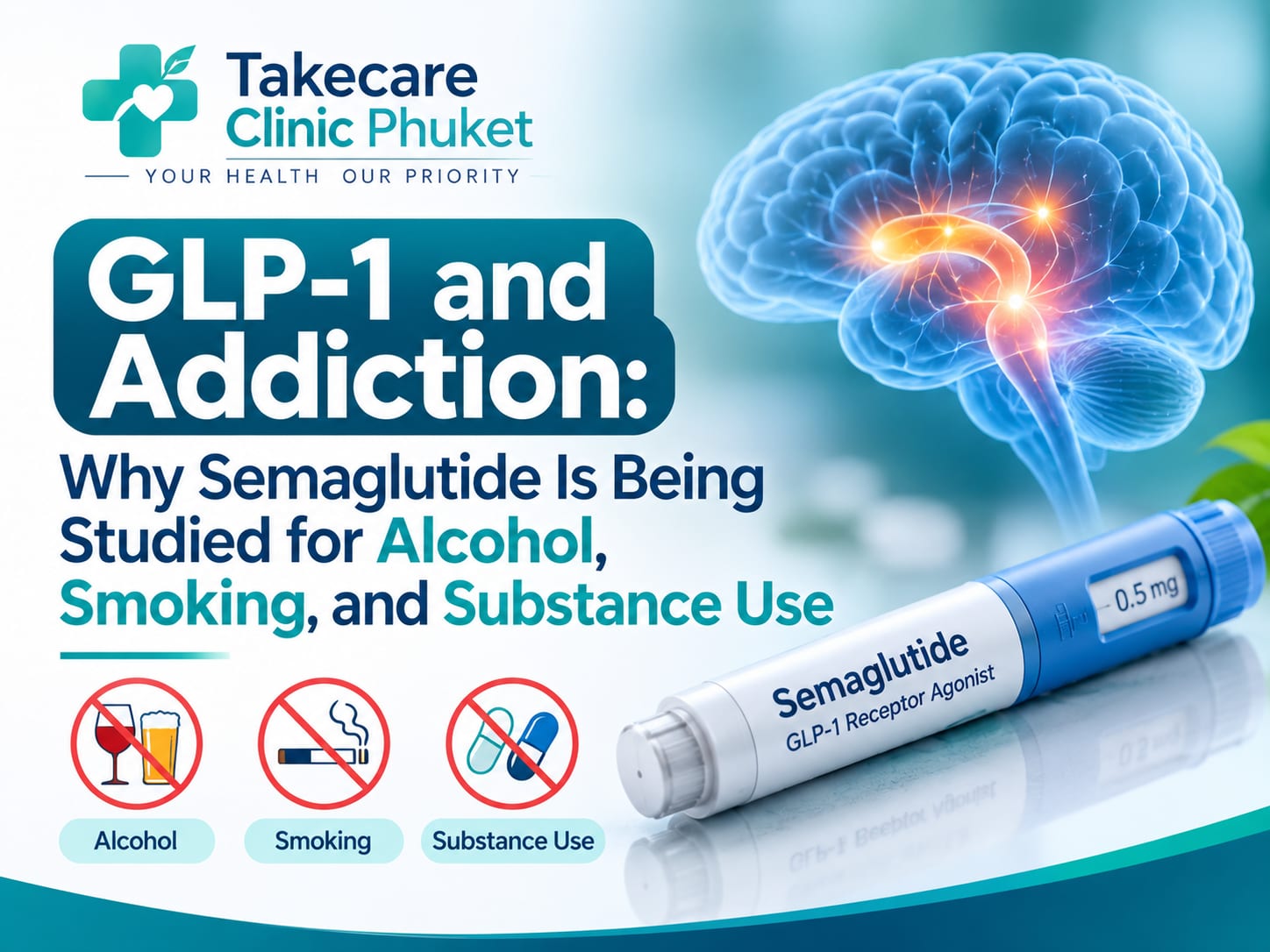
Semaglutide and other GLP-1 receptor agonists are under active investigation for reducing cravings related to alcohol, nicotine, and other substances. The most significant human evidence so far comes from a 2025 JAMA Psychiatry trial in people with alcohol use disorder, which found reduced drinks per drinking day and lower weekly craving scores. No GLP-1 drug is approved for addiction treatment in any country. The research is genuinely interesting, but human trial data remains early and limited.
Patients already on GLP-1 drugs for diabetes or obesity sometimes report changes in their relationship with alcohol, cigarettes, and in some cases other habits they have carried for years.
What they are describing lines up with what researchers are now testing formally. The science is moving, but it is not as far along as the headlines suggest. If you are on semaglutide in Phuket and wondering what this means for you, here is where things actually stand.
How GLP-1 Drugs Affect the Brain’s Reward System
Most people know semaglutide, sold as Ozempic or Wegovy, as a diabetes and weight-loss drug. It mimics a hormone called GLP-1, which plays a role in appetite, blood sugar, and how full you feel after eating.
What surprised researchers is that GLP-1 receptors also exist in the brain’s reward circuits. Two regions central to how the brain processes pleasure and motivation both carry these receptors. The working theory is that semaglutide dampens the sharp dopamine spike that drives the urge to seek out a reward, whether that reward is food, alcohol, or nicotine. Less of that spike, less of the pull toward the substance.
That is a plausible circuit. It is not yet a proven clinical effect in large human trials.
GLP-1 Addiction Research by Substance: What the Evidence Actually Shows
The evidence is not the same across every substance. It helps to see them separately.
Alcohol is where the strongest human evidence exists. A 2025 randomised controlled trial published in JAMA Psychiatry gave semaglutide or placebo to 48 adults with alcohol use disorder over nine weeks. The semaglutide group showed a significant reduction in drinks per drinking day and lower weekly craving scores. The trial did not find a statistically significant change in average drinks per calendar day. Effect sizes for the significant outcomes were described as medium to large. That is a genuine signal. It is also 48 people over nine weeks. Phase 3 trials are underway.
Nicotine has some promising animal study data, and observational reports from patients already on GLP-1 drugs who found smoking less appealing. Human randomised trial data for smoking cessation is not yet published at the scale needed for clinical recommendations.
Opioids and cocaine are at an earlier stage. Registered trials exist, but peer-reviewed results at meaningful scale are not yet available. A dual GLP-1 and glucagon receptor agonist called pemvidutide is also in early investigation for alcohol use disorder, expanding the field beyond semaglutide alone.
Current approved treatments for alcohol use disorder include naltrexone and acamprosate. For opioid use disorder, buprenorphine remains a first-line treatment supported by substantial evidence. GLP-1 drugs are not a replacement for these in current clinical practice.

What the GLP-1 Addiction Research Does Not Yet Prove
Semaglutide is not approved for addiction treatment anywhere, including Thailand. Using it for this purpose would be off-label, and off-label prescribing for an unproven indication before phase 3 data exist is not standard practice. NIDA researcher Lorenzo Leggio, who led early work in this area, has stated publicly that patients should not seek semaglutide specifically for addiction treatment while the trial evidence is still maturing.
There is also a concern worth naming: anhedonia risk. Because semaglutide appears to dampen dopaminergic reward responses broadly, not just for a specific substance, there is a real question about whether reward blunting could generalise. That means reduced pleasure from things you enjoy, not just reduced craving for alcohol or cigarettes. This has not been well-studied in humans yet, and it is flagged in peer-reviewed commentary as a genuine open question.
The animal model data across alcohol, nicotine, opioids, and cocaine is robust. But animal models and human clinical outcomes do not always translate directly. The JAMA Psychiatry trial needs replication at larger scale before the alcohol signal becomes clinical guidance.
Drinking Alcohol on GLP-1s in Phuket
If you are already on semaglutide for weight loss or diabetes and you are here in Phuket, this is the practical question that matters most right now.
Semaglutide slows gastric emptying, which can change the timing and pattern of alcohol absorption. You may find intoxication feels unpredictable compared to what you are used to. That matters after a beach club afternoon in Surin or a night out in Patong where drinks come quickly and the heat accelerates dehydration.
Alcohol also worsens nausea, one of the most common semaglutide side effects, especially in the first weeks of use or after a dose increase. The combination in Phuket’s climate, with dehydration compounding both, is worth taking seriously. For a fuller picture of managing drinking alcohol on GLP-1 risks, that is worth reviewing before your next night out.
Managing Your GLP-1 Prescription in Phuket
Thailand’s regulatory environment for GLP-1 drugs is in flux. The Thai FDA has been reviewing whether semaglutide pens should be reclassified as special controlled substances, which would affect how they are dispensed. What applied when you last filled a prescription at home may not reflect the current situation here.
If you are an expat or long-stay visitor managing an existing semaglutide prescription in Phuket, a physician review is the right step before assuming your supply situation is unchanged. A prescription refill in Phuket requires a doctor visit regardless of what you were on before. An English-speaking physician can review your current dose, check for interactions including alcohol use, and help with documentation.
Should You Talk to a Doctor About GLP-1 and Addiction in Phuket?
If you are already on semaglutide and noticing changes in your drinking or smoking habits, that is worth mentioning to a doctor. Not because something is wrong, but because understanding what you are observing helps you make better decisions about your health.
If you are not on semaglutide and considering it primarily to reduce substance use, the honest answer is that the evidence is not yet strong enough to support that as the main reason to start. A physician can review your full picture and discuss what options make sense.
If questions about alcohol interactions or your GLP-1 prescription come up while you are here, Takecare Clinic Phuket has English-speaking doctor care available without an appointment. Whether you are based in Rawai, Kamala, Bang Tao, or Phuket Town, you do not need to wait until you are back home to have this conversation. Our physician can also arrange any relevant blood tests in Phuket if your health history warrants a closer look.
Already on semaglutide and have questions about how it interacts with alcohol, or want to discuss your prescription while you are in Phuket? Takecare Clinic Phuket is a walk-in clinic in Patong with English-speaking physician care and no appointment needed. We see patients from across the island including Kata, Karon, Bang Tao, Rawai, Chalong, and Phuket Town. Our physician can review your current GLP-1 prescription, advise on alcohol interaction risks, and assist with prescription documentation. Visit us at 34/14 Prachanukhro Rd, Kathu District, Patong, or find us at takecareclinicphuket.com.
Frequently Asked Questions
Dr. Ponlawat Pitsuwan
Physician, Takecare Medical Clinic Phuket
a walk-in medical clinic based in Patong with no appointment needed and English-speaking physician care for the whole island. He sees tourists, expats, and residents across Phuket for prescription management, GLP-1 consultations, chronic disease care, and questions about how medications interact with the realities of life and travel in a tropical environment. His focus is straightforward, evidence-based care delivered in plain language.
References
- Hendershot CS et al. Once-Weekly Semaglutide in Adults With Alcohol Use Disorder: A Randomized Clinical Trial. JAMA Psychiatry. 2025;82(4):395-405.
- Altimmune. Altimmune Announces FDA Fast Track Designation for Pemvidutide in Alcohol Use Disorder. BioSpace, 2025.
- US FDA. Fast Track, Breakthrough Therapy, Accelerated Approval, Priority Review. FDA.gov.
- NIDA. Medications to Treat Opioid Use Disorder Research Report. National Institute on Drug Abuse.
The information in this article is for educational purposes only and does not constitute medical advice. It should not be used to self-diagnose or replace a consultation with a qualified physician. If you have concerns about your health, contact a licensed medical professional. For appointments at Takecare Clinic Phuket, visit takecareclinicphuket.com.
