
Clinically reviewed by Dr. Ponlawat Pitsuwan, Physician, Takecare Clinic Phuket.
Last reviewed: November 2026
Pre-exposure rabies vaccination is a two-dose course given on days 0 and 7. It does not eliminate the need for care after an animal bite, but it removes the need for rabies immunoglobulin and reduces post-bite treatment to two doses instead of up to five. Anyone spending extended time in Phuket, travelling with children, or planning time outdoors should consider it before or on arrival.
You are walking back from Monkey Hill in Phuket Town when a macaque grabs your bag and scratches your hand. You wipe it off and wonder if it matters. It does. Thailand is a rabies-endemic country, and Phuket has animal exposure risks that most visitors underestimate until after something happens.
The decision to get pre-exposure rabies vaccination is one most travellers skip. This article explains who actually needs it, what the schedule looks like, how it changes your options if something bites you, and what the cost difference looks like. If you are already in Phuket and have not had it yet, the course can still be started here.

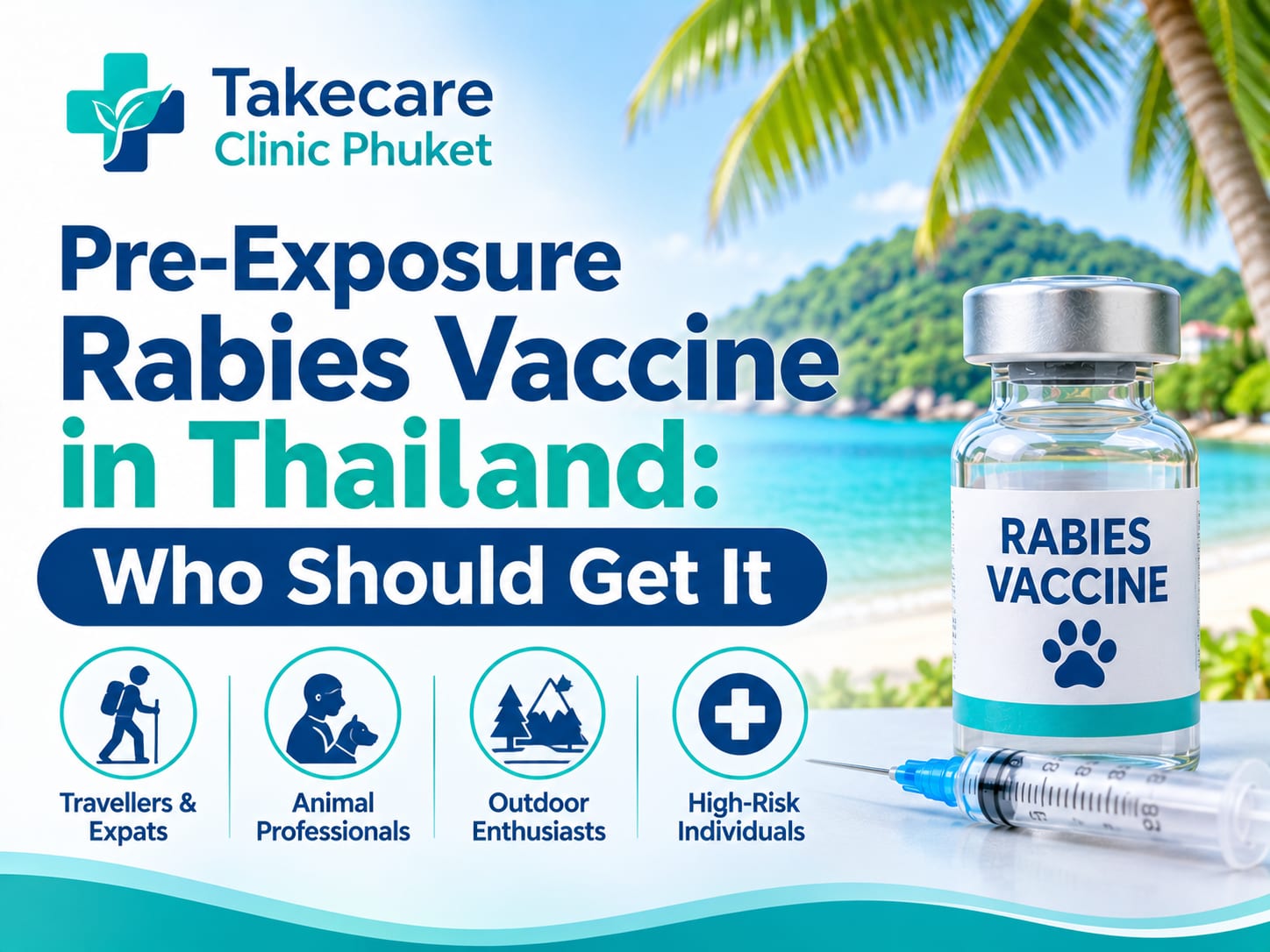
Who Benefits Most From Pre-Exposure Rabies Vaccine in Thailand
Short answer: more people than currently get it.
The clearest cases are children, long-stay visitors, digital nomads, expats, and anyone planning outdoor activities near animals. Children tend to approach animals and may not tell an adult about a scratch or small bite. WHO guidance supports pre-exposure vaccination for children travelling to rabies-endemic areas.
Long-stay visitors and expats living in Phuket face ongoing exposure across the whole island. Soi dogs are present everywhere: Rawai beach, the streets around Nai Harn, Kamala village, the residential back-roads of Chalong and Cherng Talay. These are not isolated animals. They are part of daily life here. Stray cats are equally common near the markets in Kata and Karon. Monkeys can carry and transmit rabies, and Monkey Hill in Phuket Town is a popular tourist stop where close contact is routine.
Divers and outdoor travellers are worth considering too. A day trip to Phi Phi, a beach walk in Rawai at dusk, a cycle around the southern cape: animal contact is opportunistic and unpredictable. A travel medicine consultation at Takecare Clinic Phuket can help you decide based on your itinerary and length of stay.
Doses and Timing for Pre-Exposure Rabies Vaccine in Thailand
The standard pre-exposure schedule is three doses of an inactivated rabies vaccine, given on days 0, 7, and 21 or 28. Completing the full course takes about a month.
Both intramuscular and intradermal routes are used for pre-exposure vaccination. Your clinic will advise on which is appropriate. WHO-approved rabies vaccines are available in Thailand, and the course can be started at any point, including after you arrive in Phuket.
If your stay is more than one week, you can complete the full two-dose course here without having done anything before departure. Even a short stay is enough time to begin and finish the course.
Expats and long-stay residents who completed their pre-exposure course some time ago may need a booster depending on how long ago they were vaccinated and their ongoing exposure risk. If you are unsure whether your cover is current, an antibody titre check can clarify this. Ask at Takecare Clinic Phuket when you come in.

What Changes After an Animal Bite
This is the part most people get wrong. Pre-exposure vaccination does not mean you can ignore a bite.
What it does change is significant. If you have completed the pre-exposure course and are bitten, you need two post-bite vaccine doses, given on days 0 and 3. You do not need rabies immunoglobulin, known as RIG. If you have not been vaccinated, you need up to five doses of vaccine plus RIG injected at and around the wound site.
RIG availability matters more than most visitors realise. It is not reliably stocked at every clinic or smaller hospital in Phuket. At some facilities it may be unavailable or delayed. Pre-exposure vaccination removes RIG from the equation entirely. That is not a minor detail.
After any animal bite in Phuket, wash the wound with soap and running water for at least 15 minutes. Then seek care the same day. For animal bite treatment in Phuket, time matters: do not wait until morning if it happened at night.
Cost: Pre-Exposure Versus Post-Exposure in Phuket
The upfront cost of a three-dose pre-exposure course is straightforward. The cost of post-exposure treatment for an unvaccinated person is not.
An unvaccinated person bitten in Phuket needs up to five vaccine doses plus RIG dosed by body weight. The total bill at a private hospital can be considerably higher than a pre-exposure course. Pre-exposure vaccination cuts post-bite treatment to two doses with no RIG. The financial logic is clear for anyone staying several weeks or more.
Exact pricing for rabies pre-exposure vaccination at Takecare Clinic Phuket is confirmed at the clinic. No appointment is needed. An English-speaking doctor handles the consultation, the schedule, and any questions about your specific situation.
For a broader overview of vaccines relevant to time in Thailand, the vaccination guide for visitors and expats covers the full picture alongside travel medicine advice.
Need the rabies vaccine in Phuket? Takecare Clinic Phuket offers pre-exposure rabies vaccination for tourists, expats, and residents with no appointment needed and English-speaking physician care. The clinic is based in Patong at 34/14 Prachanukhro Road and serves the whole island, from Rawai and Nai Harn to Bang Tao and Phuket Town. If you have already been bitten or scratched by an animal, seek animal bite assessment the same day. Walk in or contact the clinic directly.
FAQ
Dr. Ponlawat Pitsuwan
Physician, Takecare Medical Clinic Phuket
a walk-in medical clinic based in Patong with no appointment needed and English-speaking physician care for the whole island. He sees tourists, expats, and residents for travel medicine, rabies vaccination, animal bite assessment, and preventative care. His focus is straightforward, evidence-based care delivered in plain language.
References
- Centers for Disease Control and Prevention. Rabies Pre-Exposure Prophylaxis: Clinical Guidance. CDC, 2022.
- World Health Organization. Rabies vaccines: WHO position paper – April 2018. Weekly Epidemiological Record, 2018; 93(16):201-220.
- Mani RS, Madhusudana SN. Laboratory diagnosis of human rabies: recent advances. Scientific World Journal, 2013. Context: WHO 2018 PrEP schedule summary in PMC6863036
- Gautret P, et al. Rabies Postexposure Prophylaxis for Travelers Injured by Nonhuman Primates, Marseille, France, 2001-2014. Emerging Infectious Diseases, 2015; 21(8).
- Centers for Disease Control and Prevention. CDC Yellow Book 2024: Rabies Immunization for Travelers.
The information in this article is for educational purposes only and does not constitute medical advice. It should not be used to self-diagnose or replace a consultation with a qualified physician. If you have concerns about your health, contact a licensed medical professional. For appointments at Takecare Clinic Phuket, visit takecareclinicphuket.com.
