
Clinically reviewed by Dr. Ponlawat Pitsuwan, Physician, Takecare Clinic Phuket.
Last reviewed: November 2026
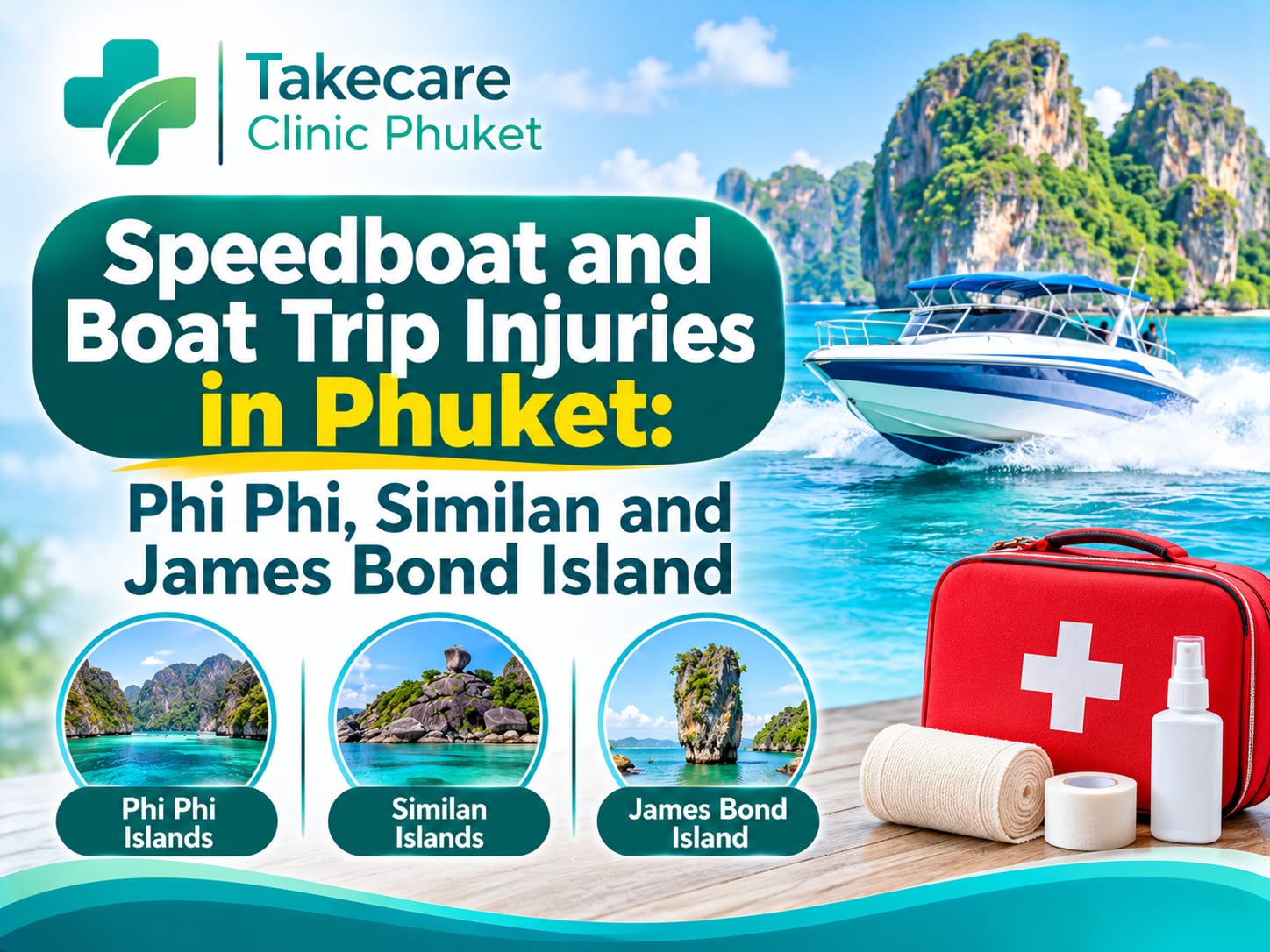
Speedboat tours to Phi Phi, the Similan Islands, and James Bond Island cause a range of injuries, from soft tissue bruising and reef cuts to spinal compression fractures in bow-seat passengers hitting rough Andaman swells. Most injuries look minor on the day but can worsen significantly in the hours or days that follow. If you have back or neck pain after a bumpy boat ride, numbness in your arms or legs, or a wound from coral or a boat fitting, get assessed the same day at a walk-in clinic rather than waiting to see how it feels tomorrow.
You booked the Phi Phi tour months ago. The sea looked fine from the Patong pier at 7am. By the time the speedboat hit open water past Karon, the swell was bigger than anyone expected, and the bow was slamming hard enough to lift passengers off their seats. If you were sitting at the front, you felt every one of those impacts through your spine.
This is not a rare story. Phuket’s major day-trip routes, out to Phi Phi, across to the Similan Islands, and up into Phang Nga Bay for James Bond Island, all run in sea conditions that can change fast. The injuries that follow are predictable once you know what to look for. What worries me most is not the obvious cut or bruise. It is the back pain that starts mild on the boat and becomes genuinely serious by the following morning.

Common Injuries From a Phuket Speedboat Accident
Soft tissue injuries are the most common outcome of a rough speedboat ride. Bruising from impact with handrails, seat edges, or other passengers is routine. Whiplash-type neck strain can follow a sudden hard impact even without a collision. Painful, but rarely dangerous on its own.
Lacerations from boat fittings, boarding ladders, and anchor lines are common at snorkelling stops. Reef abrasions deserve separate attention, which I cover below. Any confusion, persistent headache, or vomiting after a head impact needs same-day hospital assessment, not a walk-in clinic.
Broken bones and dislocations happen in more serious incidents: collisions, capsizing in a squall, or a passenger thrown overboard. These are less common but not rare in Phuket’s incident history, particularly on routes with heavy traffic near channel markers around Chalong Bay and the Phi Phi approach.
Spinal Compression on Speedboats
The injury most likely to be missed on the day is a vertebral compression fracture, particularly at the junction where your mid-back meets your lower back. When a speedboat slams down off a wave, the force transmitted through a seated passenger’s spine can be significant. Bow and front seats take the worst of it.
A compression fracture means one of the vertebral bones has been partially crushed by that downward force. A burst fracture is more serious: bone fragments may have shifted and can affect the spinal cord, causing numbness, tingling, or weakness in the legs. You cannot tell these apart without imaging.
The pattern I watch for: sitting at the front, rougher sea than expected, a sharp jolt, back pain starting mild but worsening overnight. That history warrants an X-ray at minimum. Any neurological symptoms mean a hospital referral, not a clinic visit.
Choosing a Safer Operator and Seat for Boat Trips in Phuket
The single most useful thing you can do before boarding is choose your seat. The bow and front rows carry the highest injury risk in rough conditions. The rear of the cabin, closer to the centre of the vessel’s mass, absorbs far less impact. If the sea looks anything other than flat, move to the back.
Thai marine regulations require life jackets to be available on passenger vessels, but enforcement of safety briefing standards is inconsistent. A reputable operator will brief passengers before departure, check sea conditions, and cancel or delay if conditions are genuinely unsafe. If your captain is making that call, that is the right call.
Look for operators with clear cancellation policies tied to wave height, not just rain. A tour that runs regardless of forecast conditions is not one to be confident about. That is what the incident record from Phuket ports shows.
Monsoon Sea Conditions
The southwest monsoon, roughly May through October, changes the Andaman Sea significantly. Phi Phi tours run year-round from Patong and Chalong piers, but conditions on the same route can vary enormously between a calm April morning and a July afternoon with two-metre swells. Operators make departure decisions based on captain judgment rather than a fixed wave height threshold.
The Similan Islands are a different situation. The national park closes officially for part of the low season, typically from mid-May to mid-October, and both liveaboard and day-trip operations halt during that window. James Bond Island in Phang Nga Bay sits in more sheltered water and runs through most of the year, though heavy rain squalls can still make the ride rough.
If you are booking during monsoon months, check the Thai Meteorological Department wave forecast for the Andaman Sea the morning of your trip. Above two metres, most responsible operators will not go. If yours will, reconsider.
What to Do After a Boat Trip Injury in Phuket
The first priority on the boat: tell the captain immediately. A crew that does not know someone is hurt cannot slow down or radio for help. For any suspected spinal injury, keep the person still and support the head and neck until someone with first aid training has assessed them.
For bleeding wounds, apply direct pressure. For reef abrasions, rinse with clean water as soon as possible. Do not use seawater. The warm tropical water around Phuket’s reefs, sitting at around 28 to 30 degrees Celsius and harbouring Vibrio and other marine bacteria, will make a wound infection more likely, not less.
Once back on land, collect the operator’s name, boat registration, and captain contact details before you leave the pier. Take photos of your injuries. This matters for insurance and for medical documentation.
Seek care the same day, even for injuries that seem manageable. If you were injured on a Phuket boat tour, Takecare Clinic Phuket in Patong is a walk-in clinic with English-speaking physician care and no appointment needed. A physician can assess neurological signs, clean and dress reef wounds, check your tetanus status, and issue a medical report for insurance. For wounds needing wound care in Phuket, most presentations can be handled on the day without sending you to an expensive hospital emergency department.
Go directly to a hospital emergency department, not a walk-in clinic, if you have any of these: loss of consciousness, confusion, persistent vomiting after a head impact, numbness or weakness in the arms or legs, inability to walk, or severe abdominal pain after a blunt impact to the torso.
For everything else, including back pain without neurological symptoms, lacerations, bruising, and reef wounds, a physician assessment at Takecare Clinic Phuket is the right first step. If imaging or specialist referral is needed, we will arrange it.
Coral abrasions need prompt irrigation and professional cleaning. Coral fragments act as a foreign body in the wound and significantly increase infection risk. This is not an ordinary cut. What looks clean on day one can be red and swollen by day two, faster than most visitors from cooler climates expect. Tetanus prophylaxis should be considered for any dirty wound, puncture, or reef injury. If you are not current, we address that at the time of your visit.
If you are unsure whether you need a clinic or a hospital after being injured on a Phuket boat tour, come in and let a physician make that call. For soft tissue injuries and wound care, motorbike and boat trip injuries in Phuket follow similar patterns, and we see both regularly at the clinic.
Injured on a Phuket speedboat or boat tour? Takecare Clinic Phuket is a walk-in clinic in Patong with an English-speaking physician available without an appointment. We assess and treat reef wounds, soft tissue injuries, and back and neck pain after boat trips, and we issue medical reports for insurance claims. If you are unsure whether your symptoms need a clinic or a hospital, come in and let a physician decide. We cover the whole island, from Patong to Rawai, Kata to Bang Tao.
Frequently Asked Questions
Dr. Ponlawat Pitsuwan
Physician, Takecare Medical Clinic Phuket
a walk-in medical clinic based in Patong with English-speaking physician care and no appointment needed. He sees tourists, expats, and residents across Phuket for injuries sustained on boat tours, reef cuts, and soft tissue and spinal trauma following speedboat accidents. His focus is straightforward, evidence-based care delivered in plain language.
References
- Morbelli A, et al. Spinal Fractures during Touristic Motorboat Sea Cruises: An Underestimated and Avoidable Phenomenon. Int J Environ Res Public Health. 2023;20(4):3691.
- Centers for Disease Control and Prevention. Clinical Guidance for Wound Management to Prevent Tetanus. CDC, 2024.
- European Centre for Disease Prevention and Control. Vibriosis. ECDC.
- Thailand PRD. Similan Islands and Surin Islands to be temporarily closed from 16 May to 14 Oct 2025. Thai Government Public Relations Department, 2025.
- World Health Organization. Drowning fact sheet. WHO, 2023.
- Centers for Disease Control and Prevention. Vibrio (Vibriosis). CDC.
The information in this article is for educational purposes only and does not constitute medical advice. It should not be used to self-diagnose or replace a consultation with a qualified physician. If you have concerns about your health, contact a licensed medical professional. For appointments at Takecare Clinic Phuket, visit takecareclinicphuket.com.
