
Clinically reviewed by Dr. Ponlawat Pitsuwan, Physician, Takecare Clinic Phuket.
Last reviewed: October 2026
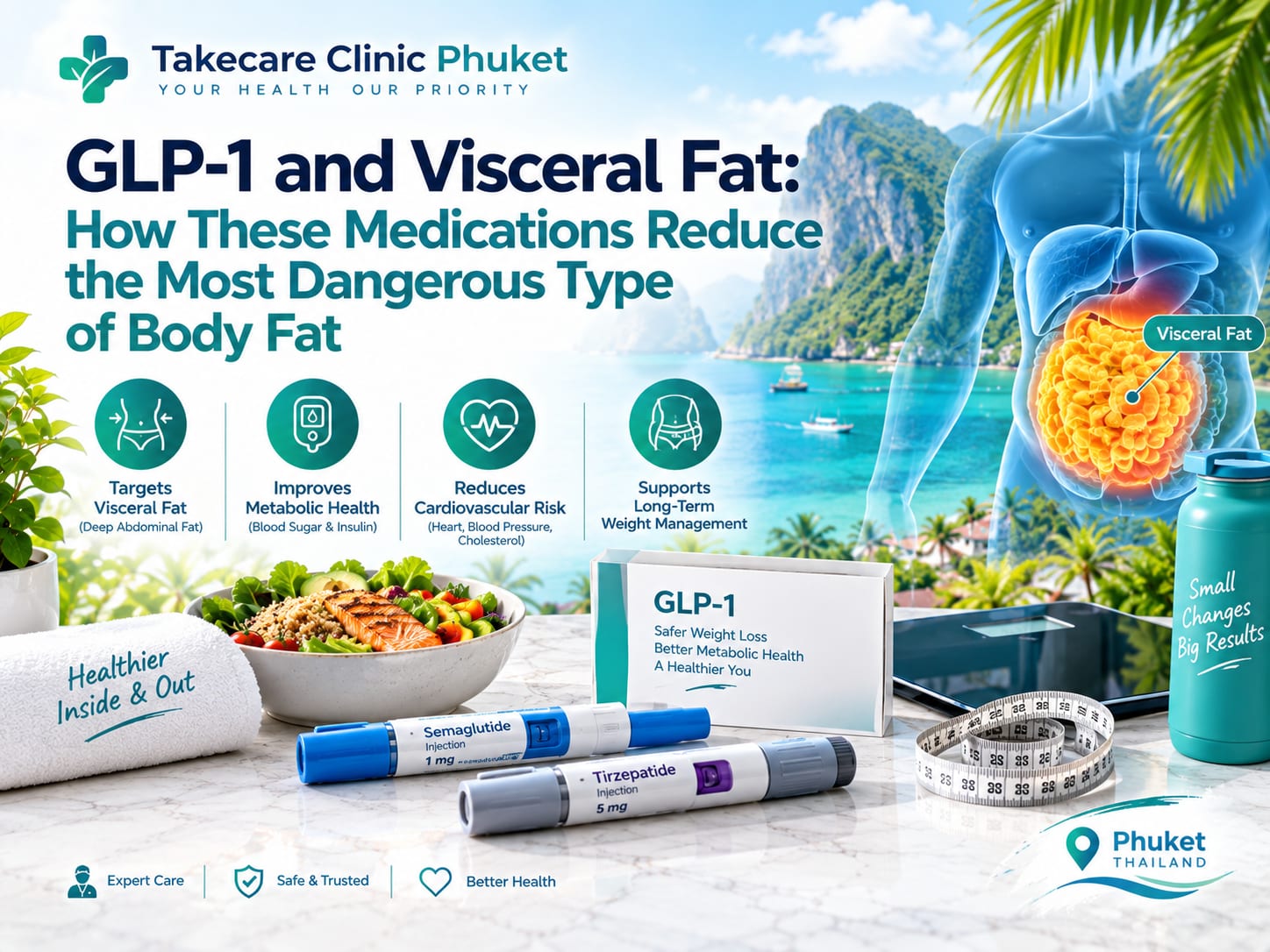
GLP-1 receptor agonists like semaglutide and tirzepatide reduce visceral fat, the deep abdominal fat packed around your organs, through two pathways: suppressing appetite via the brain and improving insulin sensitivity, which reduces fat storage in deep abdominal depots. Head-to-head trial data shows tirzepatide produced greater waist reduction than semaglutide over 72 weeks. Both medications require a doctor’s prescription and ongoing supervision, and both are legally prescribable in Thailand.
A patient came in recently after three months in Rawai. He was walking every morning along the beachfront, eating at the local market rather than the tourist strip, and his weight had barely shifted. But his fasting glucose was creeping up and his waist measurement told a completely different story from his BMI. That pattern is common among long-stay expats and slow travellers in Phuket. The fat you can pinch at the side of your waist is not the problem. The dangerous kind sits deeper, wrapped around your liver and intestines, and it does not respond to effort the way most people expect.
GLP-1 medications work differently from a diet. They act on the brain to reduce hunger and improve how your body handles blood sugar, which reduces the drive to store fat in the deep abdominal area. This article explains what the trial evidence shows and what getting started looks like if you are in Phuket.

Why Visceral Fat Is More Dangerous Than the Fat You Can See
Most people think about fat in terms of how they look. Visceral fat, stored deep in the abdomen around the organs, is a different problem from the softer fat sitting just under the skin.
Visceral fat drains directly into the portal vein, the vessel that feeds your liver. That constant flow of fatty acids stresses the liver and contributes to fat accumulation inside it. Visceral fat also releases signalling molecules in abnormal amounts, which drive inflammation and interfere with how your cells respond to insulin.
The result is a cluster of problems: high blood sugar, high blood pressure, poor cholesterol profile, and elevated cardiovascular risk. You can have all of that at a BMI that looks fine on paper. Waist-to-height ratio is a more useful indicator for this kind of risk, and it is something we look at during a health check-up at Takecare Clinic Phuket alongside standard blood work.
How GLP-1 Medications Target Visceral Fat
GLP-1 receptor agonists do not instruct your body to burn fat directly. The mechanism is more indirect, and more effective for visceral fat specifically, than most people expect.
The first pathway is appetite regulation. GLP-1 receptors sit in areas of the brain that control hunger and fullness. When those receptors are activated, you feel less hungry and feel full sooner. That sustained reduction in calorie intake is what drives fat loss over time.
The second pathway is insulin sensitivity. Visceral fat accumulates partly because insulin resistance pushes excess glucose toward fat storage, and visceral depots are particularly sensitive to this. GLP-1 medications improve how the body uses insulin, which reduces the signal to keep storing fat around the organs.
These two pathways together explain why a 2023 meta-analysis of 30 randomised controlled trials found GLP-1 receptor agonists significantly reduced visceral adipose tissue, with this effect holding even after accounting for total body weight loss.

Semaglutide vs Tirzepatide for Visceral Fat
Both semaglutide and tirzepatide are GLP-1 receptor agonists. Tirzepatide also activates a second hormone receptor, GIP, involved in fat metabolism. That additional action appears to matter for fat distribution outcomes.
The SURMOUNT-5 trial, a direct head-to-head comparison in adults with obesity and no diabetes, found tirzepatide produced a mean waist circumference reduction of 18.4 cm over 72 weeks, compared to 13.0 cm with semaglutide. That is a clinically meaningful difference in visceral fat territory.
| Medication | Type | Waist Reduction (SURMOUNT-5, 72 weeks) |
|---|---|---|
| Semaglutide | GLP-1 agonist | 13.0 cm |
| Tirzepatide | GLP-1 + GIP dual agonist | 18.4 cm |
Which medication suits you depends on your medical history, existing conditions, and how you respond to treatment. That is a clinical decision. A consultation at Takecare Clinic Phuket will review your blood work, waist measurement, and metabolic risk factors before any prescription is written.
Beyond the Scale: What Visceral Fat Loss Does to Your Organs
The number on the scale is not the main reason to treat visceral fat. The organ-level changes are.
Patients with fatty liver who lose visceral fat show measurable reduction in liver fat content, which reduces the long-term risk of progression to more serious liver disease. Cardiovascular risk markers, including blood pressure, triglycerides, and fasting glucose, improve as visceral fat falls. For expats managing metabolic health in Phuket without easy access to a home-country specialist, these are not small changes.
Sleep apnoea severity also improves with significant visceral fat reduction. Fat around the upper airway contributes to obstruction at night, and this tends to respond to meaningful fat loss in the abdominal and thoracic area.
What to Expect During GLP-1 Treatment in Phuket
GLP-1 medications are given as a weekly injection just under the skin. The dose starts low and increases gradually over several weeks to reduce nausea and other gastrointestinal side effects.
Most people notice appetite changes within the first few weeks. Fat loss, including visceral fat reduction, accumulates over months, not days. Maintaining lean body mass during weight loss matters, which is why adequate protein and regular activity are part of a supervised programme.
Nausea and mild gut discomfort are the most common side effects, usually occurring as the dose increases. They typically settle. If you are vomiting persistently or unable to stay hydrated, that warrants a same-day review. In Phuket’s heat and humidity, dehydration develops faster than most people expect from experience in cooler climates. Patients at Takecare Clinic Phuket can access walk-in review or, if needed, IV therapy support during treatment.
GLP-1 medications are not appropriate for everyone. People with a personal or family history of medullary thyroid cancer or multiple endocrine neoplasia syndrome type 2 should not use them. People with a history of pancreatitis should discuss this with their doctor before starting, as GLP-1 medications have not been adequately studied in this group and pancreatitis has been reported as a side effect. These medications should also be stopped if pregnancy is confirmed, and are not recommended during breastfeeding. Medullary thyroid cancer history and MEN 2 are absolute contraindications listed in current prescribing information; the other situations above require careful clinical review. Other conditions may require further review before starting.
What Happens When You Stop GLP-1 Treatment
This is the part most people do not ask about until it matters. A 2025 systematic review confirmed that stopping GLP-1 medication typically results in significant weight regain. Evidence suggests the regained weight tends to be predominantly fat rather than lean mass, though direct visceral fat measurements after cessation have not been systematically reported.
This does not mean you are on medication permanently. It means stopping without a plan is not the same as finishing treatment. A supervised tapering approach combined with a realistic maintenance plan is what separates a durable outcome from starting over.
For expats in Phuket without a home-country GP nearby, this continuity question matters more than for someone who can walk back into their local clinic next month. A prescription refill or ongoing monitoring consultation at Takecare Clinic Phuket is one way to manage that without flying home.
Getting a GLP-1 Prescription in Phuket
GLP-1 receptor agonists are legally prescribable in Thailand by licensed physicians. You do not need to fly home to continue treatment or to start it for the first time.
What you do need is a medical consultation. No reputable clinic will hand over a GLP-1 prescription without reviewing your history, current medications, and relevant blood work. That is not bureaucracy: it is how these medications are used safely. A blood test in Phuket, waist measurement, blood pressure check, and metabolic risk review are all part of that first visit.
Tourists on a short stay, long-stay expats, and permanent residents across Phuket can access this at Takecare Clinic Phuket in Patong, with no appointment needed and English-speaking physician care. If you are based in Rawai, Bang Tao, Chalong, or Kamala, the clinic is straightforward to reach. Telemedicine follow-up is available for ongoing consultations once you are established as a patient.
Takecare Clinic Phuket offers doctor-supervised GLP-1 consultations for tourists, expats, and residents across the island, with no appointment needed. If you are considering starting treatment, continuing a programme you began at home, or want blood work and a metabolic risk assessment before deciding, walk in to our clinic in Patong or reach us via telemedicine. English-speaking physician care is available now.
Frequently Asked Questions
Dr. Ponlawat Pitsuwan
Physician, Takecare Medical Clinic Phuket
a walk-in medical clinic based in Patong with no appointment needed and English-speaking physician care available for the whole island. He sees tourists, expats, and residents across Phuket for GLP-1 weight management consultations, metabolic health assessments, and chronic disease management. His focus is straightforward, evidence-based care delivered in plain language.
References
- Liao X, et al. The effects of GLP-1 receptor agonists on visceral fat and liver ectopic fat in an adult population with or without diabetes and nonalcoholic fatty liver disease: A systematic review and meta-analysis. PLoS ONE, 2023.
- Jastreboff AM, et al. Tirzepatide Once Weekly for the Treatment of Obesity. New England Journal of Medicine, 2022.
- Wilding JPH, et al. Once-Weekly Semaglutide in Adults with Overweight or Obesity. New England Journal of Medicine, 2021.
- American College of Cardiology. SURMOUNT-5: Greater Loss of Weight, Waist Circumference With Tirzepatide Than Semaglutide. ACC Journal Scans, 2025.
- Rubino DM, et al. Effect of Weekly Subcutaneous Semaglutide vs Daily Liraglutide on Body Weight in Adults With Overweight or Obesity. JAMA, 2022.
- World Health Organization. Obesity and Overweight: Key Facts. WHO, 2024.
The information in this article is for educational purposes only and does not constitute medical advice. It should not be used to self-diagnose or replace a consultation with a qualified physician. If you have concerns about your health, contact a licensed medical professional. For appointments at Takecare Clinic Phuket, visit takecareclinicphuket.com.
