
Clinically reviewed by Dr. Ponlawat Pitsuwan, Physician, Takecare Clinic Phuket.
Last reviewed: October 2026
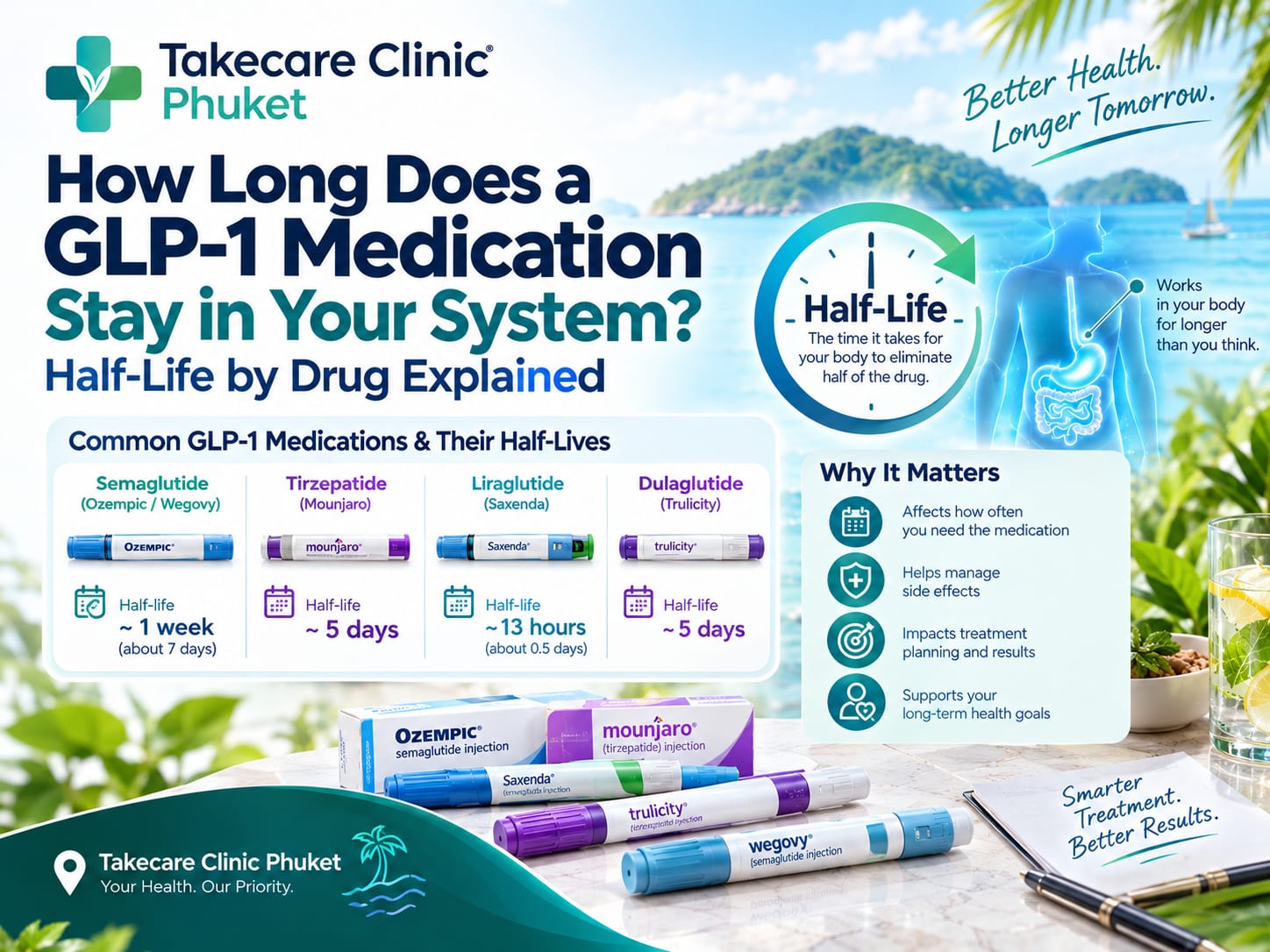
How long a GLP-1 medication stays in your system depends on which drug you take. Semaglutide (Ozempic, Wegovy) has a half-life of approximately 7 days and clears after roughly 5 weeks. Tirzepatide (Mounjaro, Zepbound) has a half-life of approximately 5 days and clears in roughly 25 days. Liraglutide (Saxenda, Victoza) clears much faster, within a few days of your last dose. Drug clearance and the end of drug effects are not the same thing.
You packed your Ozempic pen for a month in Phuket, counted the doses carefully, and now you are three weeks into a long-stay guesthouse in Rawai and you are one injection short. Or you have a dental procedure booked at a clinic in Phuket Town and the dentist just asked what medications you are on. Either way, the same question comes up: how long does this drug actually stay in your system, and does it matter right now?
Two things trip people up most. The first is assuming drug clearance and drug effects are the same thing. They are not. The second is not knowing what to do practically when a routine gets disrupted mid-trip. This article gives you the half-life numbers by drug, explains what they mean for your body, and covers what to do if you have missed doses or run out while you are here.
Half-Life Explained: What It Actually Means for Your Body
Half-life is how long it takes your body to reduce the drug level in your blood by half. It takes roughly five half-lives for a drug to be effectively cleared. Pharmacologists call this the five-half-lives rule.
For semaglutide, with its 7-day half-life, that works out to about 35 days after your last injection. Tirzepatide, at around 5 days, clears in roughly 25 days. These figures come from FDA prescribing information, and individual factors like kidney function and body composition can shift them slightly.
Here is the part that confuses most patients. GLP-1 steady state, the point where the drug has built up to its full working level, takes the same number of half-lives to reach. The drug takes weeks to fully build up and weeks to fully leave. Effects like appetite suppression start fading before the drug is technically gone.
GLP-1 Half-Life by Drug: Reference Table
| Drug Name | Brand Name(s) | Dosing Frequency | Approximate Half-Life | Approximate Full Clearance |
|---|---|---|---|---|
| Semaglutide | Ozempic, Wegovy | Weekly | ~7 days | ~5 weeks |
| Tirzepatide | Mounjaro, Zepbound | Weekly | ~5 days | ~25 days |
| Dulaglutide | Trulicity | Weekly | ~5 days | ~25 days |
| Liraglutide | Saxenda, Victoza | Daily | ~13 hours | ~3 days |
| Exenatide ER | Bydureon | Weekly | ~2 weeks | ~10 weeks |
| Exenatide IR | Byetta | Twice daily | ~2.4 hours | ~12 hours |
Half-life figures are from FDA prescribing information for each drug. Full clearance is estimated using the five-half-lives rule and should be treated as a clinical approximation. Individual variation exists.
A note on newer oral agents: orforglipron (Foundayo), an oral GLP-1 receptor agonist approved in April 2026, has a reported half-life of approximately 29 to 49 hours, with full clearance estimated at roughly 6 to 10 days after the last dose. Consult the prescribing information directly for this agent as it continues to be updated.
Drug Clearance vs. Effect Duration: They Are Not the Same
When semaglutide clears your system after five weeks, appetite suppression, blood sugar control, and the slowing of gastric emptying all taper on their own timelines. Effects often begin fading within the first one to two weeks after stopping, well before the drug is technically gone.
Hunger tends to return faster than most patients expect. Some people notice it within days of a missed dose. That is not a sign something went wrong. It is what happens when the drug level drops below its effective threshold.
Blood sugar effects follow a similar pattern for people using GLP-1 drugs for type 2 diabetes. If you are using a GLP-1 for diabetes and run out mid-trip, that is a clinical matter, not just a weight management concern. Get a consultation before assuming you can wait it out.
What Happens If You Miss a Dose or Run Out While Travelling?
Say you have been on a weekly GLP-1 injection and missed one dose while on a day trip out to Phi Phi. For most weekly drugs, missing a single dose by a few days is manageable. The long half-life means blood levels do not drop to zero immediately.
The situation that needs proper medical input is when you have been off the medication for more than a week or two. Most GLP-1 prescribing guidelines recommend restarting at a lower dose after a gap of this length, rather than picking up where you left off. Going back to your previous dose without stepping down first increases the risk of nausea, vomiting, and other gastrointestinal side effects. The specific restart protocol is drug-dependent, so this is a conversation to have with a doctor.
Do not try to source GLP-1 medications without a valid prescription in Thailand. A walk-in consultation at Takecare Clinic Phuket allows an English-speaking doctor to review your current regimen, assess your situation, and issue a legitimate local prescription or refill if clinically appropriate. You can find more detail on the prescription refill process in Phuket on the clinic’s service page.
What GLP-1 Clearance Means for Surgery or Procedures
If you have an elective procedure coming up in Phuket, whether dental work, a minor procedure, or anything requiring sedation or anaesthesia, your GLP-1 use is information your treating team needs.
The reason is gastric emptying delay. GLP-1 drugs slow how fast food and liquid leave your stomach. Under sedation or anaesthesia, that raises the risk of aspiration, where stomach contents enter the lungs. Current multi-society guidance is more nuanced than a simple one-week hold. It depends on which drug you take, how recently you injected, your dose, and whether you have active gastrointestinal symptoms.
Tell your anaesthetist and surgeon that you are on a GLP-1 drug. Give them the drug name, the dose, and when you last injected. If you need help working through whether your procedure timing is safe given your last injection, Takecare Clinic Phuket can advise or help coordinate with your treating team.
When the Drug Leaves Your System: What to Expect
Stopping a GLP-1 drug, whether planned or because you ran out, has predictable effects. Appetite returns. Hunger signals that the drug was suppressing come back, often within the first week or two. Clinical evidence shows that weight tends to return after stopping GLP-1 therapy, over weeks to months. This is not a sign the drug failed. GLP-1 receptor agonists manage an ongoing condition rather than alter it permanently.
If you are stopping intentionally, the right approach is a conversation with a doctor about a transition plan. For long-stay expats in Phuket managing weight or type 2 diabetes, continuity of care matters. For a visitor who simply ran out, the priority is a clinical review and a decision about whether to bridge, restart, or wait.
If you are also managing gastrointestinal symptoms while off your medication, the team at Takecare can help with that as well. Nausea, loose stools, or stomach discomfort after stopping or restarting a GLP-1 are common presentations, and gastritis treatment in Phuket is available at the same clinic.
Getting a GLP-1 Prescription or Refill in Phuket
Running out of medication mid-trip is more common than most people expect. Phuket’s long-stay visitors and expats across the island, from Laguna and Cherng Talay to Chalong and Nai Harn, often find themselves managing chronic conditions without easy access to their home GP.
Takecare Clinic Phuket is a walk-in clinic in Patong with no appointment needed. An English-speaking doctor in Phuket can review your current GLP-1 regimen, take a brief history, and determine whether a local prescription is appropriate. If you have been off the medication long enough to need a restart dose review, that is part of the same consultation. You can also book a telemedicine consultation in Phuket if you are elsewhere on the island and need a first assessment before coming in.
If you have run out of your GLP-1 medication in Phuket, missed doses while travelling, or need a prescription refill or restart consultation, Takecare Clinic Phuket is a walk-in clinic in Patong with no appointment needed. An English-speaking doctor can review your regimen and advise on next steps the same day. Telemedicine consultations are also available for patients across the island. Visit takecareclinicphuket.com or walk in to 34/14 Prachanukhro Road, Kathu District, Patong.
FAQ
Dr. Ponlawat Pitsuwan
Physician, Takecare Medical Clinic Phuket
a walk-in medical clinic in Patong with no appointment needed and English-speaking care for visitors, expats, and residents across the island. He sees patients for ongoing prescription management, GLP-1 medication reviews, refill consultations, and chronic disease care including diabetes and weight management. His focus is straightforward, evidence-based care delivered in plain language.
References
The information in this article is for educational purposes only and does not constitute medical advice. It should not be used to self-diagnose or replace a consultation with a qualified physician. If you have concerns about your health, contact a licensed medical professional. For appointments at Takecare Clinic Phuket, visit takecareclinicphuket.com.
