Clinically reviewed by Dr. Ponlawat Pitsuwan, Physician, Takecare Clinic Phuket.
Last reviewed: October 2026
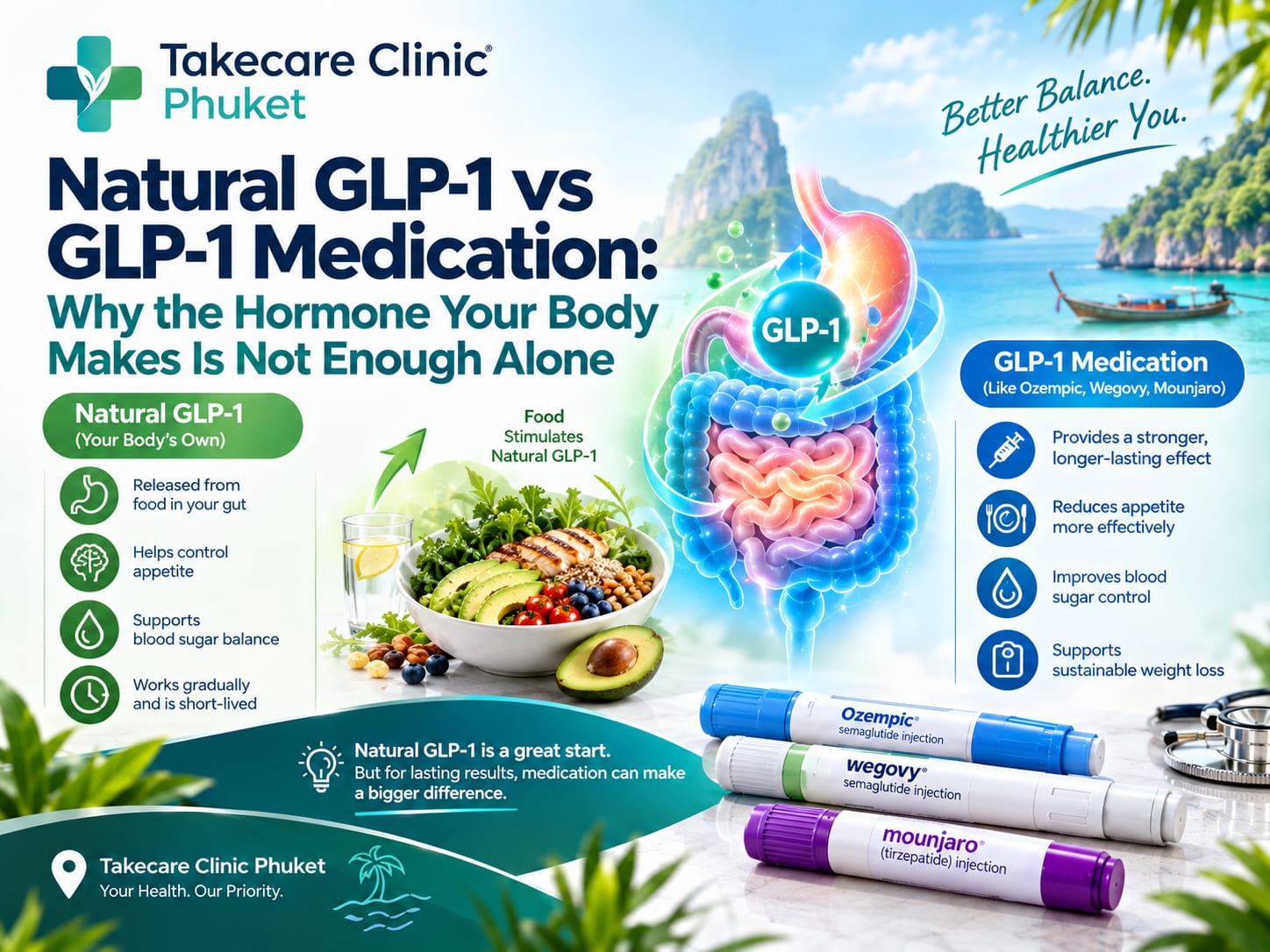
Your body makes GLP-1 naturally after every meal, but an enzyme called DPP-4 destroys it within roughly two minutes. GLP-1 medications like semaglutide are engineered to survive that destruction and stay active for days. That structural difference is why medication produces meaningfully greater weight loss than diet and lifestyle changes alone, particularly in people with obesity.
A long-stay expat in Chalong asked me this recently. He had cleaned up his diet, added evening walks around the reservoir, cut back on the Singha, and read enough about GLP-1 to know it is a gut hormone involved in appetite and blood sugar. He wanted to know whether the high-fibre breakfasts and HIIT sessions at the gym near Nai Harn were actually doing anything, or whether he was just avoiding a harder conversation about medication.
The honest answer is: both things are true at the same time.
Your gut does release GLP-1 after meals. The problem is not how much it releases. The problem is how fast your body destroys it. That single biological fact is what makes the natural GLP-1 versus medication comparison clear.

What Natural GLP-1 Is and Where It Comes From
GLP-1 stands for glucagon-like peptide-1. It is a hormone made by cells in your small intestine, released when food arrives after eating. It tells your pancreas to release insulin, slows how quickly your stomach empties, and signals your brain that you are getting full.
Your body makes it every time you eat. Certain foods stimulate more of it than others. High-fibre vegetables, oats, fermented foods, and protein all support GLP-1 release. Higher-intensity exercise adds to that.
The issue is what happens next.
Why Natural GLP-1 Disappears in Minutes
An enzyme called DPP-4 cleaves the GLP-1 molecule and inactivates it within roughly two minutes of release. Your kidneys clear what remains. The half-life of your own GLP-1 is under two minutes.
That is not a flaw. Short hormone pulses keep metabolic signalling precise. The problem comes when you need a sustained effect for weight management and blood sugar control. A two-minute signal cannot do that.
This is why natural GLP-1 is short-lived and why no amount of fibre or exercise changes that biological ceiling.

How GLP-1 Medications Are Engineered to Last
Semaglutide, the active ingredient in Ozempic and Wegovy, is a synthetic GLP-1 analogue with one key modification. It carries a fatty acid chain that binds to albumin, a protein in your blood. That binding shields the molecule from DPP-4. The result is a half-life of around seven days, compared to under two minutes for your own hormone.
Tirzepatide targets two gut hormone receptors rather than one, but the principle is the same: structural engineering to survive long enough to produce a sustained clinical effect. These are prescription medicines regulated by the Thai FDA, not supplements.
What the Numbers Actually Show
This is where the comparison becomes concrete. Intensive lifestyle programs, meaning structured diet and exercise intervention, typically produce weight loss of around five to ten percent of body weight, based on data from major trials including the Diabetes Prevention Program. That is clinically meaningful and worth doing.
Large randomised trials of semaglutide at the weight-management dose showed average body weight reductions of approximately fifteen percent. The STEP 1 trial reported a mean reduction of 14.9% of body weight at 68 weeks. Tirzepatide trials showed higher figures still in some populations. These are not marginal differences, and the gap matters most for people who have made genuine lifestyle effort without seeing the results they need.
| Approach | Typical Weight Loss | Duration of Effect |
|---|---|---|
| Diet and exercise alone | 5-10% body weight | Requires sustained effort |
| Natural GLP-1 boosting foods | Modest, transient signal | Minutes |
| GLP-1 medication (semaglutide) | ~15% body weight in trials | Weekly dosing |
Why Natural Approaches Work Even Less If You Have Obesity
People with obesity tend to have a blunted postprandial GLP-1 response. After a meal, the amount of GLP-1 their gut releases is lower than in people without obesity. The very population most likely researching this topic is also the population for whom dietary GLP-1 boosting works least well.
This is not a character issue. It is a physiological one. Obesity itself alters gut hormone signalling. It is one of the clearest clinical arguments for why lifestyle changes alone are often insufficient once obesity is established, and why medication changes the equation.
Can Natural GLP-1 Boosters Still Help Alongside Medication
Yes, and they should. Natural approaches and GLP-1 medication are not competing choices.
High-fibre meals slow gastric emptying and support gut hormone signalling. Regular exercise improves insulin sensitivity and helps your body respond more efficiently to the medication. Adequate sleep reduces the hormonal disruption that drives appetite. Keeping meals small and fibre-rich also helps manage the most common side effect of GLP-1 medication: nausea. That is a very direct reason to keep working on diet quality even after starting a prescription.
Getting GLP-1 Medication Safely in Phuket
Thailand regulates GLP-1 weight-loss pens as prescription-only. You cannot legally purchase semaglutide or tirzepatide over the counter here. The Thai FDA has issued warnings about counterfeit and unregulated products circulating through informal sellers and some online channels. Fake GLP-1 pens containing incorrect doses or unverified contents have been seized. This is a real risk in Phuket, not a hypothetical one.
Getting a legitimate prescription means seeing a licensed physician who can assess your suitability, check for contraindications, and support ongoing monitoring. If you have a personal or family history of medullary thyroid carcinoma or MEN2 (multiple endocrine neoplasia type 2), GLP-1 medications are not appropriate for you. A history of pancreatitis or significant gastrointestinal disease also requires careful assessment before starting.
Takecare Clinic Phuket in Patong takes walk-in patients with no appointment needed. A physician can review your history, discuss whether GLP-1 medication is appropriate, and issue a prescription the same day if suitable. For expats and long-stay visitors already on GLP-1 medication at home, the clinic can review your existing prescription and support continuity of care. Bring documentation of your current dose and prescribing physician if you have it. Details about prescription refill support in Phuket are on the clinic website.
Before starting any weight management intervention, a blood test in Phuket to check fasting glucose, HbA1c, and lipids gives a useful baseline. You can arrange this at the same walk-in visit. If you have questions before coming in, telemedicine in Phuket is also available through the clinic.
Takecare Clinic Phuket offers walk-in physician assessment for GLP-1 medication, prescription refills for patients already on treatment, and blood testing for metabolic health. No appointment needed. Based in Patong, serving patients from Rawai and Nai Harn to Bang Tao and Kamala. Visit takecareclinicphuket.com or come in directly.
Frequently Asked Questions
Dr. Ponlawat Pitsuwan
Physician, Takecare Medical Clinic Phuket
a walk-in medical clinic based in Patong with no appointment needed and English-speaking physician care available across the island. He sees tourists, expats, and residents for metabolic health assessment, GLP-1 medication consultation, weight management, and prescription refill support for patients continuing treatment from their home country. His focus is straightforward, evidence-based care delivered in plain language.
References
- Wilding JPH et al. Once-weekly semaglutide in adults with overweight or obesity. New England Journal of Medicine. 2021;384:989-1002.
- Lau J et al. Discovery of the once-weekly glucagon-like peptide-1 (GLP-1) analogue semaglutide. Journal of Medicinal Chemistry. 2015;58(18):7370-7380.
- Knowler WC et al. Reduction in the incidence of type 2 diabetes with lifestyle intervention or metformin (Diabetes Prevention Program). New England Journal of Medicine. 2002;346(6):393-403.
- World Health Organization. Obesity and overweight: key facts. WHO. 2024.
The information in this article is for educational purposes only and does not constitute medical advice. It should not be used to self-diagnose or replace a consultation with a qualified physician. If you have concerns about your health, contact a licensed medical professional. For appointments at Takecare Clinic Phuket, visit takecareclinicphuket.com.