Clinically reviewed by Dr. Ponlawat Pitsuwan, Physician, Takecare Clinic Phuket. Last reviewed: September 2026
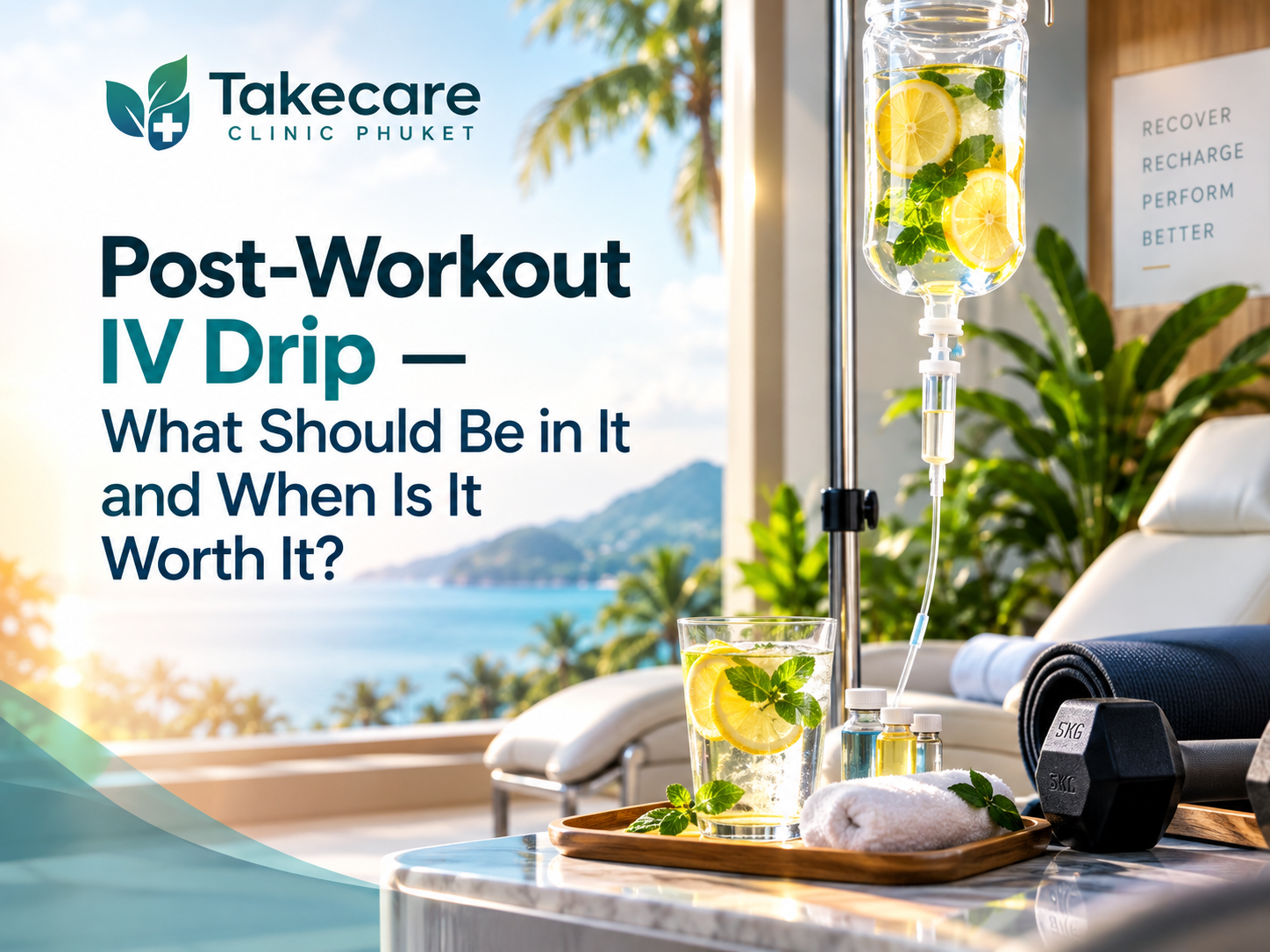
A post-workout IV drip delivers fluids, electrolytes, and vitamins directly into the bloodstream, bypassing the gut for faster absorption. Whether it is worth it depends on how hard you trained, how much you sweated, and whether you can tolerate oral fluids. For serious athletes, prolonged outdoor training, or anyone training in Phuket’s heat and humidity, the case for IV recovery is stronger than most people realise. For a single air-conditioned gym session, a good sports drink and a meal will usually do the job.
You have just finished a two-hour Muay Thai session at a camp near Chalong. You drank water throughout, but by the end you were soaked, your calves were cramping, and the walk back to your car felt harder than it should. Now you are sitting there wondering whether that IV drip advertised at a clinic on the way in is useful or just expensive water. That is a fair question, and I get it a lot.
Phuket’s climate changes the recovery equation in a way that most generic wellness articles ignore. Training here in 32 to 35 degrees with high humidity means your body loses fluids and electrolytes faster than you are used to at home. Genuine dehydration arrives sooner than you expect. Whether a post-workout IV drip is the right answer depends on what your session looked like, what is actually in the drip, and whether your body needs it. Let me walk you through both.

What Goes Into a Post-Workout IV Drip
The base of any solid sports recovery drip is a sterile fluid. Normal saline or lactated Ringer’s solution makes up most of the bag. It rehydrates faster than drinking because it goes straight into the bloodstream, with no delay for the gut.
Electrolytes come next. Sodium, potassium, magnesium, and calcium are all lost through sweat. Magnesium matters most for muscle function and cramp prevention. After a heavy session in the heat, oral electrolyte drinks often cannot keep pace with what you have lost.
B vitamins support energy metabolism and help reduce post-exercise fatigue. Vitamin C at higher doses acts as an antioxidant that damps down the inflammation that builds during intense training. Some formulations include amino acids such as branched-chain amino acids and glutamine, which support muscle repair after hard sessions.
Optional Add-Ons Worth Considering
Glutathione is an antioxidant the body produces naturally. IV delivery reaches higher tissue concentrations than oral supplements, and some athletes use it to reduce oxidative stress after long or intense training blocks. The evidence supporting it is moderate rather than strong, but it is a reasonable addition for anyone doing back-to-back training days.
L-carnitine supports fat metabolism and may reduce muscle damage markers after prolonged aerobic exercise. The evidence is limited but not absent. NAD+ is increasingly popular for cellular energy and recovery, though the research is still early. At Takecare Clinic Phuket, a physician reviews your session and your situation before selecting any add-ons. There is no fixed menu that works for every patient.
Why Phuket’s Climate Changes the Recovery Equation
I see this most clearly with patients arriving from cooler countries. They train at the same intensity they do at home, expect the same recovery, and are surprised by how flat they feel the next day.
In Phuket’s heat and humidity, your body sweats significantly more than it does in a temperate climate, even at the same exercise intensity. Even a two percent drop in fluid levels can impair muscle function and slow recovery. That threshold is reached much faster here than in Europe or East Asia.
For Muay Thai fighters doing two sessions a day, triathletes on the coastal roads near Rawai, or cyclists grinding through the hills toward Kamala or Bang Tao, the physiological case for IV rehydration is genuinely stronger than in cooler environments. Casual exercise is a different story. An hour in an air-conditioned gym in Patong is not the same event. Oral hydration with a proper electrolyte drink and food is usually enough, and I would rather be honest about that than oversell a drip to someone who does not need it.
When a Post-Workout IV Drip Is Actually Worth It
There is a real post-exercise recovery window. Coming in within one to two hours of finishing a hard session means the drip supports the body while it is still in active recovery mode. A drip the following morning still helps if soreness and fatigue persist, but earlier is better after the most intense sessions.
The patients who benefit most trained hard in outdoor heat, lost large amounts of fluid, have persistent cramping or fatigue despite drinking, or cannot get enough oral fluid down to replace what they lost. Athletes doing multi-day training blocks with short recovery gaps are also well-suited to IV rehydration, because oral intake alone often falls short.
If you did a moderate gym session, drank throughout, feel reasonable, and are eating a proper meal, you probably do not need a drip. I will tell you that directly if you come in and that turns out to be your situation. You can read more about what IV therapy for recovery involves at our IV therapy page.
Who Should Not Skip the Physician Assessment
This is the section no wellness spa or mobile drip service will write for you. Some post-workout presentations are not simply dehydration.
If you finish a session with confusion, very dark or reduced urine, persistent vomiting, severe muscle weakness, or a feeling that you might collapse, those symptoms need full medical assessment. Not a commercial wellness drip. A doctor.
Exertional heat stroke is a real risk in Phuket’s climate and it looks like bad dehydration until it does not. Rhabdomyolysis, where muscle tissue breaks down rapidly, produces similar symptoms and requires blood and urine testing to identify it properly. Competitive athletes subject to WADA anti-doping rules should also know that IV infusions over 100ml may require a Therapeutic Use Exemption. This is rarely mentioned in wellness-focused settings.
Takecare Clinic Phuket is a physician-led walk-in facility. A doctor sees you before any drip is started. If your presentation turns out to be something more serious, we have the clinical capacity to manage it and escalate if needed. A hotel spa nurse does not.
What to Expect at Takecare Clinic Phuket
Walk in, no appointment needed. A physician assesses you first, asking about your session, your symptoms, and your medical history. The drip formulation is chosen based on that assessment, not from a fixed price list. The session typically takes 30 to 45 minutes.
We see athletes and active visitors from across the island. Muay Thai camps near Chalong, cycling groups from Laguna, triathletes training out of Nai Harn. You do not need to be staying in Patong to come in. If you have questions about which post-workout IV drip formulation suits your training, the physician will go through that with you before anything is started. If you are planning a multi-day training block, IV therapy can be built into your recovery schedule from day one.
Trained hard today and not recovering the way you should? Walk into Takecare Clinic Phuket in Patong. No appointment needed, open extended hours, and a physician assesses you before any drip is started. Post-workout IV drip therapy tailored to your session type and Phuket’s climate, for Muay Thai fighters, triathletes, and endurance athletes training across the island. Walk in any time and we will work out what your body actually needs.
Frequently Asked Questions
Dr. Ponlawat Pitsuwan
Physician, Takecare Medical Clinic Phuket
a walk-in medical clinic based in Patong with no appointment needed and English-speaking physician care available across the island. He sees tourists, expats, and residents for IV therapy, sports recovery, dehydration management, and general medical assessment after intense training in tropical conditions. His approach is straightforward, evidence-based care delivered in plain language.