
Clinically reviewed by Dr. Ponlawat Pitsuwan, Physician, Takecare Clinic Phuket.
Last reviewed: October 2026
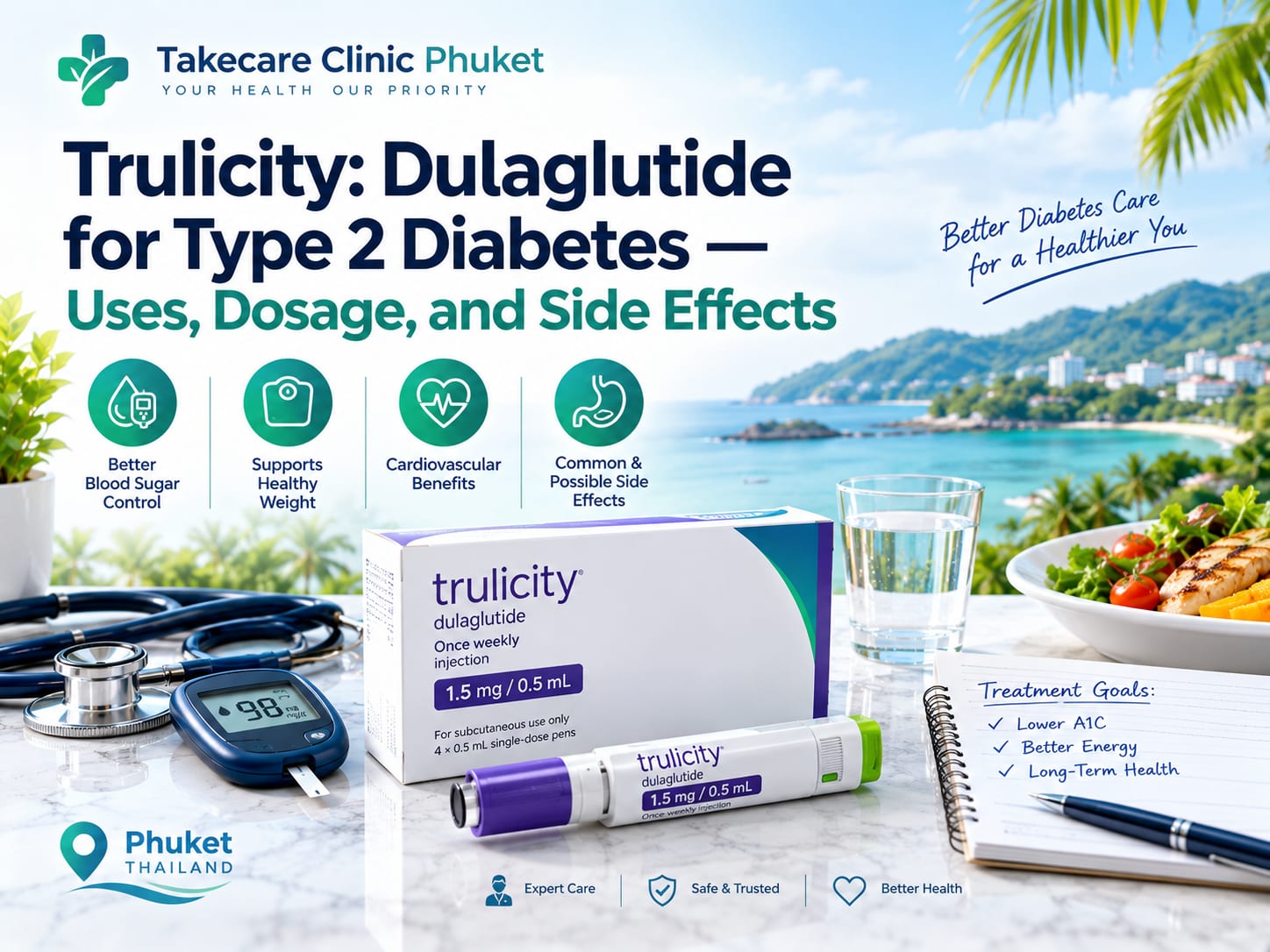
Trulicity (dulaglutide) is a once-weekly injectable medication for type 2 diabetes. It lowers blood sugar, reduces HbA1c, and in patients with established heart disease or high cardiovascular risk, it has been shown to reduce the risk of serious cardiac events. It is prescription-only in Thailand. If you are managing type 2 diabetes in Phuket and need a prescription review or a refill, a licensed physician can assess you the same day without a prior appointment.
You packed your Trulicity pens carefully before leaving home. Three weeks into a longer stay in Bang Tao, you open the villa fridge and realise you are down to your last one. Your GP is in another country. Your next dose is in four days. This is entirely manageable, but only if you act before you run out rather than after.
This guide covers how Trulicity works, the correct dosage steps, what side effects to expect, how to store your pens in Phuket’s heat, and what to do if you need a prescription continued while you are here. Whether you are a long-stay expat with established diabetes, a tourist managing a chronic condition mid-trip, or someone newly prescribed this medication, the information below is built for patients dealing with it in Phuket.
What Trulicity Does and Who It Is For
Trulicity contains dulaglutide, a GLP-1 receptor agonist. GLP-1 is a hormone your gut releases after eating. It prompts the pancreas to release insulin, slows how quickly your stomach empties, and reduces appetite. Dulaglutide mimics this effect, which is why it helps lower blood sugar after meals and can lead to modest weight loss in many patients.
It is approved for adults with type 2 diabetes to improve blood sugar control, and also for children aged 10 and above. It is not used for type 1 diabetes and is not an insulin replacement.
The REWIND trial, published in The Lancet in 2019, found that dulaglutide reduced the risk of major cardiovascular events, including heart attack and stroke, in adults with type 2 diabetes who had established heart disease or multiple cardiovascular risk factors. This makes it a reasonable choice for patients managing both diabetes and cardiovascular risk.
Trulicity Dosage: Starting Dose and Titration
The starting dose is 0.75 mg once weekly by subcutaneous injection. After at least four weeks, the dose can be increased to 1.5 mg once weekly if better blood sugar control is needed. Further increases to 3 mg and then 4.5 mg are possible, each requiring at least four weeks at the previous dose before stepping up.
Your prescribing doctor decides when and whether to increase the dose based on your HbA1c, your tolerance of side effects, and your overall treatment plan. Do not self-adjust. Dose changes should always be reviewed by a physician.

How to Inject Trulicity: The Autoinjector Pen
Each Trulicity pen is a single-use autoinjector. You do not dial a dose or attach a needle. Take the pen from the fridge, let it reach room temperature for about 30 minutes, then choose an injection site: abdomen, upper arm, or thigh. Rotate sites each week to reduce skin irritation.
Remove the base cap, place the pen flat against your skin, unlock the green button, then press and hold until you hear a click and the grey plunger is visible in the window. Hold for a few more seconds, then remove. Do not rub the injection site afterwards.
Used pens are sharps waste. Do not discard them in a hotel bin. Bring a travel sharps container or ask at a local pharmacy about safe disposal options.
Side Effects to Expect, Especially in the First Weeks
Nausea is the most common side effect and is most noticeable in the first few weeks after starting or after a dose increase. It usually settles as your body adjusts. Vomiting, diarrhoea, and reduced appetite are also common early on.
In Phuket’s heat, nausea combined with reduced fluid intake can lead to dehydration faster than you would expect at home. If you are vomiting repeatedly and cannot keep fluids down, that warrants a same-day clinic visit. Mild nausea alone, without vomiting or signs of dehydration, is expected and does not need a clinic trip.
Severe and persistent abdominal pain, especially pain that radiates to the back, needs urgent assessment. This can be a sign of pancreatitis, an inflammation of the pancreas. Acute kidney injury has also been reported, usually in the context of prolonged vomiting or diarrhoea causing dehydration.
Who Should Not Take Trulicity
Trulicity carries a boxed warning for the risk of thyroid C-cell tumours based on animal studies. It is contraindicated in patients with a personal or family history of medullary thyroid carcinoma and in patients with Multiple Endocrine Neoplasia syndrome type 2 (MEN 2).
It should not be used in type 1 diabetes or for treating diabetic ketoacidosis. Patients with a history of pancreatitis should discuss the risk with their doctor before starting. There is a precaution for patients with pre-existing diabetic retinopathy, as rapid improvement in blood sugar control can sometimes worsen retinopathy in the short term. Patients with severely slowed stomach emptying (gastroparesis) should also use caution, as GLP-1 medications slow gastric motility further.
Trulicity is not recommended during pregnancy. Speak to your doctor if you are pregnant or planning to become pregnant.
Trulicity vs Ozempic: How They Compare
Both Trulicity (dulaglutide) and Ozempic (semaglutide) are once-weekly GLP-1 receptor agonists for type 2 diabetes. The SUSTAIN-7 trial found that semaglutide produced greater reductions in HbA1c and greater weight loss than dulaglutide at the doses studied. That does not automatically make Ozempic the better choice for every patient.
Trulicity’s autoinjector is simpler to use. There is no dose dialling, no needle attachment, and no prime step. For patients who are new to self-injecting, this matters. Trulicity is also approved for use in children aged 10 and above, while Ozempic is not. For a direct comparison in the context of your own history, that conversation is worth having with a physician. You can review the full comparison of Trulicity vs Ozempic or speak with a doctor directly if your usual prescriber is not accessible while you are in Phuket.
Storing Trulicity in Phuket’s Heat
This is the section most patients need most. According to the Trulicity product label, pens should be stored in the refrigerator between 2°C and 8°C. Once removed from the fridge, a pen can be kept at room temperature up to 30°C for up to 14 days. After 14 days at room temperature, or if the pen has been exposed to temperatures above 30°C, it must be discarded.
Phuket’s ambient temperature routinely sits between 30°C and 35°C. A hotel room without air conditioning, a beach bag, a car parked in the sun, or a villa balcony can all exceed safe storage temperature quickly. A hotel minibar set to its lowest setting is your best option if a full refrigerator is not available.
Never leave pens in a glove box or a bag left in a vehicle. Never store them at the beach. If you are unsure whether a pen has been heat-damaged, discard it and get a replacement rather than inject a potentially degraded medication.
What to Do If You Miss a Dose While Travelling
According to the Trulicity prescribing information, if you miss a dose and your next scheduled dose is three or more days (72 hours) away, take the missed dose as soon as you remember. If fewer than 72 hours remain before your next scheduled dose, skip the missed dose and continue your normal weekly schedule.
Never take two doses in the same week to make up for a missed one. For travellers crossing time zones, anchor your injection to a fixed day of the week rather than a fixed time of day. The 24-hour window is generous enough that a morning-to-evening shift is not clinically significant.
Getting a Trulicity Prescription Continued in Phuket
Dulaglutide is registered in Thailand and available at major hospital pharmacies and some private pharmacies in Phuket. Under Thai law, it is prescription-only. No pharmacy will legally dispense it without a valid prescription from a Thai-licensed physician.
If you have run out, are about to run out, or need a prescription review while staying anywhere on the island, from Rawai and Nai Harn in the south to Kamala, Surin, and Bang Tao in the north, Takecare Clinic Phuket can see you the same day without an appointment. Bring whatever documentation you have: your home prescription, a photograph of your medication packaging, or your medical records if available. A physician will review your diabetes management and issue a Thai prescription if appropriate.
For ongoing prescription management rather than a single refill, a prescription refill consultation is the right starting point. If your diabetes is part of a broader health picture and you want a more complete review while you are here, a health check-up can cover HbA1c, blood glucose, kidney function, and cardiovascular markers in one visit. If you need blood tests in Phuket run as a standalone, that is available at the same clinic.
If you are managing type 2 diabetes in Phuket and need a Trulicity prescription reviewed, renewed, or issued for the first time, Takecare Clinic Phuket sees patients island-wide with no appointment needed. English-speaking physician care is available at our Patong clinic at 34/14 Prachanukhro Rd. Walk in, or contact us through takecareclinicphuket.com to reach us from Kata, Karon, Rawai, Bang Tao, or anywhere else on the island.
FAQ
Dr. Ponlawat Pitsuwan
Physician, Takecare Medical Clinic Phuket
a walk-in medical clinic based in Patong with English-speaking physician care and no appointment needed. He sees tourists, expats, and residents across the island for chronic disease management including type 2 diabetes, prescription continuity, and ongoing care for patients without a local GP. His focus is straightforward, evidence-based care delivered in plain language.
References
- Gerstein HC, et al. Dulaglutide and cardiovascular outcomes in type 2 diabetes (REWIND): a double-blind, randomised placebo-controlled trial. Lancet. 2019;394(10193):121-130.
- U.S. Food and Drug Administration. Trulicity (dulaglutide) Prescribing Information. FDA Label, 2026.
- American Diabetes Association. Standards of Medical Care in Diabetes 2024. Diabetes Care. 2024;47(Suppl 1).
- American College of Cardiology. Researching Cardiovascular Events With a Weekly Incretin in Diabetes (REWIND) trial summary. ACC, 2019.
The information in this article is for educational purposes only and does not constitute medical advice. It should not be used to self-diagnose or replace a consultation with a qualified physician. If you have concerns about your health, contact a licensed medical professional. For appointments at Takecare Clinic Phuket, visit takecareclinicphuket.com.
