
Clinically reviewed by Dr. Ponlawat Pitsuwan, Physician, Takecare Clinic Phuket.
Last reviewed: October 2026
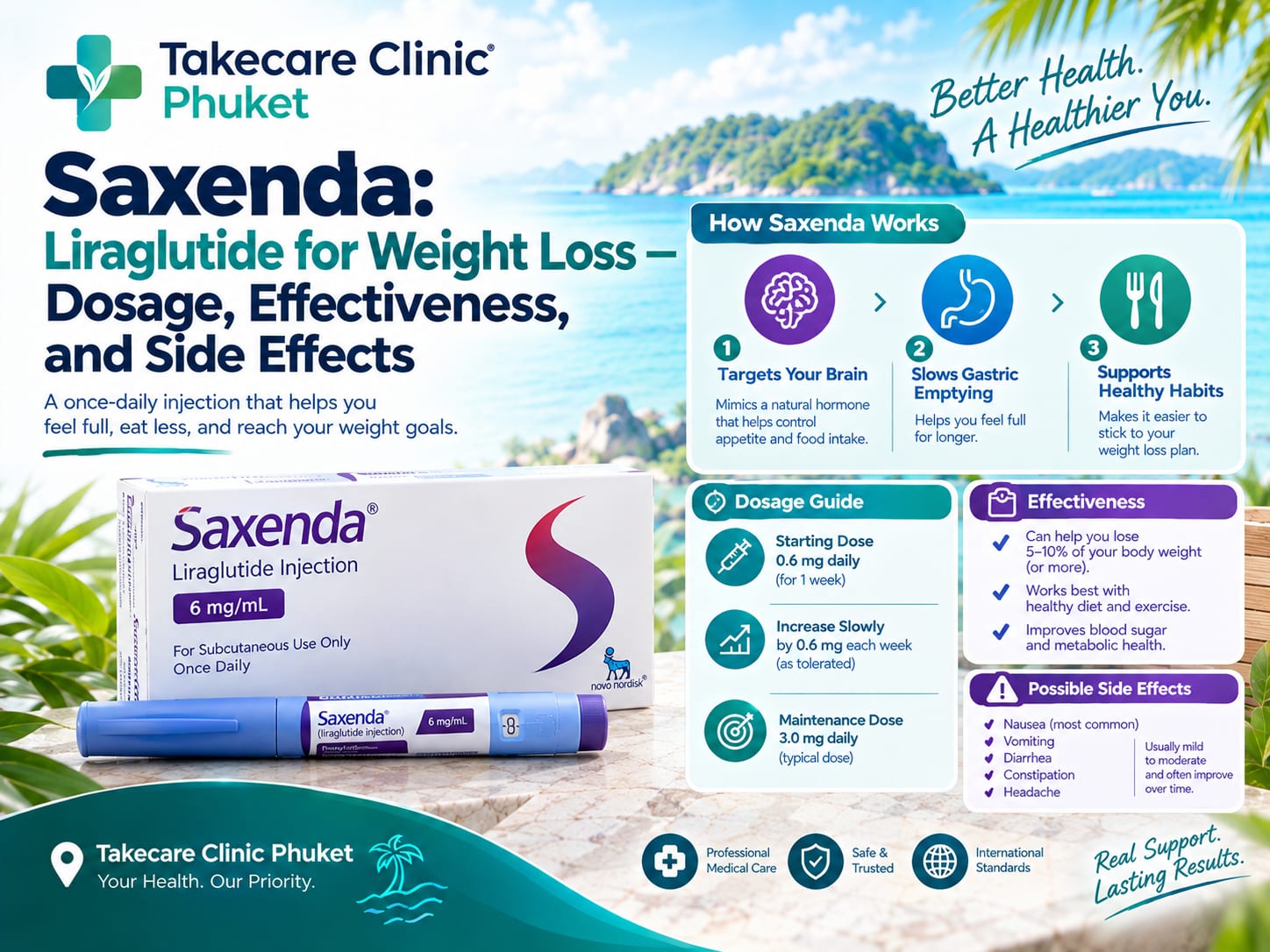
Saxenda (liraglutide 3 mg) is a once-daily injectable GLP-1 medication approved for chronic weight management in adults with a BMI of 30 or above, or 27 and above with a weight-related health condition. It is started at a low dose and increased over five weeks to reduce side effects. In the SCALE Obesity and Prediabetes trial, participants at the full 3 mg dose lost an average of around 8 percent of body weight over 56 weeks when combined with diet and exercise. It is prescription-only in Thailand and requires a physician consultation before starting.
Many patients asking about Saxenda in Phuket are in the same position: they have been managing their weight carefully at home, their GP and their prescription are both back in Europe or Australia, and they want to know whether they can get a proper consultation here without flying home. You can. A walk-in consultation with an English-speaking physician at Takecare Clinic Phuket covers the eligibility check, medical history review, and prescription in a single visit.
This guide covers what Saxenda actually does, who qualifies, how dosing works, what results look like, and the safety warnings that matter most for patients living on or visiting the island.
How Saxenda Works for Weight Loss
Saxenda contains liraglutide, which mimics a hormone your gut releases after eating. That hormone tells your brain to reduce appetite and slows how quickly food leaves your stomach. You feel full sooner and stay full longer.
This is not a willpower fix. It changes the signals your brain receives about hunger. Most patients notice they are simply less driven by food, without having to fight the urge constantly.
It does not burn fat directly. It works by making it easier to maintain a caloric deficit, which is still the mechanism behind any weight loss. Patients who do not also adjust their eating and activity tend to see much smaller results.
Who Qualifies for Saxenda
The approved adult criteria: a BMI of 30 or above, or a BMI of 27 or above with at least one weight-related condition such as type 2 diabetes, high blood pressure, or high cholesterol. Saxenda is also approved for adolescents aged 12 to 17 with a BMI at or above the 95th percentile for age and sex and a body weight above 60 kg, though this age group needs more careful clinical oversight.
For expats and long-stay visitors in Phuket, the consultation follows the same process: BMI check, blood pressure, medical history, and a review of current medications for interactions. If you have recent blood results from home showing cholesterol, blood glucose, or thyroid function, bring them. Useful, but not required.

Who Should Not Take Saxenda
Anyone with a personal or family history of medullary thyroid carcinoma or Multiple Endocrine Neoplasia syndrome type 2 should not use Saxenda. It is not approved in pregnancy. It should not be combined with other GLP-1 medications or used in people with severe gastrointestinal conditions such as gastroparesis.
Saxenda has not been studied in patients with severe heart failure, end-stage renal disease, or severe liver impairment, and is generally not recommended in these groups. A physician consultation will identify any of these before you start.
The Saxenda Dosage Schedule
The dose increases gradually over five weeks. Starting low reduces nausea and other early side effects.
| Week | Daily Dose |
|---|---|
| Week 1 | 0.6 mg |
| Week 2 | 1.2 mg |
| Week 3 | 1.8 mg |
| Week 4 | 2.4 mg |
| Week 5 onwards | 3.0 mg (maintenance) |
If side effects are significant at any step, the dose increase can be delayed by a week. The maximum approved dose is 3.0 mg per day. Going above this does not improve results and increases side effect risk.
Saxenda is injected under the skin in the abdomen, thigh, or upper arm. Rotating sites reduces skin reactions. If the pen has been stored in the fridge, let it reach room temperature before injecting. Cold medication is noticeably more uncomfortable.
What Results to Expect, and the 12-Week Rule
In the SCALE Obesity and Prediabetes trial, participants on liraglutide 3 mg lost an average of around 8 percent of body weight over 56 weeks, compared to around 2.6 percent with placebo. Both groups followed diet and exercise guidance. That is a real but moderate result.
The 12-week checkpoint matters. If you have not lost at least 5 percent of your starting body weight by week 12 at the full 3 mg dose, the EMA prescribing guidance recommends reconsidering whether to continue. Carrying on without a meaningful response just means ongoing cost and side effect exposure without benefit.
Weight loss typically slows after the first few months. A plateau is normal and does not mean the medication has stopped working. It does mean your dietary approach needs to keep pace with the medication, not rely on it alone.
Saxenda Side Effects and How to Handle Them
Nausea is the most common side effect, particularly during dose escalation. It usually improves once your body adjusts to each new dose. Eating smaller meals, avoiding high-fat food, and not lying down immediately after eating all reduce it. Vomiting, diarrhoea, and constipation are also common in the early weeks. If you are dealing with significant diarrhoea, diarrhoea treatment is available at the clinic separately.
Pancreatitis is a more serious but less common risk. If you develop severe, persistent abdominal pain that spreads to your back, stop the medication and get seen the same day. Gallbladder problems, including gallstones, are associated with rapid weight loss generally and have been reported with Saxenda.
An increased resting heart rate has also been reported. If your pulse feels consistently elevated, tell your doctor.
The Anaesthesia Warning Saxenda Patients in Phuket Need to Know
Saxenda slows gastric emptying. Food and liquid stay in your stomach longer than they would without the medication. If you go under general anaesthesia or deep sedation without your anaesthetist knowing you are on Saxenda, there is a concern about inhaling stomach contents into your lungs, called pulmonary aspiration, because retained gastric contents are increased with GLP-1 medications. This is a serious complication.
Tell every doctor, anaesthetist, dentist, or dive medical examiner that you are on Saxenda before any procedure involving sedation. Do not wait to be asked. Your anaesthetist may need to extend your fasting period or adjust the approach entirely.
Travelling with Saxenda Across Phuket, Storage That Actually Works Here
Unopened pens must be kept refrigerated between 2 and 8 degrees Celsius and must not be frozen. A pen that has been frozen is no longer safe to use. Once you start a pen, it can stay at room temperature below 30 degrees Celsius for up to 30 days.
In Phuket’s heat, that rule has real teeth. Keep the pen out of your beach bag, your car, and any direct sunlight. Most hotel rooms have a mini-fridge that works fine. If you are moving between Patong, Kata, Rawai, or up toward Laguna and Bang Tao, think about where the pen is going before you leave.
Flying in with a personal supply? Carry pens in hand luggage, not checked baggage, where hold temperatures can drop below freezing. Keep the pharmacy label on the box. Thai customs allows personal medication with appropriate documentation.
Saxenda vs Ozempic and Wegovy, Which One Is Right for You
Saxenda uses liraglutide at 3 mg injected daily. Ozempic uses semaglutide injected weekly and is approved for type 2 diabetes, though widely used off-label for weight loss. Wegovy is the semaglutide version approved specifically for obesity management. Semaglutide trials have generally shown greater average weight loss than liraglutide trials, though direct head-to-head comparisons in the same population are limited.
Availability in Thailand varies and changes. A physician consultation at Takecare Clinic Phuket is the right starting point to discuss which option is currently accessible, appropriate for your health profile, and realistic for ongoing management here on the island.
Getting a Saxenda Consultation in Phuket
You do not need a prescription from home, a referral, or an appointment. The eligibility assessment at Takecare Clinic Phuket covers BMI, blood pressure, medical history, and current medications. If you qualify, the physician issues the prescription and walks you through dosing and injection technique before you leave.
If you are already on Saxenda and need to continue while in Phuket, bring whatever you have: the pen, a pharmacy label, or previous prescription records. The prescription refill service allows ongoing management without interrupting treatment. An English-speaking physician is available for all consultations.
The clinic is at 34/14 Prachanukhro Road in the Kathu District and sees patients from across the island, from Kamala and Surin in the north to Rawai and Nai Harn in the south.
Considering Saxenda for weight management in Phuket? Takecare Clinic Phuket offers walk-in consultations with an English-speaking physician, no appointment needed. The consultation covers eligibility assessment, medical history review, and prescription in a single visit. We see patients from across the island, from Patong and Kata to Rawai, Chalong, Bang Tao, and Phuket Town. Visit us at 34/14 Prachanukhro Road, Kathu District, or see all services at takecareclinicphuket.com.
Frequently Asked Questions
Dr. Ponlawat Pitsuwan
Physician, Takecare Medical Clinic Phuket
a walk-in medical clinic based in Patong with English-speaking physician care available across the island. He sees tourists, expats, and long-stay residents for chronic weight management, GLP-1 medication consultations, prescription refills, and ongoing care for patients without a home GP in Phuket. His approach is straightforward and evidence-based.
References
- Pi-Sunyer X, et al. A Randomized, Controlled Trial of 3.0 mg of Liraglutide in Weight Management. N Engl J Med. 2015;373:11-22.
- Davies MJ, et al. Efficacy of Liraglutide for Weight Loss Among Patients With Type 2 Diabetes: The SCALE Diabetes Randomized Clinical Trial. JAMA. 2015;314(7):687-699.
- European Medicines Agency. Saxenda: EPAR — Product Information. EMA.
- US Food and Drug Administration. Saxenda (liraglutide) Prescribing Information. FDA. 2014.
- Perioperative Medicine Journal. GLP-1 receptor agonists and perioperative aspiration risk: a narrative review. 2024.
The information in this article is for educational purposes only and does not constitute medical advice. It should not be used to self-diagnose or replace a consultation with a qualified physician. If you have concerns about your health, contact a licensed medical professional. For appointments at Takecare Clinic Phuket, visit takecareclinicphuket.com.
