
Clinically reviewed by Dr. Ponlawat Pitsuwan, Physician, Takecare Clinic Phuket.
Last reviewed: October 2026
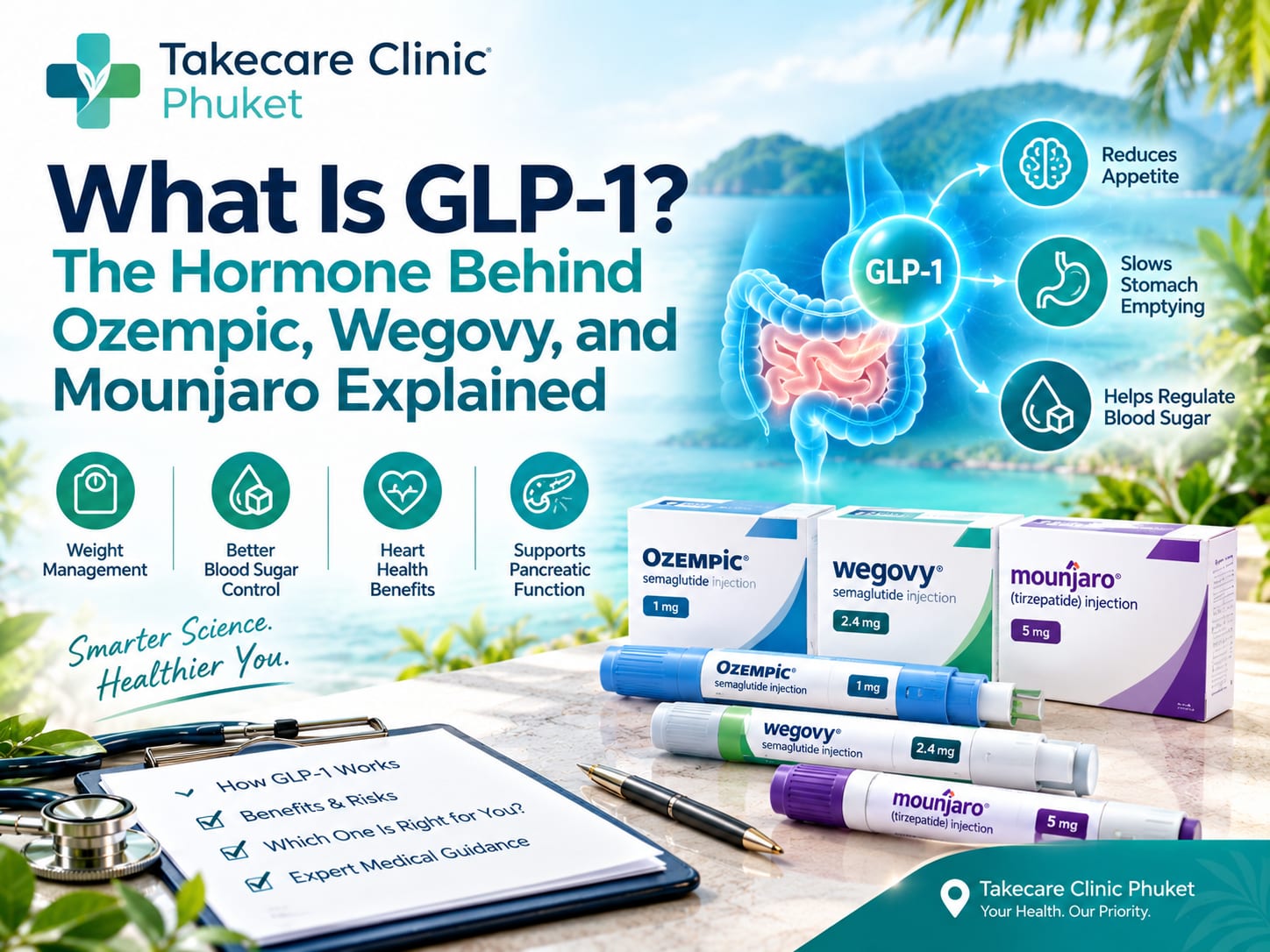
GLP-1, glucagon-like peptide-1, is a hormone your gut produces naturally after you eat. It tells your pancreas to release insulin, slows digestion, and signals your brain to reduce appetite. Medications like Ozempic, Wegovy, and Mounjaro are designed to mimic and extend those effects. They are not GLP-1 itself. They are synthetic compounds that bind to the same receptors and keep them active far longer than your body would on its own.
Many long-stay expats and tourists across Phuket are reading about Ozempic and related medications and want a clear answer to two questions: what actually is GLP-1, and does any of this apply to me?
GLP-1 is a hormone your small intestine releases every time you eat. It prompts your pancreas to produce insulin, slows how quickly food leaves your stomach, and sends a signal to your brain that you are full. The medications you keep reading about do not add GLP-1 to your body. They activate the same receptors and hold them open far longer, which is why their effects on blood sugar and appetite are so much stronger than your body’s own hormone.

What GLP-1 Actually Does in Your Body
Your gut releases GLP-1 within minutes of eating. It travels to your pancreas and triggers insulin release. At the same time, it suppresses glucagon, the hormone that raises blood sugar, which is why GLP-1 medications are useful in type 2 diabetes management.
The slower gastric emptying is usually what patients feel first. Food sits in your stomach longer, so you feel full sooner and stay full longer. That is not a placebo effect. It is a direct physical consequence of the hormone doing its job.
GLP-1 also acts on appetite centres in the brain. Medications that mimic this do not suppress hunger through willpower. They change the hormonal signal itself.
Ozempic, Wegovy, and the Role of Semaglutide
Ozempic and Wegovy both contain the same active ingredient: semaglutide. The difference is the approved dose and the intended use. Ozempic is prescribed for type 2 diabetes at lower doses. Wegovy is the higher-dose version approved for chronic weight management.
Semaglutide binds to GLP-1 receptors in your pancreas, gut, and brain and activates them. Its half-life is roughly one week, which is why both medications are injected once weekly rather than daily.
The STEP 1 trial, published in the New England Journal of Medicine, showed semaglutide produced a mean body weight reduction of around 15 percent over 68 weeks in adults with obesity. That is significantly more than diet and lifestyle changes alone typically achieve.
How Mounjaro Works Differently: Dual GLP-1 and GIP Action
Mounjaro contains tirzepatide, which targets two receptors instead of one. It activates both GLP-1 receptors and GIP receptors. GIP, glucose-dependent insulinotropic polypeptide, is a second incretin hormone that works alongside GLP-1 to regulate insulin secretion and fat storage.
The SURMOUNT-1 trial showed mean body weight reductions of around 21 to 22 percent at the highest studied dose of tirzepatide, depending on the analysis method used. That is higher than the semaglutide figures, but Mounjaro is not simply a stronger version of Ozempic. It works through a broader mechanism.
Whether tirzepatide or semaglutide is right for a specific patient depends on medical history, current medications, and existing conditions. That decision requires a physician assessment, not an online comparison.
GLP-1 Side Effects and Safety Before You Start
The most common side effects are nausea, vomiting, and diarrhoea. These are most pronounced early on and typically improve as the body adjusts over time. Starting low and stepping up slowly is standard practice to reduce the intensity of these effects at each new dose level.
Less common but more serious risks include pancreatitis. If you develop severe abdominal pain while on these medications, stop and get medical attention. These medications are also contraindicated in patients with a personal or family history of medullary thyroid carcinoma or MEN2 syndrome, a rare endocrine condition.
In February 2026, the UK Medicines and Healthcare products Regulatory Agency updated prescribing information for semaglutide products (Ozempic, Wegovy, Rybelsus) to include a newly flagged very rare risk of NAION, non-arteritic anterior ischemic optic neuropathy. This is a rare eye condition that can cause sudden vision changes. The absolute risk is low, but it is now part of the informed consent conversation before starting treatment.
If you are managing other conditions at the same time, such as a gout flare or a chronic gastrointestinal issue, those interact with your candidacy assessment too.
What Is New in GLP-1 Therapy in 2026
Oral semaglutide is now available in some markets as a weekly pill rather than an injection, though the dose and efficacy profile differ from the injectable form. Availability in Thailand needs to be confirmed at the time of your consultation, as not all formulations have been approved here.
Orforglipron is an oral GLP-1 receptor agonist in late-stage development. Phase 3 trial data published in 2025 showed meaningful weight loss results, and regulatory review was ongoing as of mid-2026. It is not yet available for prescription.
CagriSema, a combination of semaglutide and cagrilintide, showed body weight reductions of around 22 to 23 percent in Phase 3 trial data in people with obesity, and regulatory submission was expected in early 2026. None of these pipeline medications are currently available at walk-in clinics in Phuket.
Am I a Candidate for GLP-1 Therapy?
The standard clinical threshold for prescribing these medications for weight management is a BMI of 30 or above, or a BMI of 27 or above with at least one weight-related condition such as type 2 diabetes, high blood pressure, or sleep apnoea.
Before prescribing, a physician will check your current medications for interactions, review your personal and family history for the contraindications above, and assess your kidney, thyroid, and pancreatic health. A baseline blood test is typically part of this process.
If you are a long-stay resident in Phuket without a regular GP, this is exactly the kind of assessment that fits a walk-in consultation. Takecare Clinic Phuket has English-speaking doctors who can review your full history, order the appropriate blood work, and discuss whether GLP-1 therapy is appropriate for you.
Getting GLP-1 Treatment in Phuket
Any GLP-1 prescription in Thailand requires assessment by a physician licensed in Thailand. You cannot legally self-import these medications or purchase them without a prescription. Counterfeit versions circulate online. Buying through unlicensed channels is a genuine safety risk, not a shortcut.
For tourists who arrived in Phuket already on a GLP-1 medication and need a prescription refill, a walk-in consultation at Takecare Clinic Phuket in Patong is straightforward. Bring your existing medication packaging, your prescription from home if you have it, and any recent blood test results.
For expats and long-stay residents across the island, from Rawai to Surin, who want to start GLP-1 therapy for the first time, the process begins with a medical history review and blood tests. The consultation is fully in English. Check current medication availability directly with the clinic, as supply of specific branded products in Thailand can vary.
Thinking about GLP-1 treatment in Phuket, or already on medication and need a prescription review? Takecare Clinic Phuket in Patong offers walk-in consultations with English-speaking physicians for GLP-1 candidacy assessment, blood testing, and prescription management. No appointment needed. Serving patients across the island, from Rawai and Chalong to Bang Tao and Kamala. Visit takecareclinicphuket.com/walk-in-doctor-phuket to find out more.
Frequently Asked Questions
Dr. Ponlawat Pitsuwan
Physician, Takecare Medical Clinic Phuket
a walk-in medical clinic in Patong with English-speaking physician care and no appointment needed. He sees tourists, expats, and long-stay residents across Phuket for weight management assessment, chronic disease management, and GLP-1 therapy consultations. His focus is evidence-based care delivered in plain language.
References
- Wilding JPH, et al. Once-Weekly Semaglutide in Adults with Overweight or Obesity. New England Journal of Medicine. 2021;384:989-1002.
- Jastreboff AM, et al. Tirzepatide Once Weekly for the Treatment of Obesity. New England Journal of Medicine. 2022;387:205-216.
- MHRA. MHRA updates guidance for semaglutide prescribers and patients. Press release, 5 February 2026.
- World Health Organization. Obesity and overweight fact sheet. 2024.
The information in this article is for educational purposes only and does not constitute medical advice. It should not be used to self-diagnose or replace a consultation with a qualified physician. If you have concerns about your health, contact a licensed medical professional. For appointments at Takecare Clinic Phuket, visit takecareclinicphuket.com.
