Clinically reviewed by Dr. Ponlawat Pitsuwan, Physician, Takecare Clinic Phuket. Last reviewed: September 2026
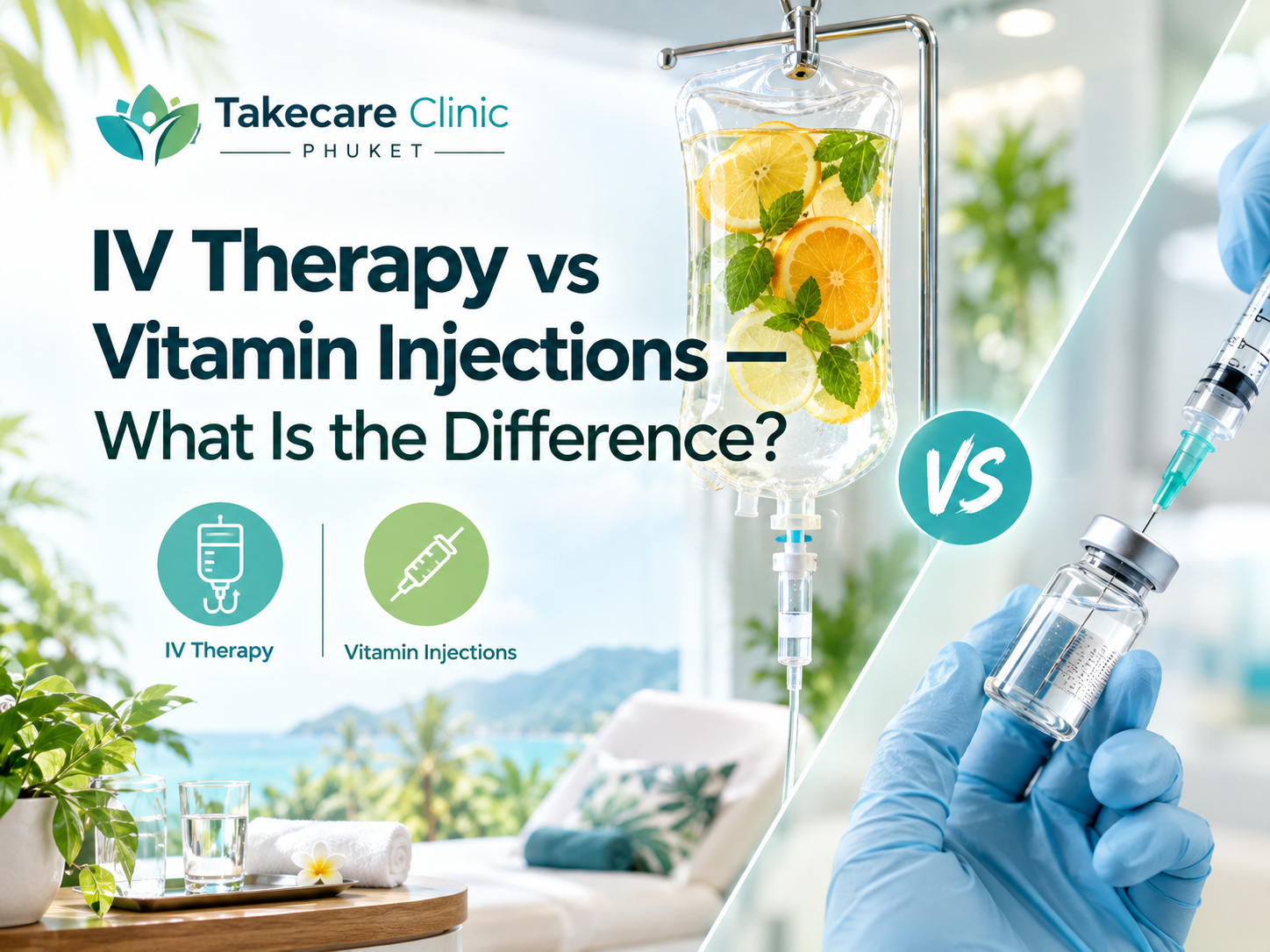
IV therapy delivers fluids, electrolytes, and nutrients directly into your bloodstream through a drip, making it the better choice when dehydration is part of the problem. A vitamin injection goes into muscle tissue and absorbs more slowly, but takes only a few minutes and works well for targeted nutrients like B12 or glutathione. Both are safe when a physician supervises the treatment. Neither replaces the other entirely.
You have just come off a liveaboard out of Chalong Pier. Three days diving the Similans, broken sleep, salt water, sun, and meals that were fine until they were not. Back in Phuket, you feel hollowed out. A friend suggests a drip. You search your phone, find clinics, spas, and mobile services all offering something, and now you are trying to work out whether you need an IV drip, a vitamin shot, or a glass of water and a lie-down.
I get this question every week. The short answer is that these two treatments work differently, suit different situations, and the setting where you get either one matters more than most people realise.

What Each Method Actually Does
An IV drip puts fluid, electrolytes, and nutrients straight into your vein. There is no absorption delay. Your body receives everything immediately. This is why IV therapy works fast for dehydration and why it helps when your gut is too unsettled to keep anything down.
A vitamin injection goes into muscle, usually your upper arm or buttock. Your body absorbs it gradually as the nutrient moves from the muscle into your bloodstream. It is slower than an IV, but still far faster and more complete than swallowing a supplement. For nutrients like B12 or glutathione, this route is well-established and effective.
The key point is this: an IV drip can replace lost fluid and deliver multiple nutrients at the same time. An injection cannot replace fluid. Those two facts drive most of the decision.
IV Therapy vs Vitamin Injections: A Direct Comparison
| IV Therapy | Vitamin Injection | |
|---|---|---|
| Delivery route | Directly into the vein | Into muscle tissue |
| Speed of effect | Immediate | 30 to 60 minutes to absorb |
| Fluids delivered | Yes, saline or Ringer’s solution | No |
| Time required | 30 to 60 minutes | 5 to 10 minutes |
| Best for | Dehydration, hangover, illness recovery | Targeted nutrient top-up, B12, glutathione |
| Volume of nutrients | Higher, multiple nutrients at once | Single or small combination |
| Physician needed | Yes | Yes |

When an IV Drip Makes More Sense in Phuket
Phuket’s heat and humidity push dehydration faster than most visitors expect. A full beach day at Kata or Nai Harn, a night out in Patong, or gastroenteritis from a dodgy buffet can leave you genuinely depleted. Not just low on one vitamin. Low on fluid, salt, and electrolytes.
A vitamin injection does not fix that. You need fluid replaced, and an IV drip with saline does it quickly. Common formulations like a Myers Cocktail add magnesium, B vitamins, and vitamin C to the saline base, covering several gaps in one session. I see this work well after food poisoning, after a dive trip, and after a heavy night in Patong.
Post-dive fatigue is the one patients underestimate most. Hours in the water, sun exposure, physical effort, and disrupted eating add up fast. A B12 shot alone does not touch it. An IV drip with electrolytes does.
When a Vitamin Injection Makes More Sense
If you are not dehydrated and you want one specific nutrient, an injection is faster, cheaper, and entirely adequate. B12 injections are the most common example. Vegetarians, older patients, and long-stay expats in places like Chalong or Cherng Talay often have low B12 that oral supplements are not correcting. An intramuscular injection bypasses the gut and restores levels reliably, with solid evidence behind it.
Glutathione injections are popular in Phuket for skin brightening and antioxidant support. The evidence for skin effects is limited, and I say that clearly to every patient who asks. For those managing fatigue alongside other care, glutathione can play a supportive role. High-dose vitamin C injections work similarly: a targeted option when dehydration is not the issue, not a substitute for an IV when it is.
If your main goal is a quick nutrient top-up and you do not need fluid replacement, a vitamin injection is a practical, low-time-cost option.
Safety: Why the Setting Matters as Much as the Treatment
This is the part the wellness market glosses over, and it is the part that matters most.
IV therapy carries real risks without proper supervision. Fluid overload is a genuine concern for patients with heart failure or kidney disease. High-dose vitamin C by IV is contraindicated if you have G6PD deficiency, a condition more common in Southeast Asian patients than many visitors realise. Allergic reactions happen. Vein irritation follows poor technique. Sterile conditions are not optional.
Vitamin injections carry fewer volume-related risks, but dose still matters. An unmonitored high-dose injection of the wrong compound can cause harm. The physician needs to know your medications, your existing conditions, and your reason for being there before choosing the dose.
I would not get either treatment from a spa or a mobile provider with no physician on site. The treatments themselves are safe. The risk is in skipping the clinical assessment that should happen first. At Takecare Clinic Phuket, every IV drip and injection starts with a physician consultation. That is not a formality. It is the part that makes it safe.
Can You Combine Both at the Same Visit?
Yes, and sometimes it makes sense. The most common scenario is an IV drip for hydration alongside a glutathione injection for antioxidant support. The drip handles the volume. The injection adds a targeted compound.
What I do not recommend is choosing that combination yourself from a menu. Let the physician assess your situation first. Sometimes a drip alone covers everything. Sometimes one injection is all you need. Combining both without a clear reason is not better care.
What to Expect at Takecare Clinic Phuket
You walk in without an appointment. A physician sees you first, asks about your symptoms, your medical history, and what you are hoping to achieve. For acute situations like dehydration or hangover recovery, that assessment is quick.
For expats or longer-stay visitors who suspect a B12, vitamin D, or iron deficiency, we can run blood work before dosing so the treatment matches your actual numbers. The IV drip runs for 30 to 60 minutes in a supervised clinical setting. A vitamin injection takes about five minutes. A doctor is present throughout.
If you are coming from Rawai, Chalong, or Nai Harn, the drive to us in Kathu takes under 30 minutes and is straightforward. Our IV therapy service page covers current formulations and what each is designed for.
Feeling flat, dehydrated, or rough after a long day in the Phuket heat or a big night in Patong? Takecare Clinic Phuket offers physician-supervised IV drips and vitamin injections with no appointment needed. Walk in any time. A doctor assesses you first, then recommends the right option for your actual situation. Based at 34/14 Prachanukhro Rd, Kathu District, serving the whole island from Rawai to Bang Tao. Find us at takecareclinicphuket.com.
Frequently Asked Questions
Dr. Ponlawat Pitsuwan
Physician, Takecare Medical Clinic Phuket
a walk-in medical clinic based in Kathu, Phuket, with no appointment needed and English-speaking physician care available across the island. He sees tourists, expats, and residents for IV therapy, vitamin injections, hangover recovery, dehydration treatment, and general wellness care. His approach is straightforward, evidence-based, and in plain language.