
Clinically reviewed by Dr. Ponlawat Pitsuwan, Physician, Takecare Clinic Phuket.
Last reviewed: October 2026
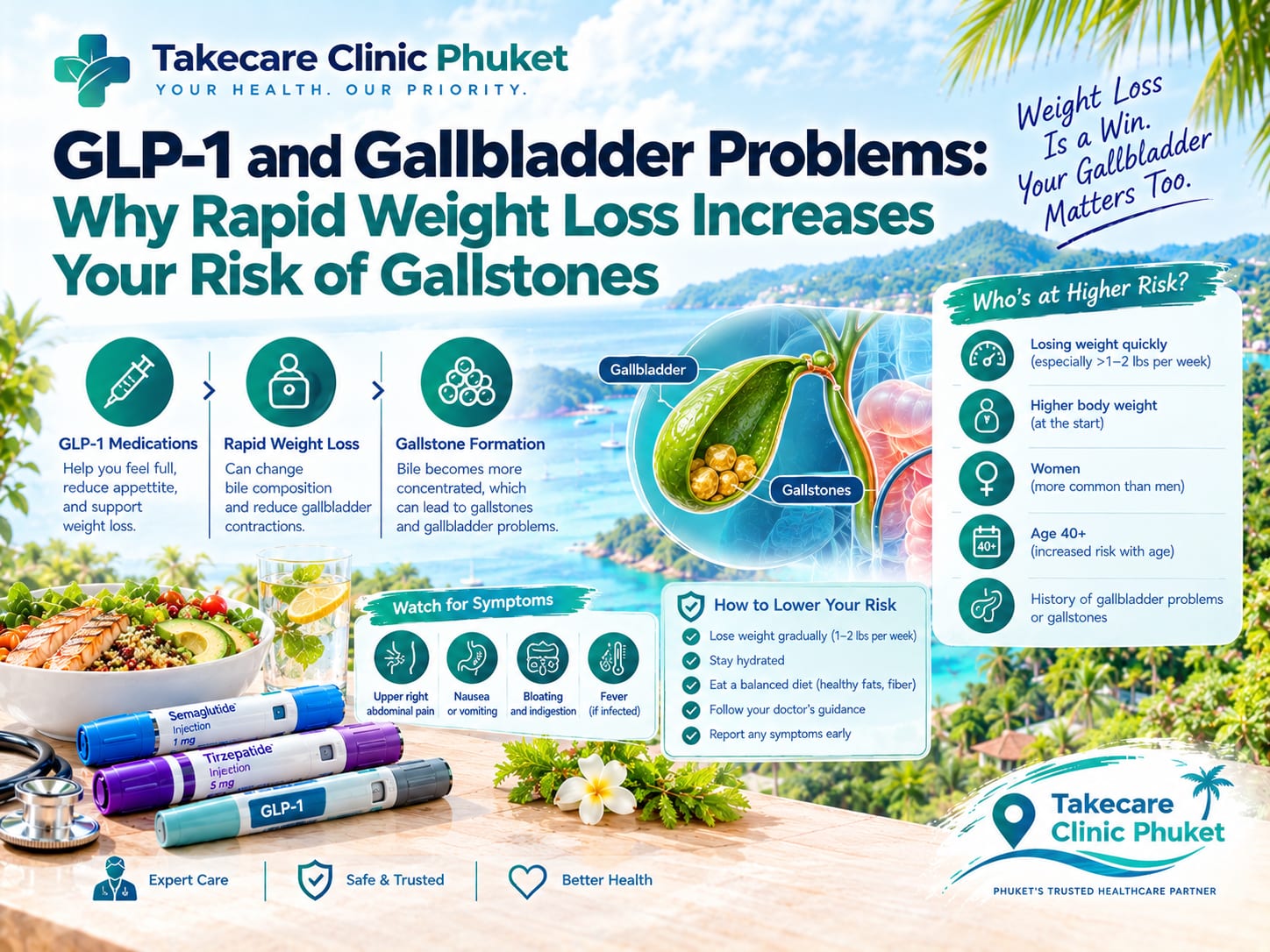
GLP-1 medications like semaglutide and liraglutide raise the risk of gallstones and gallbladder inflammation through two separate mechanisms: rapid weight loss changes the chemical balance of bile, and the drugs directly reduce how well the gallbladder contracts. A meta-analysis published in JAMA Internal Medicine found a statistically significant increase in biliary tract disease among GLP-1 users, with the signal stronger in trials where the drugs were used for weight loss than in trials for type 2 diabetes. Right upper quadrant pain after a fatty meal is the most common early sign. If that pain comes with fever, chills, or yellowing of the skin, seek same-day care.
You have been in Phuket two months into your Wegovy prescription, down several kilos and feeling good. Then, after a seafood dinner in Rawai, a sharp ache develops under your right ribs. You write it off as the rich food, or the GLP-1 nausea you have been managing since you started. Three hours later it is still there.
That decision, wait or go, matters more than most people realise at 10pm in a villa on the south end of the island. The nausea and upper abdominal discomfort that come with GLP-1 medications are real and common. So is gallbladder disease in people using these drugs. The early symptoms overlap almost completely, which means patients often dismiss a warning sign as a side effect and wait far longer than they should. This article explains why the risk exists, what the difference looks like in practice, and what to do if symptoms arrive while you are on the island.

What Actually Happens to Your Gallbladder on a GLP-1
There are two separate mechanisms at work, and both matter.
The first is bile becoming chemically unstable. When you eat much less, your liver keeps producing cholesterol but the compounds that keep it dissolved in bile decrease. Cholesterol crystallises, and those crystals are the starting point for gallstones. This is the same process that causes gallstones in patients who lose weight rapidly after bariatric surgery.
The second mechanism is more direct. GLP-1 receptors sit in the gallbladder wall itself. When the drug activates these receptors, the gallbladder contracts less often and less forcefully. Bile pools inside it. Sludge forms first, then stones. This happens independently of how much weight you are losing, which is why the risk is not simply about eating less.
Rapid weight loss creates unstable bile. The drug reduces the gallbladder emptying that would normally flush it. Both happening at the same time is what makes GLP-1 gallbladder problems a clinically real concern, not just a theoretical one.
What the Research Actually Shows on GLP-1 Gallbladder Problems
A 2022 meta-analysis in JAMA Internal Medicine found a statistically significant increase in biliary tract disease, including gallstones and gallbladder inflammation, among GLP-1 receptor agonist users compared to controls. The excess risk was higher in patients using these drugs for weight loss than in those using them for type 2 diabetes, which fits the mechanism: the faster the weight loss, the greater the bile instability.
FDA adverse event data show semaglutide (Ozempic, Wegovy) consistently appearing in reports linked to gallstones and gallbladder inflammation. Liraglutide (Saxenda, Victoza) has shown the same signal in trial data. A 2025 meta-analysis of obesity trials found a significant gallbladder signal for semaglutide but did not find a statistically significant biliary risk for tirzepatide, though tirzepatide data continue to accumulate and a direct head-to-head comparison cannot yet be drawn. What the available evidence supports is that higher doses and longer treatment duration appear to increase risk across the class.
The absolute risk for any individual remains relatively low. But relatively low is not zero, and the clinical picture changes fast when a stone obstructs the bile duct.

Recognising Gallbladder Pain While on a GLP-1
This is the part that matters when you are deciding whether to go to a clinic.
Standard GLP-1 side effects are generalised nausea, a feeling of fullness, and mild upper abdominal discomfort. These tend to peak in the first few weeks after a dose increase and gradually improve. They are not sharp, and they are not triggered by a particular type of food.
Gallbladder pain is different. It sits in the right upper quadrant, just below your right ribs, and can radiate to the right shoulder tip. It is specifically triggered by fatty meals, because fat signals the gallbladder to contract, and if there is a stone or sludge in the way, that contraction causes pain. A fatty meal trigger is not a feature of ordinary GLP-1 nausea.
If you are unsure which one you are dealing with, the safe default is to get assessed. A clinical examination can usually distinguish between the two. If there is doubt, an ultrasound referral can be arranged. In Phuket, that referral is straightforward through a walk-in clinic.
Warning Signs: When GLP-1 Gallbladder Pain Becomes an Emergency
Some symptoms need a doctor the same day. Some need one right now.
A dull right-sided ache after a rich meal that resolves within an hour or two: see a doctor that day. It is not an emergency, but it should not be dismissed. Pain that lasts more than a few hours, is severe enough to stop you doing anything, or wakes you from sleep: do not wait until morning. That pattern is more consistent with acute cholecystitis, which is gallbladder inflammation requiring prompt assessment.
The red flags that require immediate care are: fever above 38 degrees Celsius with right upper abdominal pain, rigors (shaking chills), vomiting you cannot control, or any yellowing of your skin or the whites of your eyes. Yellowing with pain suggests possible bile duct obstruction, which is a surgical emergency.
If those red flag symptoms arrive while you are on the island, the emergency doctor in Phuket service at Takecare Clinic provides same-day assessment. For patients in Kata, Rawai, or Bang Tao who have fever and severe pain and cannot travel, a doctor hotel visit can reach you directly.
Can You Reduce Gallstone Risk Without Stopping Your GLP-1?
Sometimes, and it requires a conversation with a doctor rather than a self-managed plan.
Dose escalation pace matters. Evidence from bariatric surgery patients shows that very fast weight loss carries more gallbladder risk than a steady, gradual loss. Staying at a lower dose longer before escalating may reduce risk, but this is a decision for your prescribing physician based on your full picture.
Ursodeoxycholic acid (UDCA, also called ursodiol) is a bile acid medication used preventively in bariatric surgery patients at high risk of gallstones during rapid weight loss. There is a reasonable clinical rationale for considering it in GLP-1 patients with the same risk profile, but it is not yet a standard guideline recommendation for all GLP-1 users. If you have a prior gallstone history, multiple risk factors, or are planning high-dose long-term treatment, ask your doctor whether UDCA is appropriate.
Diet also plays a role. The gallbladder needs to empty regularly to clear sludge. Regular meals with moderate fat content help maintain gallbladder movement. A completely fat-free diet can actually worsen stasis, because fat is what signals the gallbladder to contract in the first place.
Getting Assessed for GLP-1 Gallbladder Problems in Phuket
Being on the island when symptoms start creates a specific practical problem. You likely do not have your scan history with you, you may not have a GP here, and if you have travel insurance, you may not know what is covered before you need it.
At Takecare Clinic Phuket, a walk-in assessment for right upper quadrant pain includes a full history, abdominal examination, and clinical triage. We can determine whether same-day imaging referral is needed, provide IV hydration if you are vomiting, and give you written documentation of the assessment and any treatment, which matters for insurance claims and follow-up at home.
No appointment is needed. If you want a baseline blood test in Phuket or a broader health review before starting or escalating your GLP-1 dose, that can also be arranged quickly. For patients managing ongoing medication while living or staying long-term on the island, a prescription refill in Phuket for GLP-1 therapy and related monitoring can be handled through a straightforward walk-in consultation.
GLP-1 medications are genuinely effective and the benefits are well-established for most patients. The gallbladder risk is real but manageable when it is monitored. The mistake is assuming that abdominal symptoms on a GLP-1 are automatically the drug’s normal side effects. Some of them are. Some of them are not.
If you are on a GLP-1 medication and have developed right-sided abdominal pain, pain after fatty meals, fever, or symptoms you cannot clearly explain as a known drug side effect, Takecare Clinic Phuket offers walk-in assessment with no appointment needed. We see patients from across the island, including Kata, Rawai, Bang Tao, and Phuket Town. Our English-speaking physician can examine you, triage your symptoms, arrange imaging referral if needed, and provide documentation for insurance or follow-up with your prescriber at home. Walk in or contact us to arrange a hotel visit if symptoms are severe.
FAQ
Dr. Ponlawat Pitsuwan
Physician, Takecare Medical Clinic Phuket
a walk-in medical clinic based in Patong with English-speaking physician care and no appointment needed. He sees tourists, expats, and residents across the island for assessment and management of GLP-1 medication side effects, abdominal symptoms, and ongoing chronic disease care. His focus is straightforward, evidence-based care delivered in plain language.
References
- He L, Wang J, Ping F, et al. Association of Glucagon-Like Peptide-1 Receptor Agonist Use With Risk of Gallbladder and Biliary Diseases: A Systematic Review and Meta-analysis of Randomized Clinical Trials. JAMA Intern Med. 2022;182(5):513-519.
- Wilding JPH, Batterham RL, Calanna S, et al. Once-Weekly Semaglutide in Adults with Overweight or Obesity. N Engl J Med. 2021;384(11):989-1002.
- U.S. Food and Drug Administration. Wegovy (semaglutide) prescribing information. 2024.
- GLP-1 receptor agonists and gallbladder disease risk: insights into molecular mechanisms and clinical implications. PubMed 2025.
- World Health Organization. Obesity and overweight: key facts.
The information in this article is for educational purposes only and does not constitute medical advice. It should not be used to self-diagnose or replace a consultation with a qualified physician. If you have concerns about your health, contact a licensed medical professional. For appointments at Takecare Clinic Phuket, visit takecareclinicphuket.com.
