
Clinically reviewed by Dr. Ponlawat Pitsuwan, Physician, Takecare Clinic Phuket.
Last reviewed: October 2026
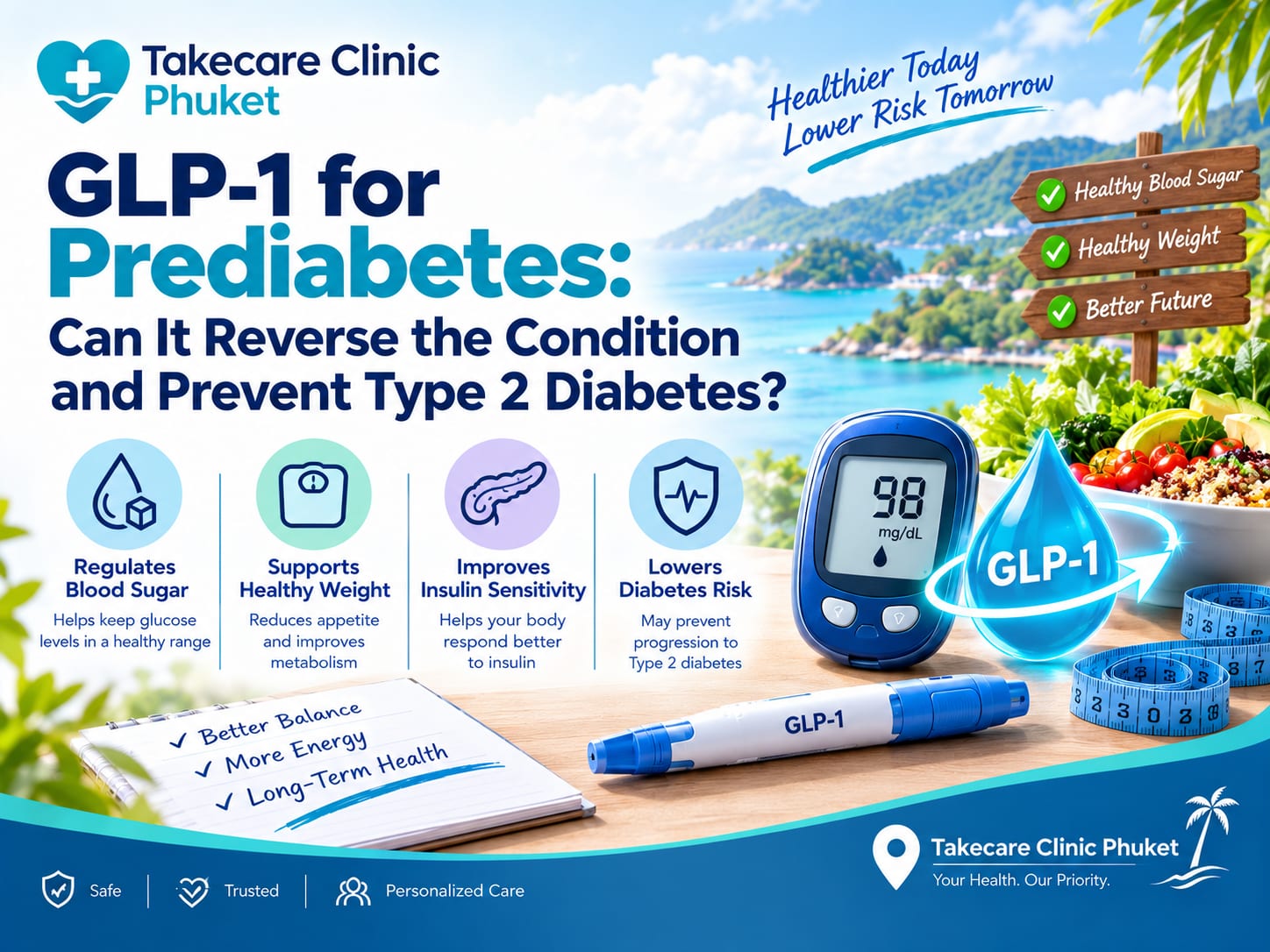
GLP-1 receptor agonists can return blood sugar to normal in some people with prediabetes, and trials show they significantly reduce the risk of progressing to type 2 diabetes. No GLP-1 medication is currently approved specifically for prediabetes, so prescribing in this context is off-label. Whether it is the right choice depends on your weight, cardiovascular risk, and how far your numbers have moved from normal, all of which can be assessed in a single walk-in visit.
You are a long-stay expat in Chalong, three months into what was supposed to be a working retirement. A health check at a Phuket clinic flags a fasting glucose result that sits higher than it should. The doctor says "prediabetes" and recommends follow-up. You go home, open your laptop, and start reading about GLP-1 medications. That is a reasonable place to start, and this is what the evidence actually shows.
Prediabetes is not diabetes, but it is not nothing either. Your blood sugar is higher than normal, typically an HbA1c between 5.7 and 6.4 percent or a fasting plasma glucose between 5.6 and 6.9 mmol/L, but not yet at the threshold for a type 2 diagnosis. Left unmanaged, a meaningful proportion of people with prediabetes will progress. GLP-1 receptor agonists are one of the tools that can change that trajectory. Here is what the evidence shows, and what your options look like in Phuket.

What Prediabetes Actually Means on a Lab Report
Two patterns come up under the prediabetes umbrella. Impaired fasting glucose means your blood sugar is elevated after an overnight fast. Impaired glucose tolerance means it rises too high and stays elevated after eating. Some people have both. Either way, your pancreas is still producing insulin, but your body is not responding to it as efficiently as it should.
An HbA1c between 5.7 and 6.4 percent reflects your average blood sugar over roughly three months. At 6.4 percent, you are close to the type 2 threshold. At 5.7 percent, you have more room, but that room narrows faster than most people expect without a clear plan.
How GLP-1 Medications Work on Blood Sugar
GLP-1, short for glucagon-like peptide-1, is a hormone your gut releases after eating. It signals the pancreas to release insulin and tells the liver to stop releasing glucose at the same time. GLP-1 receptor agonists mimic this effect more strongly and for longer than your body does naturally.
The practical result in prediabetes is lower fasting glucose and reduced post-meal spikes. Because GLP-1 also slows stomach emptying and reduces appetite, meaningful weight loss follows. That matters because excess body fat, particularly around the abdomen, drives insulin resistance directly. Reducing it improves blood sugar beyond the medication’s direct glucose effect.
What the Clinical Evidence Shows for GLP-1 Prediabetes Treatment
The strongest trial data comes from tirzepatide. In the SURMOUNT-1 trial, participants with prediabetes at baseline showed high rates of reversion to normal blood sugar over three years. A post hoc analysis from SURMOUNT-5, which compared tirzepatide directly against semaglutide, found reversion to normoglycemia in roughly 90 percent of tirzepatide participants versus roughly 76 percent of semaglutide participants. These are post hoc figures from a trial not designed primarily to measure prediabetes reversion. Read them as directional, not definitive.
Semaglutide has its own supporting data. Liraglutide, an older GLP-1 agent, showed a statistically significant reduction in progression to type 2 diabetes in the SCALE Obesity and Prediabetes trial. The direction of the evidence across agents is consistent. The magnitude varies by agent and dose.
Tirzepatide vs Semaglutide for Prediabetes
Tirzepatide works on two receptors, GLP-1 and GIP, where semaglutide works on GLP-1 alone. That dual action appears to produce greater weight loss and, based on available post hoc data, higher rates of blood sugar normalisation.
Semaglutide is better studied across a wider range of populations and has a longer safety record. For patients who tolerate it well and for whom cost is a factor, it remains a reasonable choice. Neither drug is approved specifically for prediabetes. Both are available in Thailand and both require a prescription.
Off-Label Prescribing: What It Means for You
No GLP-1 medication currently holds approval for prediabetes as a standalone indication, including from the US FDA, the European Medicines Agency, or the Thai FDA. Prescribing one for prediabetes is off-label, meaning the physician is using a licensed medication for a purpose supported by evidence but not yet by a formal approval label.
Off-label prescribing is legal and common. It requires informed consent, a clear clinical rationale, and a prescriber who knows the contraindications. In Thailand, semaglutide and tirzepatide are classified as prescription-only medications. You cannot buy them over the counter or online without a valid prescription from a licensed physician. A consultation is not optional.
GLP-1 vs Lifestyle Change vs Metformin
For most patients with early prediabetes and modest weight gain, structured lifestyle change remains first-line. Significant weight loss through diet and physical activity consistently reduces progression to type 2 diabetes in trials. That is not a soft recommendation. It is strong evidence.
Metformin is sometimes used off-label for prediabetes. It is inexpensive, has decades of safety data, and is taken as a daily tablet. It does not produce the weight loss that GLP-1 agents do. GLP-1 therapy makes most sense when BMI is elevated, lifestyle change alone has not moved the numbers, or cardiovascular risk tips the benefit-risk balance.
A long-stay Chalong resident with a stable routine and an existing primary care relationship faces different choices than someone mid-holiday in Patong with two days left before flying home. The right answer is not the same for everyone.
Who Should Consider GLP-1 for Prediabetes, and Who Should Not
GLP-1 therapy is worth a serious conversation if your HbA1c sits in the upper part of the prediabetes range, your BMI is elevated, and lifestyle change alone has not moved your numbers after a genuine effort. Other metabolic risk factors, high blood pressure, a strong family history of type 2 diabetes, also shift the calculation.
There are people for whom GLP-1 medications are not appropriate. A personal or family history of medullary thyroid carcinoma or multiple endocrine neoplasia type 2 is a contraindication. Active pancreatitis, or a history of recurrent pancreatitis, is a contraindication. Pregnancy and breastfeeding are contraindications. Severe kidney impairment requires specialist input before starting. These are the reason a proper clinical assessment matters before any prescription is written.
Getting GLP-1 Treatment for Prediabetes in Phuket
At Takecare Clinic Phuket, you can walk in without an appointment and have baseline blood work done the same day. The minimum workup before starting a GLP-1 for prediabetes includes HbA1c, fasting plasma glucose, renal function, and a lipid profile. A thyroid function test is also advisable given the theoretical thyroid risk associated with this drug class. You can review the full blood test menu in Phuket to see what same-day screening covers.
If a prescription is appropriate, the consultation also covers dose titration, what to expect in the first few weeks, and how to track your response. For visitors starting treatment here and continuing at home, the clinic can provide documentation of your diagnosis, the agent and dose, and your baseline labs so your home GP can continue the prescription without starting over. Raise this during the consultation, not at the end.
For longer-stay patients or expats managing ongoing metabolic concerns, a prescription refill in Phuket is also available, and the clinic provides English-speaking doctor care for residents and visitors across the whole island.
If your blood sugar is in the prediabetes range, or if you have not checked in a while and have risk factors, a same-day assessment at Takecare Clinic Phuket tells you exactly where you stand. We run HbA1c, fasting glucose, lipid profile, and renal function testing on-site. Our walk-in doctor consultation covers whether GLP-1 treatment is appropriate for you, what the alternatives are, and how to get a plan in place before you leave Phuket. No appointment needed. Open to tourists, expats, and residents across the island.
Frequently Asked Questions
Dr. Ponlawat Pitsuwan
Physician, Takecare Medical Clinic Phuket
a walk-in medical clinic based in Patong with no appointment needed and English-speaking physician care for the whole island. He sees tourists, expats, and residents across Phuket for metabolic health assessments, prediabetes evaluation, GLP-1 candidacy consultations, and chronic disease management. His focus is straightforward, evidence-based care delivered in plain language.
References
- Jastreboff AM, et al. Tirzepatide Once Weekly for the Treatment of Obesity. New England Journal of Medicine, 2022.
- le Roux CW, et al. 3 years of liraglutide versus placebo for type 2 diabetes risk reduction and weight management in individuals with prediabetes. The Lancet, 2017.30069-7/fulltext)
- American Diabetes Association. Standards of Care in Diabetes 2024. Diabetes Care, 2024.
- World Health Organization. Classification of Diabetes Mellitus. WHO, 2019.
- Nauck MA, Quast DR, Wefers J, Meier JJ. GLP-1 receptor agonists in the treatment of type 2 diabetes — state-of-the-art. Molecular Metabolism, 2021.
- Asian News Network. Thai FDA seeks to tighten controls on GLP-1 slimming pens, proposing special controlled-drug status. 2025.
The information in this article is for educational purposes only and does not constitute medical advice. It should not be used to self-diagnose or replace a consultation with a qualified physician. If you have concerns about your health, contact a licensed medical professional. For appointments at Takecare Clinic Phuket, visit takecareclinicphuket.com.
