
Clinically reviewed by Dr. Ponlawat Pitsuwan, Physician, Takecare Clinic Phuket.
Last reviewed: November 2026
Mpox spreads through direct skin-to-skin contact, including sexual contact, and through contact with contaminated bedding or clothing. The rash appears as raised, fluid-filled blisters that crust over before healing. Thailand’s Department of Disease Control has confirmed mpox cases including clade 1b in 2026. If you have an unusual rash, swollen glands, or fever after close contact in Phuket, get a PCR swab test rather than waiting to see if it clears on its own.
You’re a few days back from a night out in Patong, and something on your skin is not right. A blister, maybe two. Some swollen glands. A fever you put down to too much sun and not enough sleep. You’ve looked it up and you’re not reassured. If that is where you are, keep reading.
Mpox is active in Thailand in 2026. The Department of Disease Control has confirmed cases across the country, including clade 1b, the strain associated with more severe disease that has been spreading internationally since 2024. Thailand reported 470 mpox cases and three deaths in the first ten months of 2026. An unusual rash after close contact here warrants testing that day, not in three days when it might look worse or better. Waiting is the part that tends to go wrong.
How Mpox Spreads in Thailand
The main route is direct, prolonged skin-to-skin contact. That includes sexual contact, but it is not limited to it. Sharing a bed, sharing towels, or close physical contact during care of someone who is unwell can all transmit mpox.
Objects contaminated with lesion fluid, such as bedding or towels, can also carry the virus. This is a less common route than direct contact, but it is real. Brief, casual contact carries much lower risk than the sustained close contact typical of a sexual encounter or household exposure.
Respiratory transmission over short distances during prolonged face-to-face contact is also possible, though this is not the dominant route.
Mpox Symptoms: What the Rash Actually Looks Like
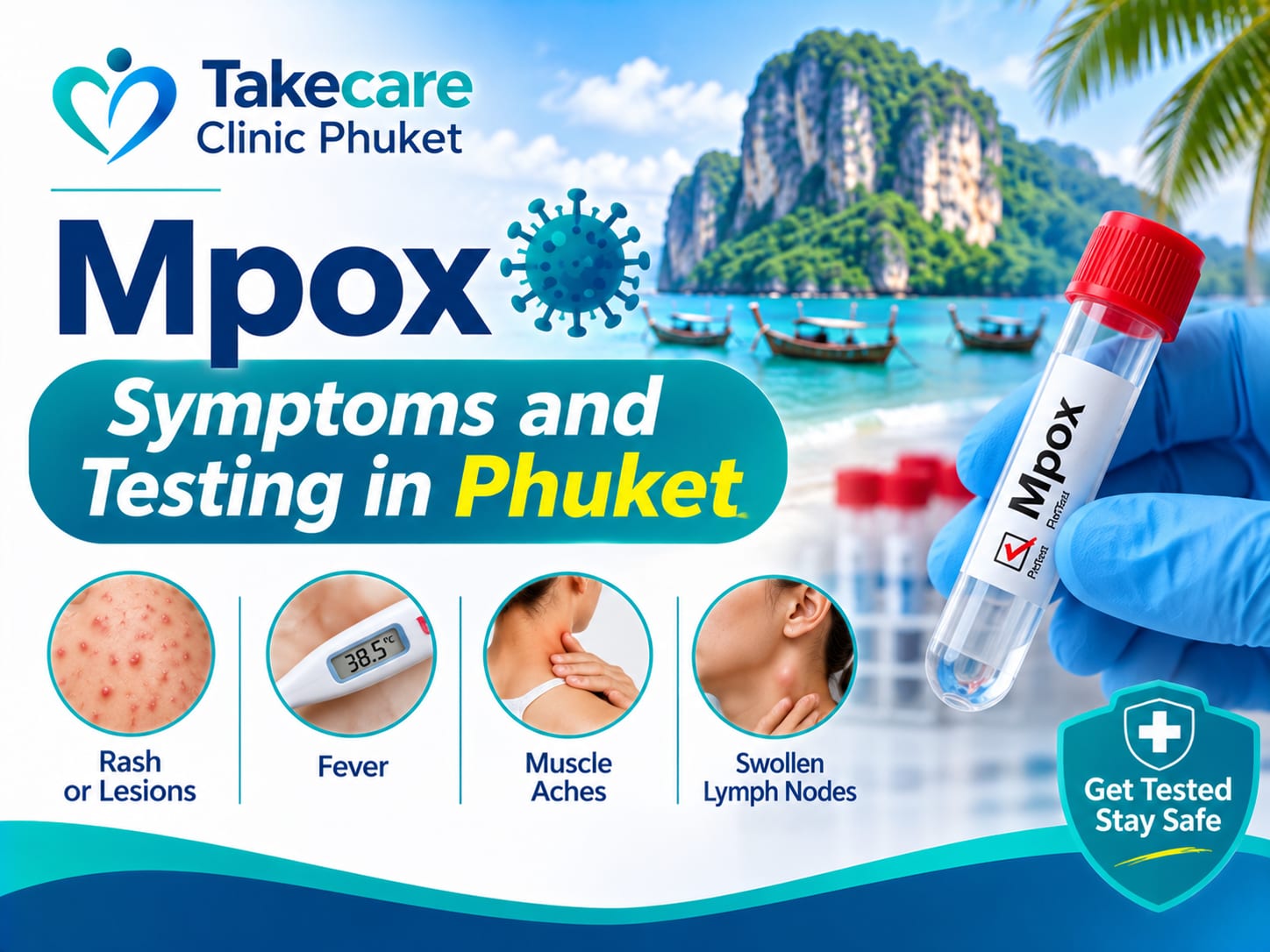
Before the rash appears, most people get fever, headache, muscle aches, and notably, swollen lymph nodes. Swollen glands are one of the features that help separate mpox from other rash conditions.
The rash follows a pattern. It starts as flat red spots, raises into bumps, fills with clear fluid, then becomes pustular blisters, and finally crusts over and scabs. All lesions tend to progress at the same rate. That is different from chickenpox, where lesions appear in waves at different stages.
Lesions can appear anywhere on the body. In sexually transmitted cases they often start on the genitals, thighs, or around the mouth. The rash may be limited to just a few lesions, which makes it easy to miss or mistake for something else entirely.

Mpox vs Herpes, Syphilis, and Other Rashes
This is the question most people have already half-answered on their phone before they come in. The honest answer is that you cannot tell these apart by looking at a photo.
Herpes typically causes clusters of small blisters in one location, often painful, and tends to recur. Syphilis can cause a painless ulcer in the primary stage and a widespread rash in the secondary stage. Mpox lesions tend to be deeper and more uniform in their progression. But none of these differences are reliable enough to skip testing.
There is another reason to test for all of them at once. Coinfection with syphilis or gonorrhoea occurs in a substantial proportion of mpox-confirmed patients, according to published case series. If the exposure was sexual, STD testing in Phuket that covers syphilis, gonorrhoea, and chlamydia alongside an mpox PCR is not overcautious. It is the right clinical approach.
For anything rash-related that is harder to categorise, our skin rash treatment service runs alongside infectious disease testing at the same visit. Early pustular lesions can also look similar to infected reef cuts from Kata or Karon, or insect bites. The key difference is systemic symptoms. Fever and swollen lymph nodes alongside a rash point toward mpox rather than a localised wound infection.
PCR Testing for Mpox in Phuket
The correct test for mpox is a PCR swab taken directly from an active lesion. This is the standard recommended by both the WHO and Thailand’s Department of Disease Control. Blood PCR has limited reliability early in infection before the virus is detectable in the bloodstream, so a lesion swab is what you want.
If you have active blisters or pustules right now, that is the right time to test. Testing before lesions appear reduces the reliability of the result. If you have a rash now, do not wait.
A negative result does not fully exclude mpox if the sample was taken too early or from a lesion already healing. Herpes, syphilis, chickenpox, and bacterial skin infection all remain possibilities. Return for follow-up if symptoms persist or worsen rather than assuming you are in the clear.
At Takecare Clinic Phuket, our English-speaking doctor will examine the lesions directly, take a swab, and send it to the lab. We explain what the result means, what to do while you wait, and whether a broader STI panel fits your situation.
Isolation, Vaccination, and What Comes Next
If your test comes back positive, mpox is a notifiable condition under Thailand’s Communicable Diseases Act. For mild cases, isolation in your accommodation is typically appropriate. A hotel room has different logistics from a rented apartment in Chalong or Rawai, so tell your doctor your situation and we can advise on the practicalities and communicate with Thai health authorities where needed.
The JYNNEOS vaccine provides protection against mpox and is available in Thailand. If you have had a confirmed exposure within the last 14 days but no symptoms yet, post-exposure vaccination may still be an option, and it works best when given within 4 days of exposure. The window is time-limited, so speak to a doctor promptly.
Management for mild mpox focuses on symptom relief, preventing secondary infection, and isolation. Most people with mild cases recover without specific antiviral treatment. If you are immunocompromised or develop severe symptoms, hospital-level care is appropriate.
For anyone concerned about broader sexual health exposure after a night out in Patong, an HIV test in Phuket, PrEP, and PEP treatment are all available as walk-in services. PEP must start within 72 hours of HIV exposure, so same-day access is what matters here.
If you have an unusual rash, blisters, swollen glands, or fever after close contact in Phuket, do not wait for it to resolve on its own. Takecare Clinic Phuket is a walk-in medical clinic in Patong with no appointment needed and English-speaking physician care. We offer mpox PCR testing alongside full STI screening, HIV testing, PrEP, and PEP, all in one visit. Walk in to 34/14 Prachanukhro Road, Patong, or visit takecareclinicphuket.com to find out more.
Frequently Asked Questions
Dr. Ponlawat Pitsuwan
Physician, Takecare Medical Clinic Phuket
a walk-in medical clinic based in Patong, Phuket, with no appointment needed and English-speaking physician care for the whole island. He sees tourists, expats, and residents across Phuket for infectious disease concerns including mpox, STI screening, HIV testing, and rash assessment. His focus is straightforward, evidence-based care delivered in plain language.
References
- World Health Organization. Mpox: Key Facts. WHO, 2024.
- Centers for Disease Control and Prevention. Vaccine Considerations for Mpox (JYNNEOS). CDC, 2024.
- Centers for Disease Control and Prevention. Lab Advisory: For Mpox Testing, Use Lesion Swab Specimens to Avoid False Results. CDC, 2022.
- The Nation Thailand. Thailand reports 470 mpox cases and three deaths as health officials urge early testing. Nation Thailand, November 4, 2026.
- Thornhill JP, et al. Monkeypox Virus Infection in Humans across 16 Countries — April–June 2022. New England Journal of Medicine. 2022;387(8):679–691.
- Patel A, et al. Clinical features and novel presentations of human monkeypox in a central London centre during the 2022 outbreak. BMJ. 2022;378:e072410.
The information in this article is for educational purposes only and does not constitute medical advice. It should not be used to self-diagnose or replace a consultation with a qualified physician. If you have concerns about your health, contact a licensed medical professional. For appointments at Takecare Clinic Phuket, visit takecareclinicphuket.com.
