
Clinically reviewed by Dr. Ponlawat Pitsuwan, Physician, Takecare Clinic Phuket.
Last reviewed: November 2026
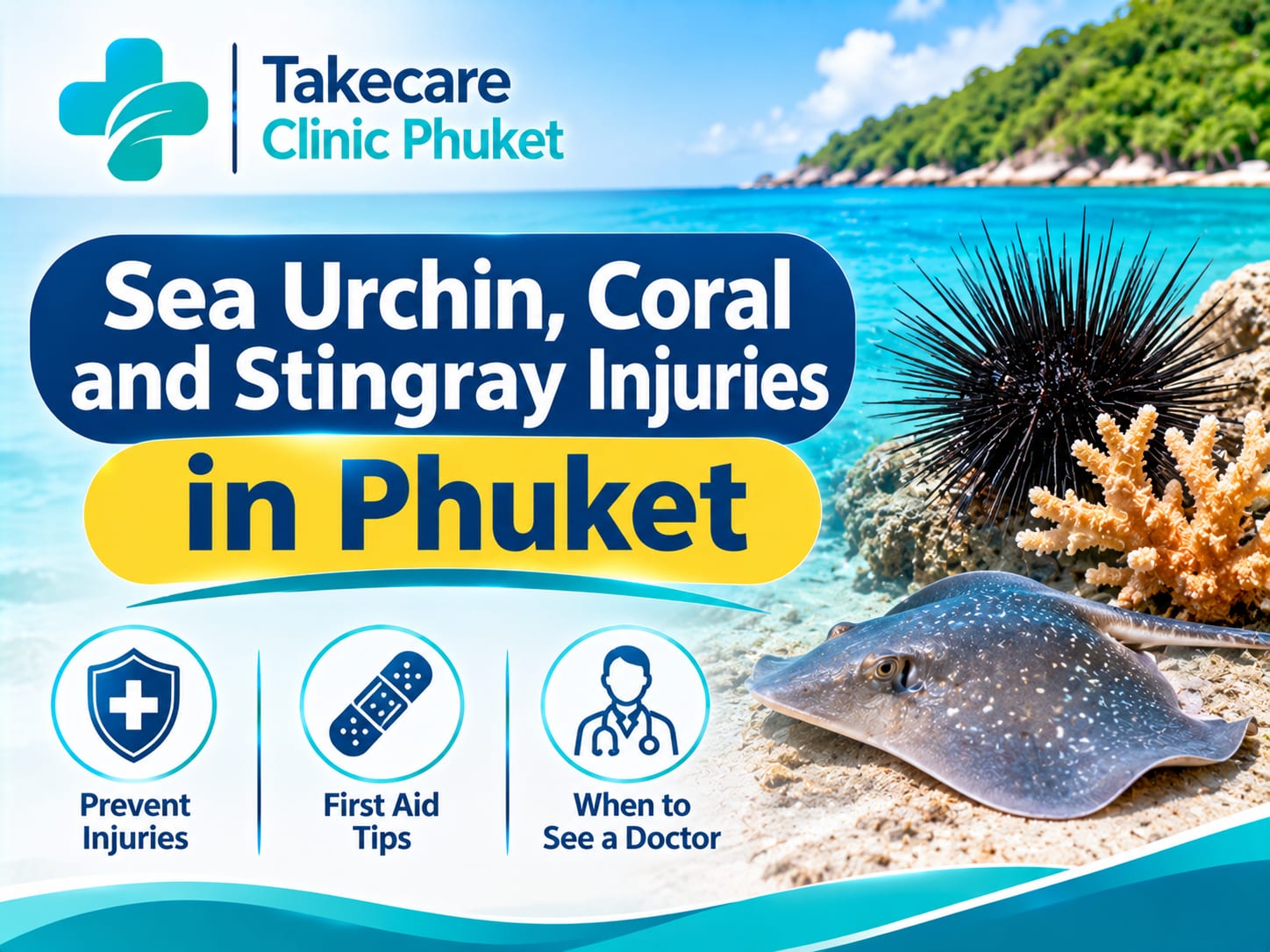
Sea urchin spines, coral cuts, and stingray stings are among the most common marine injuries on Phuket’s reefs. Most can be managed with correct first aid, but deep puncture wounds, spines near a joint, and any wound not improving after 48 hours need a clinical assessment. Tetanus status matters for all three, and in Phuket’s warm water, infection can set in faster than you would expect.
You are wading out from the shallows at Kata Noi, the sand drops away, and you put your foot down on something that feels like broken glass. That sharp, burning pressure through the sole is almost always a sea urchin. The spines snap off inside the skin, the foot swells, and the first question most people ask is whether they can sort this out themselves or whether they need a doctor. The honest answer is: it depends on where the spines are and how deep they went.
Phuket’s reefs produce a specific set of injuries, from Kata and Karon to day trips out to Phi Phi. Sea urchin punctures, coral abrasions, and stingray wounds each need a different approach, and the mistakes people make in the first hour matter more than most visitors realise. Here is what to do, what not to do, and when to come in.
Sea Urchin Spines in Phuket
The urchins you are most likely to meet on Phuket reefs are the long black-spined species clustered on rocky ledges in shallow water. Their spines are brittle and break off easily. They also carry mild venom that causes immediate burning pain and localised swelling. A less common but more dangerous species, the flower urchin, looks almost decorative but can deliver a genuinely painful sting.
Do not try to pull the spines straight out. They fragment. Soaking the foot in warm vinegar for 15 to 30 minutes may help loosen superficial spines and ease the sting. Reef shoes are the simplest prevention, particularly at rocky entry points.
Superficial spines, those sitting just beneath the surface with no joint nearby, may partially dissolve over days to weeks. Deep spines will not dissolve reliably. A retained spine that the body walls off can cause a small firm lump under the skin that often needs minor surgical removal. If you can see a black dot and it is not near a joint or tendon, watch it for a few days. If it is near a joint, still there after two weeks, or the area is swelling, come in.
Coral Cuts and Why They Infect So Quickly
A coral abrasion looks minor. It is not. Coral leaves fragments of organic material inside the wound, and in Phuket’s warm seawater, those fragments carry bacteria that drive infection faster than a standard cut would at home.
The bacteria worth knowing about are Vibrio species, which live in warm tropical seawater and can cause a wound to escalate quickly, particularly in anyone with diabetes or a weakened immune system. A coral cut that is red, warm, and swelling two days after the injury in Phuket is more concerning than the same wound on a cool-water beach in Europe. Do not use a European timeline as your guide.
Clean the wound thoroughly as soon as possible with fresh water, soap, and gentle scrubbing. If you have dilute antiseptic, use it. Do not tape or seal a coral cut shut: these wounds need to drain. Watch for redness spreading beyond the wound edge, pus, increasing warmth, or fever. Any of those signs means you need antibiotics, not a pharmacy guess. For marine wound care in Phuket, Takecare Clinic Phuket handles walk-in reef injuries with no appointment needed.
Stingray Stings and Hot Water First Aid
Stingrays rest on the sandy bottom in shallow water. They are common at wading depth along gentler beaches near Rawai and the southern end of Karon. You step on one, the barbed tail whips up, and the result is a deep puncture wound with intense pain.
Immerse the wound in water as hot as you can tolerate without burning yourself, around 45°C, for 30 to 90 minutes. Heat breaks down the venom proteins and reduces pain. Use a bucket on the beach, or the hottest tap water available. This is genuine first aid, not folk remedy.
What hot water does not do is remove a stingray barb fragment. Barbs have backward-pointing serrations. If the barb broke off inside the wound, it cannot be pulled out safely without clinical help. A wound that is deeper than a surface scratch, still bleeding, or showing a visible entry point needs to be seen the same day. Dizziness, chest tightness, or difficulty breathing means an emergency department, not a walk-in clinic.
When Removal Needs a Doctor
Location determines this more than anything else. Spines near or over a joint are a different clinical situation from a superficial spine on the sole of the foot.
A retained spine close to a toe joint or the small joints of the foot can trigger inflammation inside the joint. If your foot is swollen around a joint, painful to flex, and you stepped on a sea urchin recently, that is the history to give a doctor.
For removal, we examine the wound, assess depth, and in most cases use a fine needle or small incision under local anaesthetic. It is a minor procedure and far more effective than self-removal attempts that push fragments deeper. Takecare Clinic Phuket handles walk-in marine injuries including spine and barb removal, wound irrigation, and skin infection treatment in Phuket, all on the same visit.
Tetanus and Reef Wounds
Sea urchin punctures, stingray wounds, and deep coral cuts are all classified as tetanus-prone wounds. The shape of the wound, narrow, deep, with organic material introduced, is exactly the type where tetanus bacteria can survive and produce toxin.
Tetanus protection for tetanus-prone wounds such as reef punctures requires a booster if your last dose was more than five years ago. For clean minor wounds the threshold is ten years, but deep puncture wounds with organic material change that calculation. Most travellers either do not know their last dose date or have not had a booster since childhood. If you are unsure, treat your status as unknown and get a booster on the same visit as your wound assessment. Guessing is not worth it.
At Takecare Clinic Phuket, you can have your wound cleaned, your tetanus status checked, and a booster given in a single walk-in visit. For anyone planning a liveaboard or a day trip to Phi Phi after a reef injury, checking your wound and your vaccination history at the same time makes sense. You can also review your full travel vaccination cover through our vaccination guide for visitors and expats in Phuket.
If you have had a more serious reef injury and want to understand your options for follow-up, our minor surgery page for Phuket covers what we can do in-clinic for retained foreign bodies and wound care.
Takecare Clinic Phuket is a walk-in clinic in Patong treating marine injuries in Phuket across the whole island, from sea urchin spine removal and coral cut assessment to stingray wound care and tetanus boosters. No appointment needed. English-speaking doctor available. If you stepped on something in the water and are not sure whether it needs attention, come in and we will check it properly.
Frequently Asked Questions
Dr. Ponlawat Pitsuwan
Physician, Takecare Medical Clinic Phuket
a walk-in medical clinic based in Patong with English-speaking physician care available across the island. He sees tourists, expats, and residents for marine injuries including sea urchin spine removal, coral wound care, stingray treatment, and tetanus assessment. His focus is straightforward, evidence-based care delivered in plain language.
References
- Auerbach PS. Marine envenomations. New England Journal of Medicine, 1991.
- MSD Manual Professional. Sea Urchin Stings. Merck & Co., 2024.
- Immunize.org / IAC. Ask the Experts: Tetanus Wound Management. Immunization Action Coalition, 2024.
- Minnesota Department of Health. Tetanus Wound Management Clinical Guidance. Minnesota Dept of Health, 2023.
- Purcell CR, et al. A Prospective Study of Stingray Injury and Envenomation Outcomes. Journal of Wilderness and Environmental Medicine, 2018.
- Moles AJ, et al. Sea Urchin Spine Embedded in the Sole of the Foot: Eight-Year Radiographic Follow-Up Without Removal. Cureus, 2024.
The information in this article is for educational purposes only and does not constitute medical advice. It should not be used to self-diagnose or replace a consultation with a qualified physician. If you have concerns about your health, contact a licensed medical professional. For appointments at Takecare Clinic Phuket, visit takecareclinicphuket.com.
