Clinically reviewed by Dr. Ponlawat Pitsuwan, Physician, Takecare Clinic Phuket. Last reviewed: September 2026
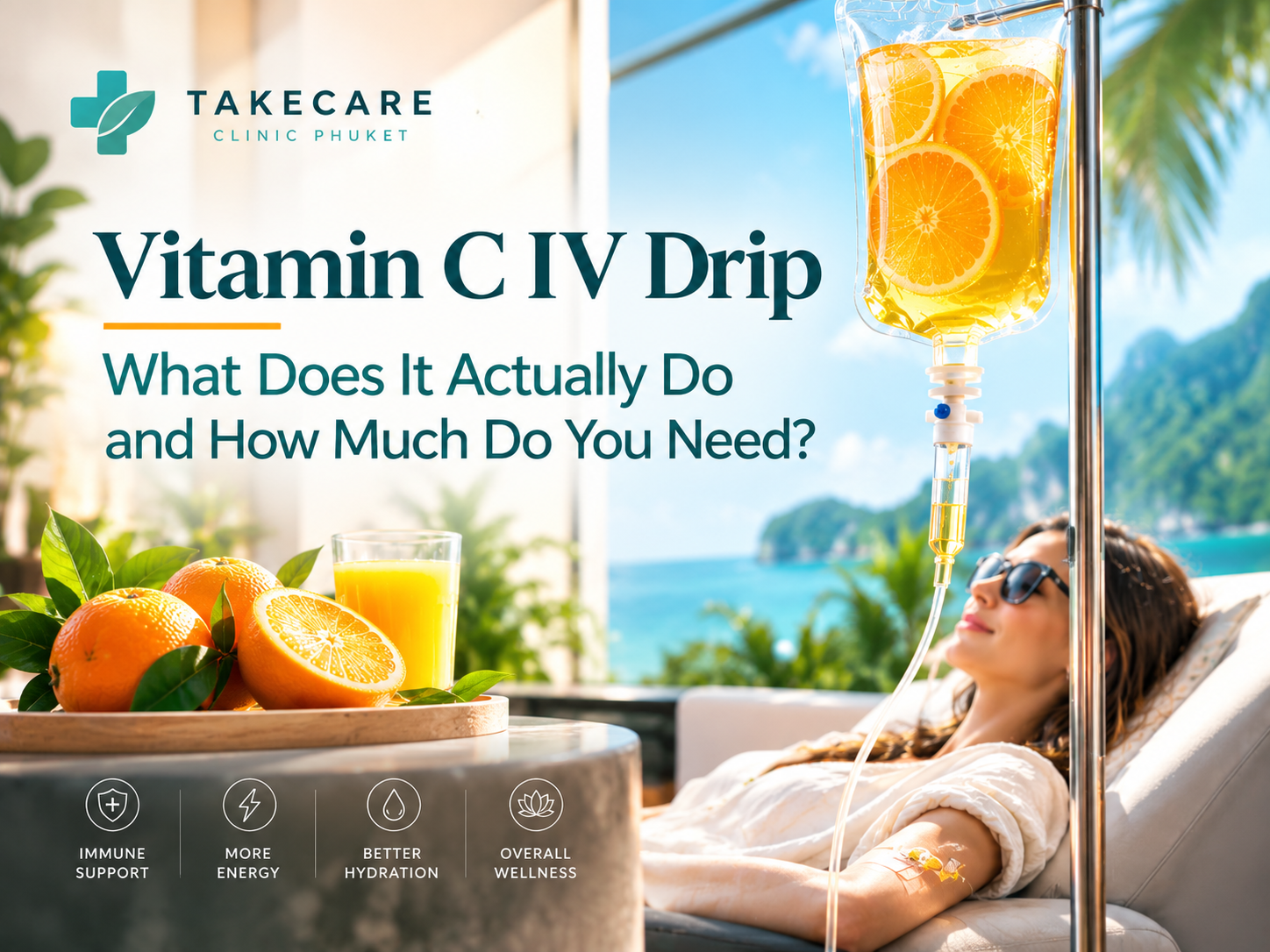
A vitamin C IV drip delivers ascorbic acid directly into your bloodstream, bypassing the gut’s absorption limit entirely. This allows plasma levels far higher than any oral supplement can reach. At wellness doses, the evidence for immune support and collagen production is solid. At higher doses, you need a doctor’s assessment first, including screening for certain conditions that make high-dose infusions risky.
You have just come in from a week of reef snorkeling off Kata, your skin feels like sandpaper, and someone at the hotel mentioned a vitamin C drip. I hear some version of this every week. The UV index in Phuket regularly hits 10 or above, and most visitors from cooler climates have no real frame of reference for what sustained exposure at that level does to skin, energy, and immune function. Layer on the heat, salt water, disrupted sleep, and travel fatigue, and the question of what a vitamin C infusion actually does becomes more than marketing.
I want to give you a straight answer: where the evidence is solid, where it is thinner, who should not have it, and how to pick the right dose for your actual situation. Most pages you find on this topic in Phuket are written by a drip menu. This one is not.

IV vs. Oral — Why the Delivery Method Changes Everything
Your gut controls how much vitamin C gets into your blood from a tablet or supplement. Once you take more than roughly 200 mg in a single dose, the intestinal wall limits absorption and your kidneys flush the excess out. Even a 2,000 mg oral dose raises plasma levels only modestly.
IV delivery bypasses that ceiling. The ascorbate goes directly into your circulation. A wellness-dose infusion of 5 to 15 grams reaches plasma concentrations that simply cannot be achieved by mouth. A high-dose infusion at 25 grams or more reaches concentrations 30 to 70 times higher than the oral maximum.
If you only want to maintain baseline vitamin C levels, a quality oral supplement is fine. If you want a genuinely therapeutic concentration, IV is the only way to get there.
What Do Vitamin C IV Drip Benefits Actually Include?
The immune support evidence is solid. Vitamin C concentrates inside white blood cells and supports their function during infection. It also helps your body produce the stress hormones it needs when you are fighting something off. That mechanism is well-documented, not speculative.
The antioxidant effect is equally well-supported. Your body produces free radicals constantly, and UV exposure, heat, and alcohol accelerate that process. Vitamin C neutralises free radicals before they damage cells. In Phuket’s climate, with high UV exposure day after day, this matters more than it would during a week in a temperate country.
Broad energy claims are where the evidence gets thinner. Some patients feel genuinely better after a session. Some of that may reflect real cellular benefit. Some of it is likely the hydrating effect of the saline carrier. I tell patients this distinction honestly, because they deserve to know.

Skin Benefits — What Vitamin C IV Actually Does Below the Surface
Collagen production requires vitamin C as a direct cofactor. Without it, your body cannot build collagen properly. At the concentrations an IV infusion delivers, this is clinically meaningful, not cosmetic guesswork.
UV-induced oxidative stress also degrades existing collagen and drives pigmentation changes. High-dose ascorbic acid can reduce that degradation by neutralising the free radicals that sun exposure generates. After days of beach and diving in Phuket’s UV environment, there is more clinical rationale for this than there would be after a weekend in London.
When vitamin C is combined with glutathione in the same infusion, there is an additional effect on melanin production that drives the skin brightening result many patients ask about. The mechanism is real. The visible result varies between individuals, and I say that upfront.
Who Should Not Get a Vitamin C IV Drip
For most healthy adults at wellness doses, the safety profile is good. Side effects are uncommon and usually mild: brief discomfort at the infusion site, or light nausea if the drip runs too fast.
A few conditions change the picture entirely. G6PD deficiency, a genetic condition affecting red blood cells, can cause a serious breakdown of those cells at high vitamin C doses. Screening before a first high-dose infusion is standard protocol at any properly run clinic. It matters especially for patients of Southeast Asian, Mediterranean, or African descent, where the condition is more common. If you have not been screened, a high-dose session should not go ahead.
Kidney disease or a history of kidney stones is a real contraindication, as high-dose vitamin C increases oxalate load and can worsen both. Hemochromatosis, a condition where the body accumulates too much iron, is another concern, since vitamin C promotes iron absorption. Pregnancy also requires a more conservative approach. Tell your doctor your full history before any infusion.
How Much Vitamin C Do You Need and How Often?
The dose depends on your goal. Vague "high dose" language on a drip menu is not clinically useful.
| Goal | Typical Dose Range | Frequency |
|---|---|---|
| General wellness and antioxidant support | 5 to 10 grams | Every 2 to 4 weeks |
| Immune support during illness or high stress | 15 to 25 grams | Weekly for a short period |
| Post-travel recovery, jet lag, dehydration | 7.5 to 15 grams | Single session or 2 to 3 sessions |
| Skin brightening with glutathione | 10 to 25 grams | Weekly for 4 to 6 weeks |
| High-dose clinical protocol | 25 grams or above | Physician-supervised, requires screening |
Frequency matters too. A single session has a measurable effect that lasts several days to a couple of weeks before plasma levels fall back. For short-stay visitors, one session after arrival works well for jet lag and travel recovery. For expats or long-stay visitors managing skin health or sustained immune support, a cadence of every two to four weeks makes more sense. You can read more about how much vitamin C IV you actually need depending on your goal before you come in.
Getting a Vitamin C IV Drip at Takecare Clinic Phuket
Every IV session at Takecare Clinic Phuket starts with a physician assessment. That means a doctor reviews your health history, checks for contraindications, and recommends the right dose for your actual goal. You are not handed a bag by a nurse and left to it.
G6PD screening is available on-site if you have not been tested before and are requesting a higher-dose infusion. Sessions run from 30 minutes to around an hour depending on dose. No appointment is needed. Walk in, tell us what you are looking for, and the doctor will take it from there.
The clinic is easy to reach from Patong directly, and patients come in regularly from Kata, Karon, Rawai, Chalong, and Bang Tao. If you want more detail on what IV therapy options are available at the clinic, that information is on our IV therapy page. For anyone who has already decided on a drip and wants to understand what dose is right for their situation, the doctor can walk you through that in the assessment.
Ready for a vitamin C IV drip in Phuket? Come into Takecare Clinic Phuket in Patong. No appointment needed. An English-speaking physician will assess your health history, recommend the right dose, and arrange G6PD screening on-site if required. Walk-in care for tourists, expats, and residents across Phuket, from Patong and Kata to Rawai, Chalong, and Bang Tao.
How much vitamin C is actually in an IV drip, and does the dose matter?
Yes, the dose matters considerably. Wellness sessions typically deliver 5 to 15 grams. Immune-support sessions during illness may use up to 25 grams. Some Phuket drip menus advertise "high dose" at 5 to 7 grams, which is not what clinicians classify as high dose. The right amount depends on your goal, your health history, and whether you have been screened for conditions like G6PD deficiency.
Why can I not just take high-dose vitamin C tablets instead?
The gut limits how much vitamin C can enter your bloodstream from an oral supplement. Anything above roughly 200 mg per dose is mostly excreted before it reaches therapeutic levels in your blood. IV delivery bypasses this entirely, which is why it is used when a genuine therapeutic concentration is the goal and not just maintenance.
Is a vitamin C IV drip safe? Who should avoid it?
For healthy adults at wellness doses, it is well-tolerated with mild, uncommon side effects. The conditions that require caution are G6PD deficiency, kidney disease, a history of kidney stones, hemochromatosis, and pregnancy. A doctor should review your history before any high-dose session, and G6PD screening should be completed before your first high-dose infusion.
Does a vitamin C IV drip actually help your skin, or is that marketing?
There is a real mechanism behind it. Vitamin C is required for collagen production, and at IV concentrations it also neutralises the free radicals that UV exposure generates in skin. In Phuket’s UV environment, that case is stronger than in a temperate setting. The skin brightening effect when combined with glutathione is also mechanistically sound, though the visible result varies between patients.
I have been diving off Kata for a week and my skin looks rough. Would a vitamin C IV drip help?
Probably yes. Days of high UV exposure, salt water, and sun fatigue generate real oxidative stress in skin. A vitamin C infusion at 10 to 15 grams supports antioxidant recovery and collagen repair through a mechanism that is well-grounded in the evidence. Come into Takecare Clinic Phuket and a doctor will assess what your body actually needs after a week like that.
How often should I get a vitamin C IV drip during a stay in Phuket?
For a short holiday, one session on arrival for recovery and one toward the end for immune and skin support is a practical approach. For expats or long-stay visitors working toward skin brightening or sustained immune support, every two to four weeks is a reasonable cadence. The doctor at Takecare Clinic can suggest a frequency based on how long you are here and what you are trying to achieve.
Dr. Ponlawat Pitsuwan
Physician, Takecare Medical Clinic Phuket
a walk-in medical clinic in Patong with English-speaking physician care and no appointment needed. He sees tourists, expats, and residents from across the island for IV therapy, vitamin C infusions, wellness drips, and the health concerns that come with living and traveling in a high-UV tropical environment. His approach is direct, evidence-based, and delivered in plain language.